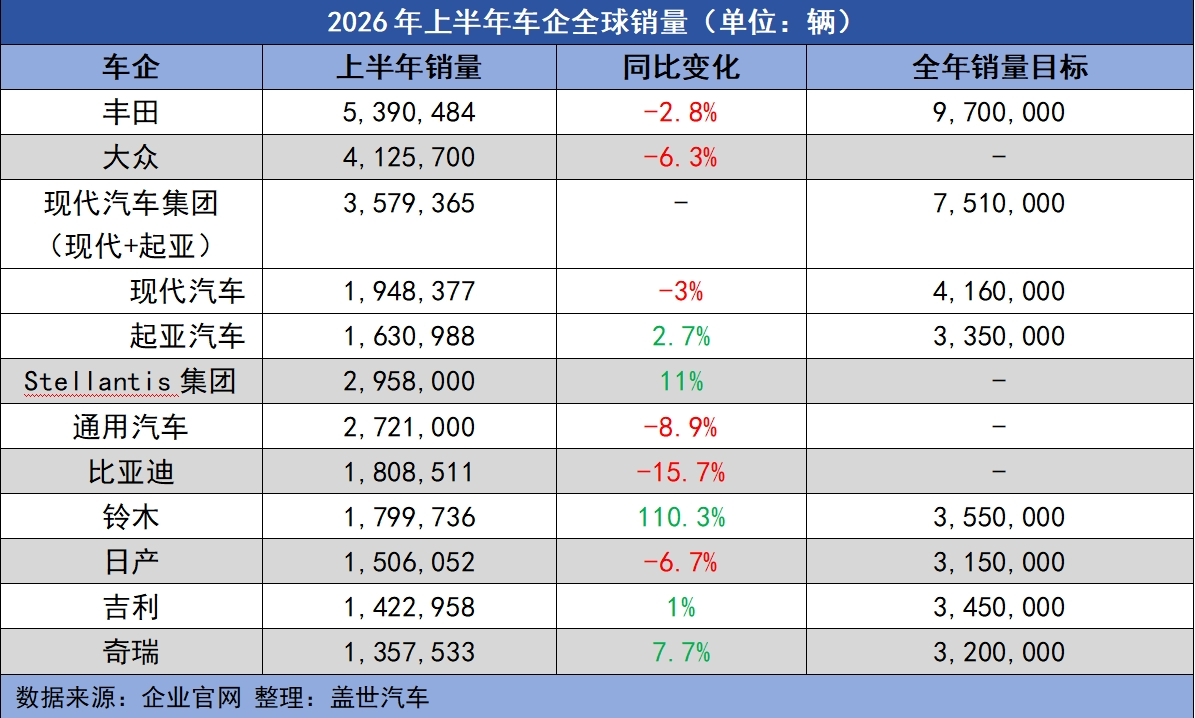
The global automotive landscape is experiencing a structural realignment. First-half (H1) global sales data indicates that while established conglomerates like Toyota continue to lead in volume, a profound shift is underway. Traditional Japanese, European, and American legacy brands are navigating transition-related headwinds, whereas the Chinese automaker global sales expansion has accelerated, driven by competitive pricing, technological agility, and rapid internationalization.
The Global Realignment: Legacy Pressure Meets NEV Momentum
Analysis of recent global sales data shows Toyota retaining its position as the world's top-selling automaker. However, underlying segment metrics suggest that traditional internal combustion engine (ICE) strongholds are experiencing localized volume contractions, particularly in the highly competitive Chinese domestic market. Meanwhile, global players like Volkswagen and General Motors are actively adjusting their product portfolios, emphasizing cross-border collaboration and strategic sourcing alliances to match the rapid pace of electrification.
This market adjustment has opened a window for Chinese OEMs. No longer confined to domestic market dynamics, brands like BYD, Geely, and Chery are securing significant market share in emerging regions, including ASEAN, Latin America, and the Middle East. This expansion highlights a systemic shift: Chinese automakers are converting domestic supply chain efficiencies into global export advantages.
By the Numbers: H1 Global Auto Sales Trends
The following table illustrates the comparative sales momentum between leading legacy auto groups and rising Chinese export leaders during the first half of the year:
| Automotive Group | H1 Global Performance Trend | Primary Growth Drivers |
|---|---|---|
| Toyota Group | Volume Leadership (Stable) | Strong hybrid vehicle demand in North America and Europe. |
| Volkswagen Group | Moderate Contraction in APAC | Acceleration of localized software integration and EV partnerships. |
| BYD Auto | Double-Digit Global Growth | Rapid adoption of PHEV technology and Latin American expansion. |
| Geely Holding | Sustained Growth | Multi-brand global strategy and European platform-sharing. |
Strategic Localization: Moving Beyond Direct Exporting
One of the most critical trends within the Chinese automaker global sales expansion is the transition from a pure export-led model to localized manufacturing. Rather than relying solely on shipments from mainland ports, leading Chinese groups are pursuing deep regional integration. Key strategic moves include:
- Localized Regional Footprints: Setting up full-scale production facilities in key regional hubs such as Thailand, Brazil, and Hungary, which ensures supply chain resilience and alignment with local content requirements.
- Supply Chain Compliance: Working closely with regional regulators and suppliers to meet ESG guidelines, ensuring long-term market access and building trust with local stakeholders.
- Technology Integration: Establishing local R&D centers in Europe and Southeast Asia to tailor vehicle software, ADAS parameters, and cabin experience to localized consumer expectations.
Market Intelligence Outlook: Implications for Western Investors
For institutional investors and strategic planners at Western OEMs, this shift indicates that the competitive arena has permanently broadened. Chinese automakers are no longer just domestic challengers; they are evolving into highly compliant, localized multinational corporations. To remain competitive, Western automotive groups are likely to increase their strategic joint ventures and technology-sharing agreements with Chinese Tier 1 suppliers, driving a highly integrated, globalized automotive supply chain.