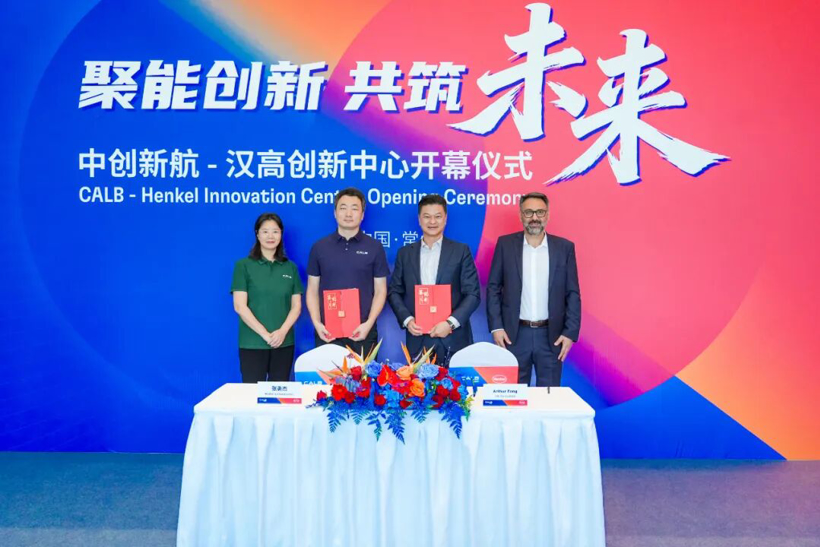
On September 29, CALB (China Aviation Lithium Battery) and German chemical giant Henkel inaugurated a joint innovation center in Changzhou, Jiangsu Province, simultaneously signing a strategic cooperation agreement. The partnership aims to co-develop next-generation battery materials and manufacturing processes. While the announcement was framed as a routine supply-chain collaboration, it signals a deeper structural shift: China's battery industry is aggressively integrating with European chemical expertise to circumvent regulatory walls and access premium automotive markets.
The collaboration comes amid a brutal price war in China's EV battery sector, where CATL and BYD dominate with over 70% market share. CALB, ranked third with roughly 6-7% share, faces a classic squeeze: scale disadvantage against giants, and a technology gap in premium chemistries. Partnering with Henkel—a leader in adhesives, sealants, and functional coatings—offers CALB access to critical materials that enhance battery safety, thermal management, and manufacturing yield. For Henkel, the deal provides a direct channel into the world's largest battery manufacturing ecosystem. But the real question is whether this alliance is a genuine leap forward or a tactical PR move to bolster CALB's narrative ahead of potential European expansion.
Why This Collaboration Matters: Context and Strategic Timing
The global battery supply chain is at an inflection point. The US Inflation Reduction Act (IRA) and EU's Critical Raw Materials Act have introduced strict localization and sourcing requirements, forcing Chinese battery makers to rethink their global strategies. CALB, like CATL and EVE Energy, is pursuing a "in Europe, for Europe" approach. Its planned gigafactory in Debrecen, Hungary, with a capacity of 20 GWh, is slated to start production in 2025. But localizing production is only half the battle; qualifying materials and processes for European OEMs—especially those demanding high-nickel chemistries and solid-state readiness—is the other half.
Henkel, through its Adhesive Technologies division, supplies a range of battery materials: thermally conductive adhesives, structural bonding agents, and dielectric coatings. These are not commodities; they are engineered solutions that can improve battery pack safety, energy density, and manufacturing speed. By co-locating R&D, CALB and Henkel can tailor these materials to CALB's specific cell designs and production lines, potentially accelerating the qualification cycle for European customers.
Inside the Joint Innovation Center: Materials, Processes, and IP
While specific technical details are scarce, the scope of the collaboration likely covers:
- Cell-to-pack (CTP) and cell-to-chassis (CTC) integration: Adhesives and sealants are critical for structural integrity, thermal management, and vibration resistance. Henkel's expertise in polyurethane and silicone-based materials could help CALB improve pack-level energy density and safety.
- High-nickel ternary (NCM) and manganese-rich chemistries: As CALB attempts to move upmarket, it needs binders, conductive additives, and coatings that support higher voltages and thermal stability. Henkel's material science capabilities could address issues like cathode microcracking and electrolyte decomposition.
- Solid-state battery interfaces: Though solid-state is still years from mass production, both companies likely aim to develop interface materials that mitigate dendrite formation and improve cycle life.
- Manufacturing process optimization: Henkel's adhesives can enable faster electrode stacking, improved cell-to-module bonding, and reduced curing times, directly impacting factory throughput and cost.
However, the joint innovation center is not a manufacturing joint venture. It is a research and development collaboration. The intellectual property (IP) generated will likely be shared or licensed, but CALB will still need to source materials from Henkel's competitors (e.g., 3M, Sika, Arkema) to avoid single-supplier dependency. This limits the strategic lock-in for both parties.
Comparison with Key Global Rivals
| Parameter | CALB (with Henkel) | CATL | BYD (FinDreams) | LG Energy Solution | Panasonic |
|---|---|---|---|---|---|
| 2023 Global Market Share (EV batteries) | ~6.5% | ~36.8% | ~15.8% | ~13.6% | ~6.4% |
| Key Chemistries | LFP, NCM | LFP, NCM, Sodium-ion, M3P | LFP (Blade), NCM | NCMA, NCM, LFP | NCA, NCM |
| Energy Density (cell level, Wh/kg) | ~180-200 (LFP), ~250-280 (NCM) | ~160-180 (LFP), ~260-300 (NCM) | ~150-160 (Blade LFP) | ~250-280 (NCMA) | ~260-280 (NCA) |
| Fast-Charging Capability (C-rate) | 1C-2C (current), targeting 4C | 4C (Shenxing), 5C (Qilin) | 2C-3C (Blade) | 2C-3C | 2C-3C |
| European Manufacturing Plans | Debrecen, Hungary (20 GWh, 2025) | Erfurt, Germany; Debrecen, Hungary | No direct plans; exports from China | Wrocław, Poland (expansion) | Kansas, US (not Europe) |
| Key Automotive Customers | GAC, XPeng, Li Auto, Volkswagen (JVs) | Tesla, BMW, Mercedes, VW, NIO | Tesla, BYD, Toyota | Tesla, GM, Ford, Hyundai-Kia | Tesla, Toyota |
Note: Market share data from SNE Research (2023). Energy density and C-rates are indicative, based on public announcements and industry estimates; actual production specs may vary.
Supply Chain & Cost Structure: The Hidden Economics
The partnership's cost implications are nuanced. Henkel's materials—adhesives, sealants, and coatings—represent a small fraction of total battery pack cost, typically 2-5%. However, they are critical enablers. A low-cost adhesive that fails to manage thermal expansion can lead to cell degradation, warranty claims, and brand damage. Conversely, a premium adhesive can improve manufacturing yield, reduce scrap, and enhance pack longevity. For CALB, the goal is likely to source high-performance materials at competitive prices, leveraging Henkel's scale and local production in Europe.
From Henkel's perspective, battery materials are a high-growth, high-margin opportunity. The global battery adhesives market is projected to reach $5-7 billion by 2030, with CAGR of 20-25%. By partnering with CALB, Henkel gains a reference customer and a co-development platform to tailor its products for the Chinese battery ecosystem, which it can then market to other OEMs.
But there is a catch: CALB's financial health is under pressure. The company reported a net loss in 2023 and has been forced to slash prices amid the Chinese price war. Its gross margin hovers around 10-15%, compared to CATL's 20-25%. Investing in a joint innovation center—even a modest one—adds R&D overhead. The payoff depends on whether CALB can translate these co-developed materials into higher-margin export contracts.
Competitive Impact: Who Gains, Who Loses?
Western OEMs and Tier-1 suppliers are the intended beneficiaries. European automakers, under pressure to localize battery sourcing and reduce carbon footprint, need compliant, high-performance battery solutions. CALB's European gigafactory, combined with Henkel's locally produced materials, could offer a "China-free" (or at least China-diversified) supply option. This is particularly relevant for US OEMs with European operations, as IRA FEOC rules do not apply to EU-manufactured content, but EU rules on foreign subsidies are tightening.
Chinese competitors like CATL and EVE Energy are unlikely to be directly threatened by this alliance. CATL has its own deep relationships with material suppliers (e.g., BASF, DIC) and a far larger R&D budget. However, if CALB succeeds in qualifying for premium European programs (e.g., BMW's Neue Klasse), it could erode CATL's share in that segment.
Other material suppliers like 3M, Sika, and Arkema face a more formidable competitor in Henkel for Chinese battery accounts. But the market is large enough for multiple players, and OEMs typically dual-source to maintain leverage.
The Reality Check: Interrogating the Headline Claims
The press release says: CALB and Henkel will co-develop next-gen battery materials and manufacturing processes. The engineering reality suggests: This is a materials qualification and process optimization exercise, not a breakthrough in battery chemistry. Adhesives and sealants are necessary but not sufficient for leapfrogging CATL or achieving solid-state leadership.
Is this spec physically achievable? The collaboration does not claim a new battery chemistry. It focuses on materials that enhance existing lithium-ion designs. Therefore, no physics-defying claims are made. However, if CALB aims to commercialize high-nickel NCM 9½½ or solid-state cells, Henkel's materials must withstand higher voltages (4.5V+) and temperatures, which may require novel polymer chemistries. That is a multi-year R&D effort.
What infrastructure is required? The joint innovation center likely houses pilot-scale mixing, coating, and testing equipment. But scaling to gigafactory volumes requires Henkel to build or expand local production in Europe. Henkel has adhesive plants in Germany, but battery-specific materials may require dedicated lines. This capital expenditure could take 18-24 months.
Has this been independently verified? No. The performance improvements are not disclosed. CALB's existing products are not known for industry-leading energy density or fast-charging. The partnership may help close the gap, but it does not prove a technological advantage.
Realistic timeline: Co-developed materials could appear in CALB's production cells by 2025-2026, coinciding with its Debrecen plant ramp-up. Solid-state interfaces are further out, likely 2028+.
What competitors say: CATL executives have publicly dismissed partnerships that do not control core cell chemistry as "peripheral." They argue that true differentiation lies in electrode design, electrolyte formulation, and manufacturing scale—not adhesives.
Regulatory & Geopolitical Landscape
The CALB-Henkel alliance is a case study in navigating the fragmenting global battery trade. The EU's Foreign Subsidies Regulation (FSR) and the upcoming battery passport requirements demand transparency in supply chains. By partnering with a European chemical leader, CALB can demonstrate compliance and reduce the risk of punitive tariffs. However, the EU is also investigating Chinese battery subsidies, and any negative finding could complicate CALB's expansion.
In the US, the IRA's FEOC rules effectively exclude Chinese-owned entities from clean vehicle credits if they have significant Chinese government ownership. CALB is partially state-owned, which may limit its ability to supply US-made EVs. The Henkel partnership does not change that calculus. Instead, it strengthens CALB's position in Europe, where the regulatory approach is more nuanced but still tightening.
For Western OEMs, the choice is between sourcing from Chinese-dominated supply chains (with associated geopolitical risk) or investing in alternatives. Partnerships like CALB-Henkel offer a middle path: European materials, Chinese manufacturing scale. But they do not eliminate dependency on Chinese cell technology.
Strategic Outlook & Investor Implications
Bull Case
CALB successfully integrates Henkel's advanced materials, achieving a 5-10% improvement in pack energy density and a 20% reduction in manufacturing defects. Its Debrecen plant qualifies for European OEM programs, and by 2027, CALB captures 10% of the European battery market. Henkel becomes the dominant battery materials supplier in Europe, driving margin expansion.
Base Case
The collaboration yields incremental improvements, but CALB remains a distant third in China and a minor player in Europe. Its margins stay thin due to price competition. Henkel gains a modest revenue stream but faces continued competition from specialized material suppliers. The joint innovation center produces useful IP but does not fundamentally alter the competitive landscape.
Bear Case
CALB's financial losses deepen, forcing it to scale back R&D and delay the Debrecen plant. The Henkel partnership stalls as resources are diverted to survival. European OEMs choose CATL, LG, or Northvolt instead. CALB becomes an acquisition target or exits the battery business, and Henkel writes off its investment.
Strategic Takeaways for Executives & Investors:
- Materials matter, but scale wins: CALB's partnership with Henkel improves its material science, but it cannot compensate for CATL's massive scale and cost advantage. Investors should view this as a defensive move, not an offensive breakthrough.
- Europe is the battleground: The ability to localize production and source compliant materials will determine which Chinese battery makers succeed in Europe. CALB's Debrecen plant is a test case; watch its qualification progress with European OEMs.
- Regulatory risk remains high: The EU's FSR and potential tariffs on Chinese batteries could disrupt CALB's plans. The Henkel partnership mitigates some risk but does not eliminate it.
- Watch for technology spillovers: If Henkel develops novel materials for CALB, it may license them to other OEMs, accelerating industry-wide improvements. This could benefit Western OEMs seeking to diversify away from Chinese cell makers.
- Financial health is the key indicator: Track CALB's gross margin, debt levels, and cash burn. Without a path to profitability, no amount of innovation will save the company.
In conclusion, the CALB-Henkel joint innovation center is a pragmatic step in a harsh competitive environment. It does not guarantee success, but it shows that CALB is willing to adapt. For Western investors and executives, it is a reminder that the Chinese battery industry is not monolithic; some players are actively seeking European partnerships to navigate regulatory and technological challenges. The next 18 months will reveal whether this collaboration is a genuine differentiator or merely a footnote in the consolidation of the global battery supply chain.