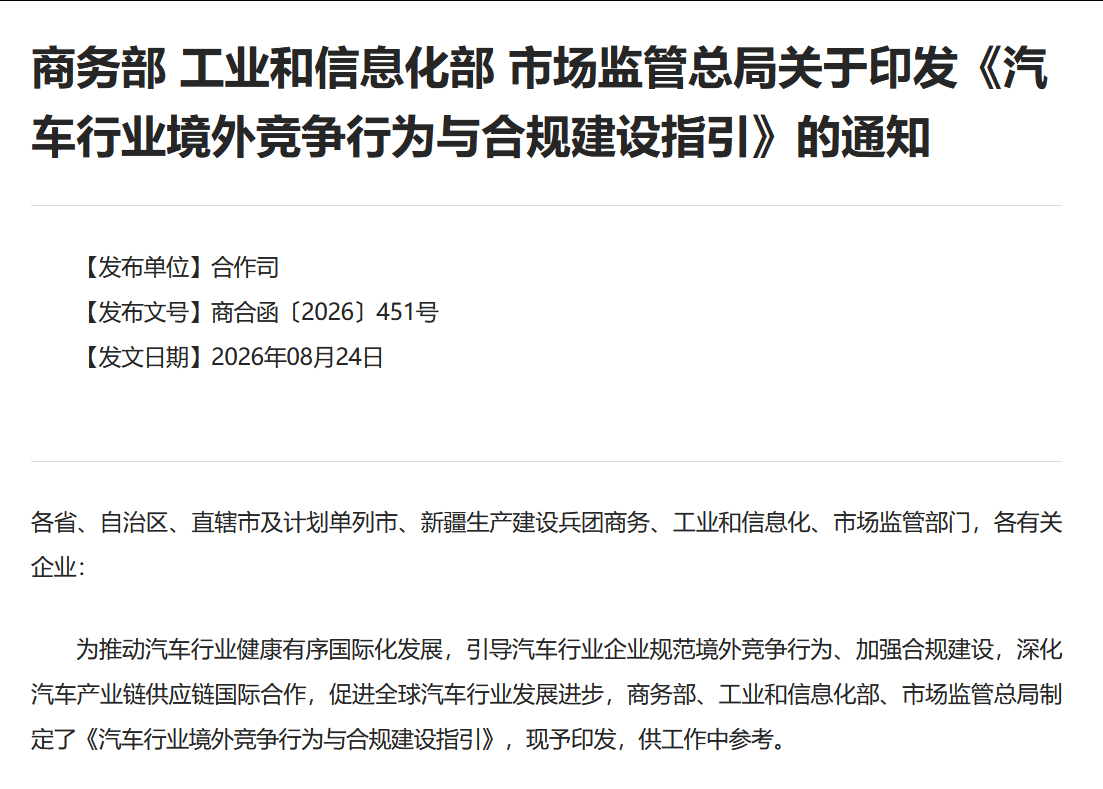
As Western markets erect increasingly complex regulatory barriers, Beijing is shifting its strategy from raw export volume to structured, high-value global integration. The newly issued joint directive focusing on the implementation of Chinese EV global compliance guidelines marks a critical turning point. Sponsored by China's Ministry of Commerce, Ministry of Industry and Information Technology, and State Administration for Market Regulation, this regulatory framework aims to guide domestic automakers toward orderly international growth.
Understanding the New Chinese EV Global Compliance Guidelines
The joint guidance serves as a strategic playbook for Chinese automotive OEMs navigating global trade friction. Rather than encouraging hyper-competitive price wars that invite anti-subsidy investigations, the document emphasizes institutional discipline, ESG (environmental, social, and governance) alignment, and intellectual property protection.
Key Pillars of the Joint Ministerial Directive
- Orderly Competition: Discouraging aggressive price-cutting behaviors that could damage the long-term reputation of Chinese automotive brands or trigger protective trade investigations.
- Supply Chain Traceability: Aligning with Western environmental and social standards, especially concerning raw material sourcing and carbon footprints.
- Intellectual Property Security: Encouraging rigorous compliance with local patent laws and proactive IP registration in target jurisdictions.
Shifting from Export-Led to Strategic Localization
For years, Chinese EV manufacturers relied heavily on exporting finished vehicles built in domestic gigafactories. However, with the European Union imposing provisional tariffs and the United States implementing strict clean-vehicle tax credit requirements, direct exporting is facing severe headwinds. The new guidelines steer automakers toward establishing a localized regional footprint.
This approach involves setting up local assembly plants, sourcing materials from regional partners, and engaging in cross-border collaboration. Companies like BYD in Hungary, Chery in Spain, and Geely's various international joint ventures showcase how strategic localization benefits both the domestic manufacturer and the host nation by creating local jobs and transferring technology safely.
A Comparison: Export Model vs. Strategic Localization
To understand how this regulatory shift changes the operational model, consider the structural transition outlined below:
| Operational Dimension | Traditional Direct Exporting | Strategic Localization (Compliant Model) |
|---|---|---|
| Primary Regulatory Risk | High vulnerability to anti-subsidy duties and unilateral tariffs. | High alignment with local trade policies and regional value-add thresholds. |
| Local Economic Impact | Creates minimal employment or investment in the destination country. | Supports local employment, infrastructure, and strategic manufacturing hubs. |
| Sourcing & ESG Compliance | Complex supply chains are difficult for Western regulatory bodies to audit. | Localized supply chain tracing aligns with ESG laws (e.g., EU Battery Regulation). |
Strategic Implications for Western Investors and OEMs
From an analytical standpoint, these compliance guidelines should not be viewed as a sign of retreat. Instead, they demonstrate a mature industry adapting to global reality. Rather than initiating trade conflicts, Chinese regulatory authorities want their automotive champions to integrate harmoniously into Western ecosystems through technology integration and strategic sourcing alliances.
For Western OEMs, this opens up significant avenues for technology partnerships. Leveraging global supplier expertise while adhering to strict local trade compliance enables a win-win scenario, driving down the overall cost of electrification globally while ensuring sustainable development.