QingTao Solid-State Battery Commercialization: New Shanghai Base Accelerates Next-Gen EV Timelines
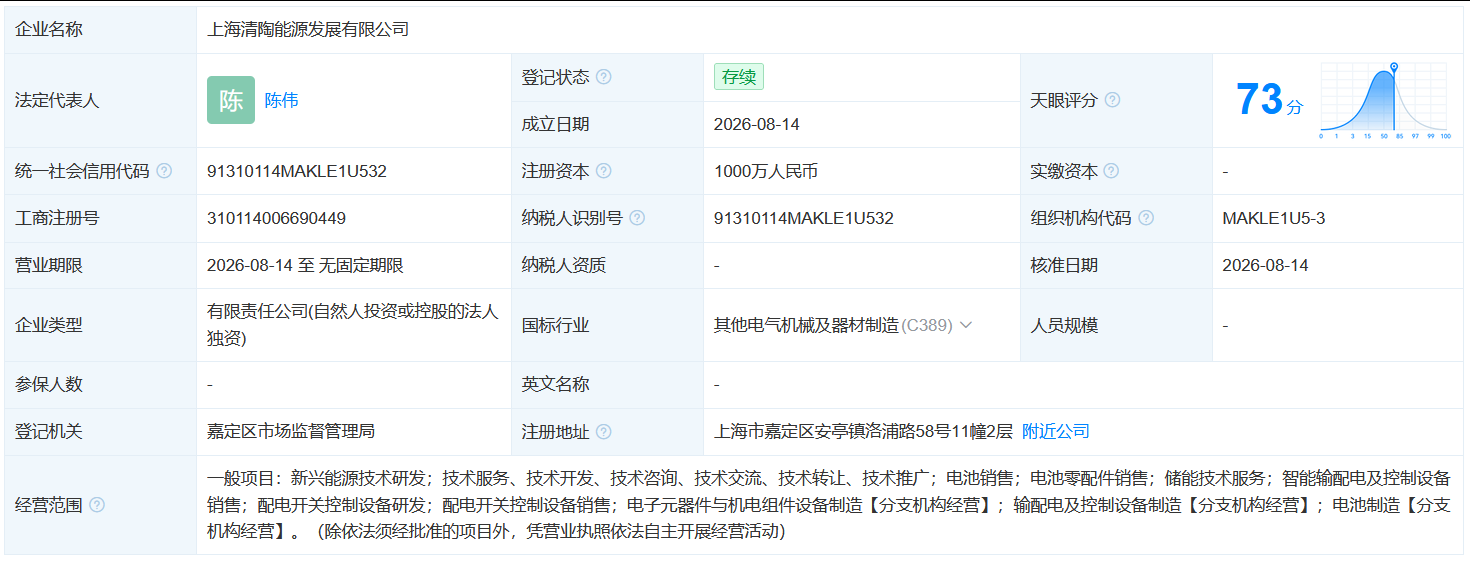
The global race for next-gen electric vehicle (EV) batteries has reached a pivotal juncture, with QingTao solid-state battery commercialization leading the charge. Recently, Shanghai Qingtao Energy Development Co., Ltd. was officially registered in Shanghai with a registered capital of 10 million RMB. Under the leadership of legal representative Chen Wei, this strategic expansion signals a major consolidation of QingTao's operational footprint closer to its primary automotive partner, SAIC Motor. This move is poised to reshape supply chain dynamics for global automakers monitoring next-generation battery readiness.
Decoding the Strategic Importance of QingTao's Shanghai Expansion
For market analysts tracking East Asian battery ecosystems, the location of this new entity is highly strategic. Shanghai is not only a major global financial hub but also the home of SAIC Motor, which has co-invested heavily in QingTao. By establishing a dedicated development entity in Shanghai, QingTao is positioning its engineering teams to work in lockstep with SAIC's vehicle platforms.
This tight geographical integration is crucial for solving the complex thermal management and pack-level packaging challenges inherent to solid-state chemistry. It allows for rapid iteration of cell-to-pack designs, ensuring that technological breakthroughs transition seamlessly from laboratory settings to active automotive assembly lines.
The Current State of QingTao Solid-State Battery Commercialization
While many global battery manufacturers view solid-state technology as a post-2030 objective, the timeline in China has been aggressively pulled forward through a phased commercialization approach. Rather than waiting for pure all-solid-state chemistry to mature, QingTao and its partners have successfully commercialized 'quasi-solid-state' or semi-solid-state variations.
A prime example of this strategy is the IM L6 sedan, developed under SAIC's premium EV brand. The vehicle features the 'Lightyear' battery, a first-generation semi-solid-state pack boasting:
- Energy Density: Over 368 Wh/kg at the cell level.
- Capacity: 133 kWh, delivering a CLTC range exceeding 1,000 kilometers.
- Safety: Significantly reduced thermal runaway risk due to a localized solid-state electrolyte barrier.
By using a semi-solid electrolyte with a liquid component, QingTao has bypassed the early-stage manufacturing challenges of pure solid-state cells, achieving mass production capabilities today rather than tomorrow.
Timeline Comparison: Semi-Solid vs. All-Solid-State Commercialization
To help Western investors and strategy directors benchmark progress, the following table outlines the projected roadmap for QingTao's battery technology generation shifts:
| Battery Generation | Electrolyte State | Target Energy Density (Cell) | Est. Mass Production Timeline | Primary Automotive Application |
|---|---|---|---|---|
| Gen 1 (Lightyear) | Semi-Solid (Liquid <10%) | 368 - 400 Wh/kg | Active (2024-2025) | Premium Passenger EVs (IM L6) |
| Gen 2 | Semi-Solid (Liquid <5%) | 400 - 450 Wh/kg | 2025 - 2026 | High-Performance & Long-Range SUVs |
| Gen 3 (All-Solid-State) | 100% Solid (Liquid 0%) | 500+ Wh/kg | 2027 (Est. Pilot) | Next-Gen Global EV Architectures |
What This Means for Western OEMs and Investors
The aggressive scaling of QingTao solid-state battery commercialization highlights a widening gap in commercialization strategies between regions. While Western OEMs have largely prioritized partnership-driven R&D with early-stage startups aiming directly for pure solid-state chemistries, Chinese suppliers are capturing early market share and gathering valuable real-world field data via semi-solid-state intermediate steps.
This practical approach yields several distinct benefits:
- Manufacturing Maturity: QingTao utilizes modified lithium-ion assembly lines, mitigating the multi-billion-dollar capital expenditure barriers associated with completely new manufacturing processes.
- Supply Chain Verification: Real-world usage allows engineers to test how solid-state interfaces degrade over thousands of charge cycles in diverse climates.
- Strategic Sourcing Alliances: Establishing localized R&D facilities in automotive hubs like Shanghai ensures that suppliers remain deeply integrated with OEMs, streamlining future global export compliance and localized regional footprint adjustments.
Western automakers looking to maintain competitiveness will need to evaluate whether to pursue similar phased implementation strategies or accelerate their existing pure-play solid-state partnerships to avoid falling behind on range and safety metrics.