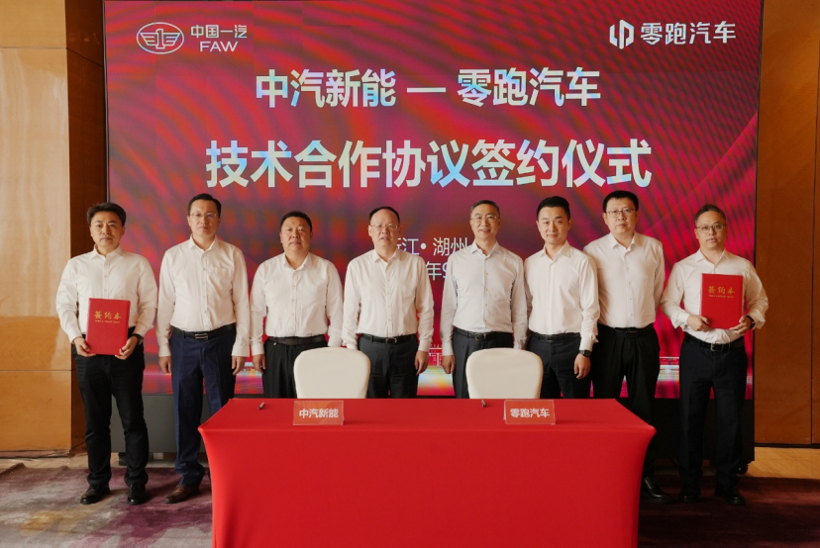
In a move that signals a decisive shift toward industrial maturity in China's electric vehicle sector, Leapmotor has signed a strategic technical cooperation agreement with CALB-affiliated Zhongqi Xinneng Battery Technology to jointly develop and industrialize standardized battery cells and next-generation battery technologies. The deal, announced on September 17, 2025, in Changchun, was witnessed by Qiu Xiandong, Chairman of China FAW Group, underscoring the deepening ties between state-backed battery innovation and one of China's most agile EV startups.
For Western auto executives, institutional investors, and supply chain strategists, this partnership is far more than a routine supply agreement. It represents a structural inflection point: the industrialization of standardized battery cells in China is set to compress costs, accelerate production cycles, and intensify the already fierce global competition in the mass-market EV segment. As the global auto industry pivots toward electrification, the ability to source high-quality, low-cost batteries at scale has become the single most important determinant of market survival. This deal positions Leapmotor and its partners to capitalize on that reality while posing fresh challenges for legacy OEMs and battery makers outside China.
Section 1: Executive Overview & The Market Catalyst
The partnership between Leapmotor and Zhongqi Xinneng is the latest in a series of moves by Chinese automakers to secure battery supply and drive down costs through vertical integration and standardization. Leapmotor, which has rapidly scaled its production to become a top-five EV maker in China, has long pursued a strategy of in-house development for key components, including battery packs and electric drive systems. However, the complexity and capital intensity of cell manufacturing have led the company to collaborate with established battery producers.
Zhongqi Xinneng, a subsidiary of China FAW Group and affiliated with CALB (China Lithium Battery Technology Co., Ltd.), brings state-backed resources and deep expertise in battery R&D. The agreement focuses on two pillars: first, the joint development of next-generation battery technologies, including high-energy-density chemistries and advanced thermal management systems; second, the industrialization of standardized battery cells that can be used across multiple vehicle platforms. This standardization is critical—it allows for economies of scale, simplifies supply chains, and reduces costs for both the automaker and the battery supplier.
Historically, the Chinese EV battery market has been dominated by CATL and BYD, with a myriad of smaller players vying for market share. The push toward standardization is a direct response to the industry's need for cost reduction amid intense price wars and thinning margins. Government policies, such as the "Battery Standardization Roadmap" issued by the Ministry of Industry and Information Technology (MIIT), have encouraged automakers and battery makers to adopt common cell formats (e.g., 4680, 4695, or prismatic cells) to facilitate interoperability and recycling. Leapmotor's deal with Zhongqi Xinneng is a concrete step in that direction.
Section 2: Technical Architecture & Deep Engineering Teardown
At the heart of the Leapmotor-Zhongqi Xinneng collaboration is a focus on standardizing battery cell formats and integrating advanced technologies. While specific cell dimensions have not been publicly disclosed, industry sources indicate that the partners are targeting a prismatic cell format with a capacity ranging from 100 Ah to 200 Ah, compatible with both 400V and 800V electrical architectures.
Cell Chemistry and Energy Density
The joint development likely encompasses multiple chemistries, including lithium iron phosphate (LFP) for cost-sensitive models and high-nickel nickel-cobalt-manganese (NCM) for premium, long-range vehicles. LFP cells, known for their safety and cycle life, have seen a resurgence in China due to innovations in cell-to-pack (CTP) and cell-to-body (CTB) integration. Zhongqi Xinneng's LFP cells are expected to achieve energy densities of 160-180 Wh/kg at the cell level, with pack-level densities exceeding 140 Wh/kg when using CTP technology.
For higher-end applications, the partners are likely to employ NCM 811 or NCMA (nickel-cobalt-manganese-aluminum) chemistries, reaching cell-level energy densities of 250-300 Wh/kg. These cells support fast-charging rates of up to 4C, enabling a 10-80% charge in approximately 15 minutes when paired with a 480 kW charger. The thermal management system, a critical component for fast charging and longevity, will likely use a combination of liquid cooling plates and phase-change materials to maintain optimal cell temperatures.
Battery Management System (BMS) and Software
A key differentiator in modern EV batteries is the software stack. Leapmotor's in-house BMS, developed under its "Leapmotor Power" initiative, employs advanced algorithms for state-of-charge (SoC) and state-of-health (SoH) estimation, active cell balancing, and thermal runaway prediction. The integration with Zhongqi Xinneng's cells will involve co-development of firmware to optimize charging curves and extend battery life. The BMS will also support over-the-air (OTA) updates, allowing for continuous improvement of battery performance and safety.
Comparison with Global Rivals
To contextualize the Leapmotor-Zhongqi Xinneng battery technology, the table below compares it with key global competitors in the mass-market EV segment.
| Parameter | Leapmotor C11 (with Zhongqi Xinneng) | Tesla Model Y (4680) | VW ID.4 (CATL) | BYD Atto 3 (Blade LFP) | Hyundai Ioniq 5 (SK On) |
|---|---|---|---|---|---|
| Cell Format | Prismatic (standardized) | Cylindrical 4680 | Prismatic | Prismatic Blade | Pouch |
| Chemistry | LFP / NCM | NCM 811 | NCM 712 | LFP | NCM 811 |
| Pack Energy (kWh) | 60-90 | 75-82 | 52-77 | 60.5 | 58-77.4 |
| Max Charging Rate | 4C (480 kW) | 3C (250 kW) | 2C (135 kW) | 2C (88 kW) | 3.5C (350 kW) |
| Pack Cost ($/kWh, est.) | 70-80 | 90-100 | 95-105 | 75-85 | 100-110 |
| Standardization Level | High (multi-platform) | Proprietary | Low | Medium | Low |
As the table illustrates, the Leapmotor-Zhongqi Xinneng approach emphasizes standardization and cost efficiency, with pack costs estimated to be 20-30% lower than those of Western OEMs. This cost advantage is largely attributable to China's scale, vertical integration, and aggressive R&D in LFP and CTP technologies.
Section 3: Supply Chain Dynamics & Bill of Materials (BOM) Economics
The partnership between Leapmotor and Zhongqi Xinneng is a case study in China's evolving battery supply chain. Zhongqi Xinneng, as a CALB affiliate, benefits from CALB's established production capacity and raw material procurement networks. CALB, China's third-largest battery maker by installed capacity, has been aggressively expanding its production footprint, with plans to reach 500 GWh of capacity by 2025. Its tie-up with FAW provides a captive customer base and access to state-backed financing.
Leapmotor, on the other hand, brings its expertise in vehicle integration and software. The company's "Leapmotor 2.0" strategy emphasizes in-house development of core components, including electric motors, battery packs, and autonomous driving systems. By partnering with Zhongqi Xinneng for cells, Leapmotor can focus on pack assembly and BMS, while benefiting from the scale and cost advantages of a dedicated cell supplier.
The BOM cost advantage of Chinese EVs is well-documented. According to a 2025 study by AlixPartners, the average BOM cost for a Chinese mid-size EV is approximately $18,000, compared to $25,000 for a comparable Western model. Battery cells account for 30-40% of the BOM. By standardizing cells and leveraging LFP chemistry, Leapmotor can achieve a battery pack cost of $70-80/kWh, versus $90-110/kWh for Western rivals. This translates to a $1,500-$3,000 cost advantage per vehicle, which can be passed on to consumers or used to fund advanced features.
Tier-1 suppliers also play a role. Companies like Bosch, Valeo, and ZF supply components such as battery disconnects, thermal management modules, and power electronics. However, Chinese suppliers like Inovance, Shinry, and Kelin are increasingly competitive, offering similar quality at lower costs. The vertical integration of Leapmotor and its partners allows for tighter coordination and faster iteration, reducing development time and cost.
Section 4: Western Legacy OEM Impact & Competitive Fallout
The Leapmotor-Zhongqi Xinneng deal is a clear signal that Chinese automakers are not just competing on price but are also innovating in supply chain organization. For Western legacy OEMs—Volkswagen, Stellantis, Ford, GM, BMW, and Mercedes-Benz—the implications are profound. These companies are already grappling with the transition to electric vehicles, facing pressure from shareholders to improve margins while investing billions in new platforms and factories.
In China, the world's largest EV market, Western OEMs have lost significant market share to domestic brands. In 2024, Chinese brands accounted for over 80% of EV sales in China, up from 70% in 2020. Volkswagen, once the market leader, has seen its share decline; its ID. series has struggled to compete with cheaper, more technologically advanced Chinese models. The cost advantage of Chinese EVs, driven by standardized batteries and vertical integration, is a key factor. If Leapmotor can produce a mid-size SUV with a 90 kWh battery for under $25,000, Western OEMs will find it increasingly difficult to compete in price-sensitive segments.
In export markets, Chinese EVs are gaining traction in Europe, Southeast Asia, the Middle East, and Latin America. In Europe, Chinese brands like BYD, MG, and NIO have captured over 8% of the EV market, despite EU tariffs. The Leapmotor-Zhongqi Xinneng partnership could accelerate this trend by enabling even more competitive pricing. Western OEMs must respond by reducing costs, localizing production, and forming strategic partnerships. Some, like Stellantis, have already invested in Chinese EV makers (e.g., Leapmotor) to leverage their technology and supply chains.
Section 5: Geopolitical, Tariff & Regulatory Adaptation
The global trade environment for EVs is increasingly complex. The European Union has imposed countervailing duties on Chinese EVs, ranging from 7.8% to 35.3% on top of the standard 10% tariff, citing unfair subsidies. The United States has levied a 100% tariff on Chinese EVs, effectively closing its market to direct imports. In response, Chinese automakers are pursuing strategic localization: building factories in Europe (Hungary, Spain), Southeast Asia (Thailand, Indonesia), and Latin America (Brazil, Mexico) to serve regional markets and comply with local content requirements.
Leapmotor, through its partnership with Stellantis, is already exploring European production. Stellantis holds a 20% stake in Leapmotor and has exclusive rights to manufacture and sell Leapmotor vehicles outside China. This cross-border collaboration is a model for how Chinese and Western companies can work together to navigate trade barriers. By localizing production, they can mitigate tariff impacts, create local jobs, and align with ESG goals.
Regulatory standards also play a role. The EU's Battery Regulation, which mandates carbon footprint disclosure and recycling targets, requires battery makers to adapt. Chinese battery producers like CALB are investing in European gigafactories to meet these requirements. The standardization of cells can facilitate recycling and second-life applications, aligning with circular economy objectives.
Section 6: 3-5 Year Strategic Market Outlook & Scenario Analysis
Looking ahead to 2028-2030, the trajectory of the Chinese EV battery supply chain will have far-reaching consequences. We present three scenarios.
Bull Case Scenario
Standardized battery cells achieve widespread adoption across Chinese automakers, driving pack costs below $60/kWh. Leapmotor, leveraging its partnership with Zhongqi Xinneng and Stellantis, expands rapidly in Europe and Southeast Asia, capturing 5% of the global EV market. Western OEMs accelerate their own battery standardization efforts, but Chinese players maintain a 15-20% cost advantage. Global EV adoption surpasses 50% of new car sales by 2030, with Chinese brands accounting for 40% of that volume.
Base Case Scenario
Standardization progresses but faces technical and coordination challenges. Battery costs decline gradually to $70/kWh. Leapmotor grows steadily in China and exports to emerging markets, but faces stiff competition in Europe. Western OEMs improve their cost structures through partnerships and localization, narrowing the gap to 10-15%. Trade tensions persist but do not escalate significantly. EV market share reaches 40% by 2030, with Chinese brands holding 30% globally.
Bear Case Scenario
Overcapacity in the Chinese battery industry leads to a price war, squeezing margins for all players. Western OEMs successfully localize battery production and reduce costs, while Chinese exports face higher tariffs and regulatory hurdles. Leapmotor's partnership fails to deliver expected synergies, and its market share stagnates. Global EV growth slows due to economic headwinds and raw material shortages. Chinese brands' global share remains below 25%.
Section 7: Strategic Implications for Executives & Institutional Investors
- For Auto Executives: Prioritize battery cost reduction through standardization and strategic partnerships. Explore collaborations with Chinese battery makers for technology access and local production. Invest in LFP and CTP technologies to remain cost-competitive in mass-market segments.
- For Supply Chain Strategists: Diversify sourcing to include Chinese Tier-1 suppliers where feasible, but balance with local content requirements. Monitor standardization trends to align procurement strategies. Consider joint ventures for battery cell production in key markets.
- For Institutional Investors: Evaluate exposure to Chinese EV and battery stocks, considering policy risks and growth potential. Companies like Leapmotor, CALB, and their suppliers may offer alpha opportunities. Hedge against tariff risks by investing in localized production plays.
- For Technology Investors: Focus on innovations in battery chemistry, BMS software, and recycling. Standardized cells create opportunities for aftermarket and second-life applications. Watch for startups in solid-state and sodium-ion batteries that could disrupt the landscape.
- For Policymakers: Balance support for domestic battery production with incentives for standardization and recycling. Engage with industry stakeholders to develop interoperable standards that facilitate global trade while ensuring supply chain resilience.
In conclusion, the Leapmotor-Zhongqi Xinneng partnership is a bellwether for the future of the EV industry. It underscores the importance of scale, standardization, and strategic collaboration in driving down costs and accelerating electrification. Western stakeholders must adapt swiftly or risk being left behind in the race for affordable, high-tech electric vehicles.