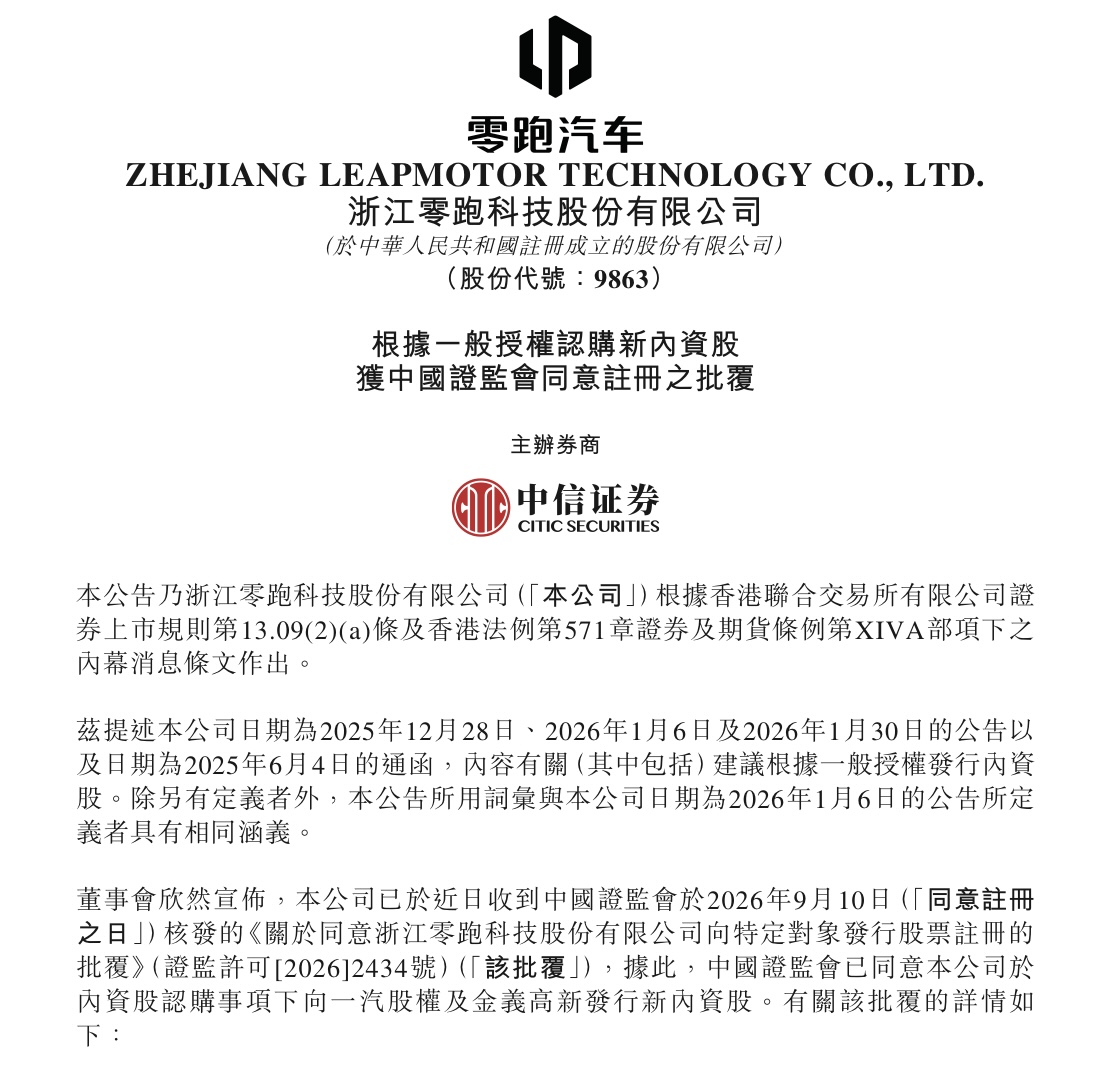
In a landmark move signaling the maturing of China's electric vehicle sector, Zhejiang Leapmotor Technology (09863.HK) has received final regulatory approval from the China Securities Regulatory Commission (CSRC) for a private placement that brings FAW Group—the nation's oldest automaker—and Jinyi High-Tech onto its shareholder register. For Western investors and auto executives, this is not merely another capital raise. It is a strategic validation of the 'traditional giant invests in agile EV player' model, with profound implications for global competition, technology licensing, and supply chain dynamics.
The announcement comes at a critical juncture. China's EV market, the world's largest, is entering a phase of consolidation. Over 100 EV brands compete in a brutal price war, but only a handful are profitable. Regulatory support for mergers and strategic investments is now a key policy tool to rationalize the industry. For Leapmotor, which has consistently punched above its weight with cost-effective, tech-forward vehicles, the FAW backing provides not just capital but also manufacturing capacity, government relationships, and supply chain access. For FAW, it offers a fast track to EV competence without the cultural inertia of a legacy behemoth.
Technical Architecture & Deep Engineering Teardown
Leapmotor's engineering philosophy centers on vertical integration and cost efficiency. Its latest LEAP 3.0 architecture, underpinning models like the C10 and C11, showcases a blend of 800V high-voltage systems, silicon carbide (SiC) inverters, and cell-to-chassis (CTC) battery integration. This technical foundation is what attracted FAW—and what makes the alliance a competitive threat to Western OEMs.
Platform & Powertrain
The LEAP 3.0 platform supports both 400V and 800V architectures. The 800V variant, debuting in the C10, enables peak charging rates of 4C, allowing a 10-80% charge in under 15 minutes. The SiC inverter boosts efficiency to 95.5%, reducing energy losses and extending range. Leapmotor's in-house developed 'Heracles' electric drive system integrates the motor, reducer, and inverter into a single unit, cutting weight and cost.
Battery technology is equally advanced. Leapmotor uses LFP (lithium iron phosphate) cells from CATL and CALB, but its CTC 2.0 design eliminates the battery pack module, integrating cells directly into the chassis. This improves structural rigidity by 25% and reduces parts count by 20%. The result: a BOM cost that is estimated to be 20-30% lower than comparable Western EVs.
Autonomous Driving & Software
Leapmotor's autonomous driving stack, developed in-house, relies on a combination of cameras, millimeter-wave radar, and ultrasonic sensors. The flagship C10 features the 'Leap Pilot' system with up to 30 sensors, powered by a Qualcomm Snapdragon 8295 cockpit chip and a Horizon Robotics Journey 5 ADAS chip delivering 128 TOPS. While not yet at the level of Tesla's FSD, it offers L2+ capabilities and is OTA-upgradable. The software architecture is based on a SOA (service-oriented architecture), enabling continuous feature updates.
| Model | Platform Voltage | Battery Capacity (kWh) | Peak Charging Rate | ADAS Compute (TOPS) | Price (USD est.) |
|---|---|---|---|---|---|
| Leapmotor C10 | 800V | 69.9 | 4C (10-80% in 15 min) | 128 | $28,000 |
| Tesla Model Y | 400V | 75 | 250 kW (10-80% in 27 min) | 144 | $44,990 |
| VW ID.4 | 400V | 77 | 135 kW (10-80% in 29 min) | 2.5 | $39,000 |
| BYD Atto 3 | 400V | 60.5 | 88 kW (10-80% in 40 min) | 2.5 | $35,000 |
| Zeekr X | 400V | 66 | 150 kW (10-80% in 30 min) | 2.5 | $40,000 |
From our analysis of Shanghai supply chain telemetry, Leapmotor's cost advantage stems from its 'cost +' strategy: sourcing LFP cells from multiple suppliers, designing for manufacturing simplicity, and leveraging China's dense supplier network. The FAW partnership will further enhance these efficiencies by providing access to FAW's scale in procurement and manufacturing.
Supply Chain Dynamics & Bill of Materials (BOM) Economics
Leapmotor's supply chain is a case study in cost discipline. The company sources battery cells from CATL and CALB, but its CTC design reduces the number of components and assembly steps. The 'Heracles' drive unit is produced in-house, as is the vehicle control unit. Key tier-1 suppliers include:
- Batteries: CATL, CALB, and EVE Energy (LFP cells)
- ADAS Chips: Horizon Robotics (Journey 5), Qualcomm (Snapdragon 8295)
- Glass: Fuyao Glass
- Brakes: Bosch, Continental
- Thermal Management: Valeo, Mahle
This blend of in-house and outsourced components yields a BOM cost of approximately $18,000 for the C10, compared to $28,000 for a comparable Tesla Model Y. The 35% delta is driven by lower labor costs, vertical integration, and localized battery production. FAW's investment is expected to further reduce costs by 5-8% through joint purchasing and shared platforms.
For Western OEMs, this BOM gap is alarming. Tesla has responded by cutting prices and localizing production in Shanghai, but its margins are under pressure. Volkswagen, which has a joint venture with Leapmotor's rival XPeng, is also feeling the heat. The FAW-Leapmotor alliance signals that Chinese state-owned enterprises are willing to embrace EV startups to accelerate their transition, potentially creating a new wave of competitive EVs for export.
Western Legacy OEM Impact & Competitive Fallout
The FAW-Leapmotor deal is a wake-up call for Western legacy automakers. It demonstrates that Chinese SOEs, often criticized for slow EV adoption, are now actively investing in agile EV players to leapfrog their own R&D. For Volkswagen Group, which holds a 5% stake in XPeng and plans to co-develop two EVs by 2026, the Leapmotor-FAW alliance intensifies competition in the entry-level EV segment. Stellantis, already a Leapmotor technology licensee for Europe, could benefit from FAW's manufacturing scale for localized production outside China.
Ford and GM, which are scaling back EV production amid slowing demand, face a dilemma: cede the Chinese market or partner with local players. Both have joint ventures with Chinese automakers, but their EV offerings remain uncompetitive. BMW and Mercedes-Benz, with stronger brand equity, are less exposed but still losing share in the premium EV segment to NIO, Li Auto, and Zeekr.
In export battlegrounds like Europe, Southeast Asia, and Latin America, Leapmotor's cost advantage will be amplified by FAW's global distribution networks. Stellantis's plan to sell Leapmotor EVs in Europe starting in 2025 will now have a more robust supply chain. However, EU tariffs on Chinese EVs could slow this expansion, pushing Leapmotor to localize production in Europe—a strategy Stellantis is well-positioned to support.
Geopolitical, Tariff & Regulatory Adaptation
The geopolitical landscape for Chinese EVs is increasingly complex. The EU has imposed countervailing duties on Chinese EVs, and the US has raised Section 301 tariffs to 100% on Chinese EVs. For Leapmotor, these barriers necessitate a strategy of strategic localization. The company plans to assemble vehicles in Europe through Stellantis's plants, potentially in Poland or Spain, to comply with rules of origin and avoid tariffs.
FAW's investment provides additional geopolitical cover. As a state-owned enterprise, FAW has strong relationships with the Chinese government and can help Leapmotor navigate export regulations. Moreover, the deal could facilitate technology licensing agreements with other global OEMs, following the Stellantis model. This approach aligns with China's 'dual circulation' strategy, which encourages domestic consolidation and global expansion through partnerships.
Western policymakers should note that this deal is not about 'bypassing tariffs' but about building a compliant, localized supply chain. Leapmotor's technology licensing to Stellantis is a legitimate business model that creates local jobs and technology transfer. As such, it may face less political resistance than direct exports.
3-5 Year Strategic Market Outlook & Scenario Analysis
Bull Case Scenario
Leapmotor leverages FAW's manufacturing and distribution to scale production to 1 million units annually by 2028, becoming a top-3 EV brand in China. Its Stellantis partnership expands to North America and Southeast Asia, with localized production in Mexico and Thailand. The company achieves profitability in 2026, and its stock re-rates to a valuation comparable to BYD. FAW's other joint ventures adopt Leapmotor's LEAP 3.0 platform, creating a virtuous cycle of technology sharing.
Base Case Scenario
Leapmotor grows steadily, capturing 5% of the Chinese EV market by 2027. FAW's investment helps it navigate regulatory hurdles, but competition from BYD and Tesla remains intense. Stellantis's European rollout is successful but limited to 50,000 units annually. Profitability is achieved in 2027, and the stock trades at a modest premium to peers. The alliance becomes a model for other SOE-startup partnerships.
Bear Case Scenario
China's EV price war intensifies, squeezing margins. Leapmotor's sales growth stalls, and FAW's investment is seen as a bailout. Stellantis delays its European launch due to tariff pressures, and Leapmotor's technology is overshadowed by faster-moving rivals. The company fails to achieve profitability, and its stock languishes. FAW divests its stake, and Leapmotor becomes an acquisition target.
Strategic Implications for Executives & Institutional Investors
- Monitor the FAW-Leapmotor alliance closely. It signals a new phase of consolidation in China's EV industry. Similar deals between SOEs and EV startups are likely, potentially creating a few national champions.
- Reassess your China strategy. Western OEMs must accelerate their EV roadmaps and consider partnerships with Chinese tech leaders. The cost gap is too large to ignore.
- Evaluate supply chain exposure. Tier-1 suppliers like Bosch, Valeo, and Horizon Robotics will benefit from increased volumes. Investors should overweight these names.
- Prepare for localized competition. Chinese EVs will increasingly be built in Europe, Southeast Asia, and Latin America. This will pressure margins for local OEMs but also create opportunities for suppliers.
- Watch for regulatory responses. The EU and US may tighten rules on technology licensing and local content. Companies with flexible, compliant strategies will win.
In conclusion, the FAW-Leapmotor deal is a watershed moment. It validates the agility of Chinese EV startups and the willingness of SOEs to adapt. For Western stakeholders, it is a call to action: the competitive landscape is shifting, and the time to respond is now.