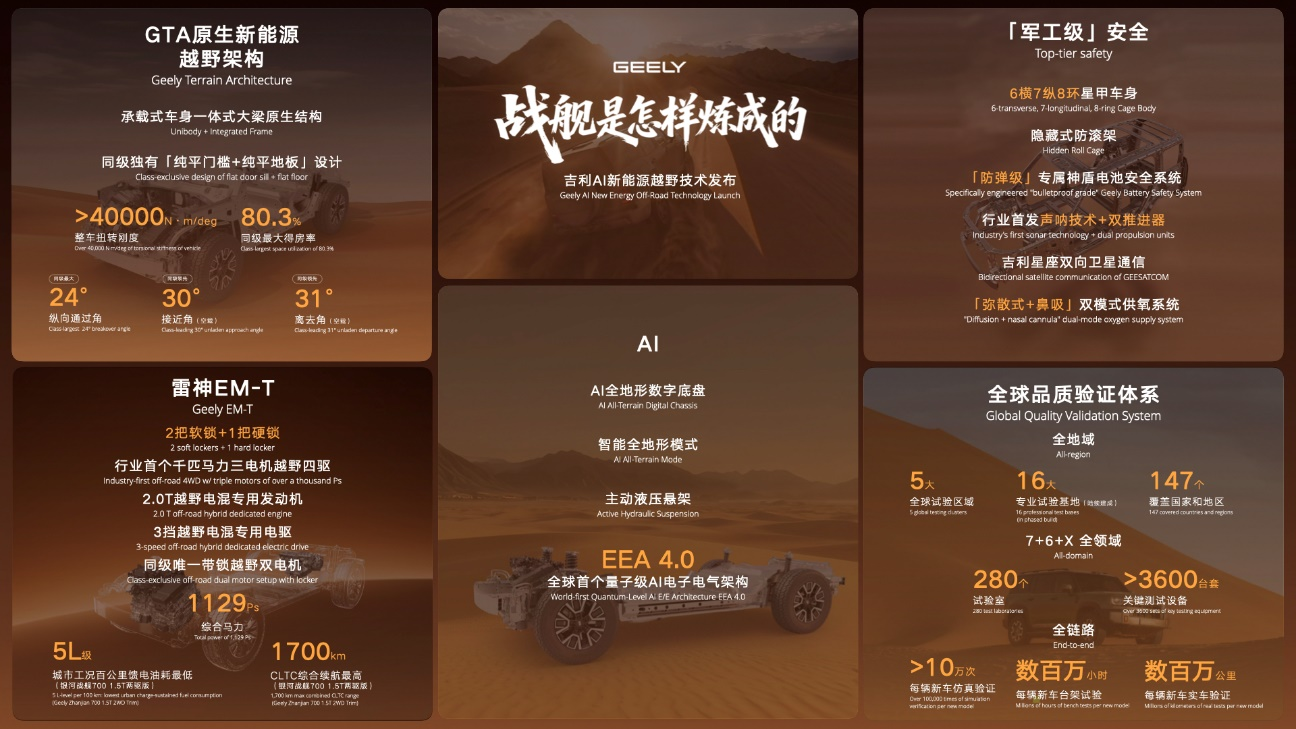
The global automotive landscape is witnessing a profound shift as leading automakers transition from rapid electrification to deep hardware-software integration. On August 28, Geely Auto Group officially pushed this frontier forward by launching its new AI off-road vehicle technology framework. At the heart of this release is the GTA (Geely Technology Architecture) native new energy off-road architecture, coupled with the Thor EM-T all-wheel-drive AI hybrid system and an AI-enabled digital chassis.
Decoding Geely’s GTA Native Off-Road Architecture
As a Shanghai-based automotive analyst tracking domestic platforms, I view the GTA architecture not just as a physical chassis, but as a paradigm shift in software-defined physical capabilities. Unlike legacy ladder-frame chassis designed purely for structural rigidity, the GTA architecture natively integrates high-voltage electrical architectures with modular structural flexibility.
Key architectural components include:
- Native New Energy Integration: Designed from the ground up to accommodate large battery packs securely within the chassis frame, enhancing structural safety and balance during extreme off-road impacts.
- Modular Adaptability: Supports multiple wheelbase lengths and suspension setups, allowing Geely to scale this technology across premium SUVs, pickups, and utility vehicles efficiently.
The Thor EM-T Powertrain and AI Digital Chassis
The operational core of Geely's new AI off-road vehicle technology lies in its propulsion and chassis control systems. The Thor EM-T is an all-wheel-drive AI electric hybrid platform that optimizes power distribution in real-time. By utilizing machine learning models running on edge processors, the system predicts tire slip conditions milliseconds before they occur.
Furthermore, the AI All-Terrain Digital Chassis leverages predictive sensory inputs to adjust damper rates, ground clearance, and torque vectoring. By analyzing terrain characteristics via onboard cameras and wheel-speed sensors, the AI system dynamically reconfigures the vehicle's driving dynamics to match the terrain seamlessly.
| Feature / Metric | Geely GTA (Thor EM-T) | BYD DMO Platform | Traditional Mechanical 4WD |
|---|---|---|---|
| Control Mechanism | AI-driven digital chassis | Hydraulic & electric torque vectoring | Mechanical locking differentials |
| Response Time | Millisecond-level predictive | Millisecond-level reactive | Mechanical engagement delay |
| Powertrain Type | AI Multi-motor Hybrid / EV | Dual-motor longitudinal hybrid | Internal Combustion Engine (ICE) |
The Geely Galaxy Starship 700: Leading the Rollout
Geely has confirmed that the first model to feature this high-end technical architecture will be the Galaxy Starship 700. Positioned as a technological flagship, this vehicle aims to demonstrate the practical viability of AI-driven off-roading to a global audience. For Western buyers and auto enthusiasts, this indicates that the next wave of smart utility vehicles will rely heavily on cloud-to-edge computing rather than mechanical locks alone.
Strategic Implications for the Global Auto Market
This technological leap underscores a broader trend: Chinese OEMs are no longer just competing on battery range or interior screens. By mastering AI-driven chassis dynamics, Geely is positioning itself as a key player in high-value, specialized segments. Rather than viewing this as a zero-sum threat, global automotive players are increasingly looking at strategic technology integration and collaborative sourcing. Adapting to this rapid innovation cycle will require global legacy OEMs to accelerate their own software-defined vehicle (SDV) architectures to maintain competitive parity in the premium off-road market.