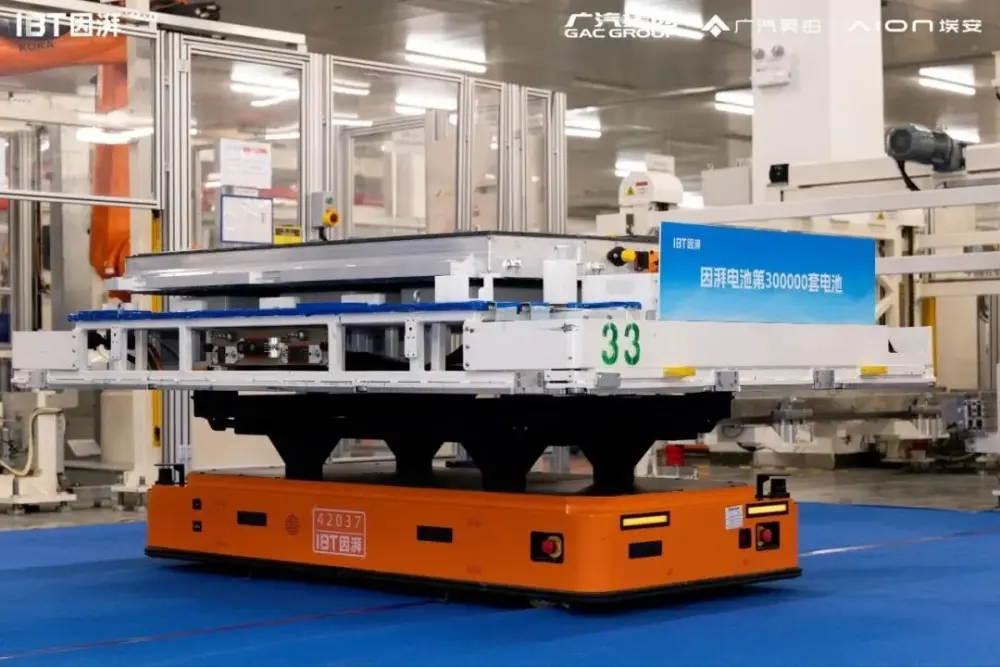
When state-backed automotive conglomerate Guangzhou Automobile Group (GAC) announced the rollout of its 300,000th proprietary battery pack from its subsidiary Yinpai Battery Technology on October 15, Chinese state-aligned business media predictably framed the milestone as a decisive victory for original equipment manufacturer (OEM) self-reliance. For years, domestic automakers have chafed under the market dominance of Contemporary Amperex Technology Co. Limited (CATL), whose commanding market share previously earned it the industry moniker of the 'feudal lord' extracting downstream margins. The achievement of 300,000 completed traction packs ostensibly proves that a legacy state-owned enterprise can master electrochemical cell manufacturing, bypass third-party merchant suppliers, and lock in vertical integration.
Yet, behind the ceremonial red ribbons at the Guangzhou industrial campus lies an uncomfortable economic reality. The rush toward in-house EV battery manufacturing is unfolding against a brutal domestic backdrop characterized by catastrophic overcapacity across China's cell-making sector, terminal price wars in the A-to-B segment electric vehicle market, and collapsing utilization rates at regional battery gigafactories. As GAC pushes its proprietary cells into its volume-focused Aion sub-brand and aspiring premium Hyper lineup, institutional investors must scrutinize whether building dedicated gigafactories delivers tangible operating margin expansion or merely saddles the parent group with unhedged upstream commodity risk, severe capital depreciation, and structural export handicaps.
The Engineering Blueprint: Decoding GAC's Magazine Battery Architecture
To evaluate GAC's operational breakthrough, one must examine what Yinpai Battery is actually building on its automated cell lines. Established with an initial planned capital outlay exceeding 10.9 billion RMB ($1.53 billion USD) and a projected nameplate capacity of 36 gigawatt-hours (GWh), Yinpai serves as the industrialization engine for GAC's proprietary electrochemical intellectual property. Foremost among these proprietary technologies is the 'Magazine Battery' (Danxia Battery) system, now in its second generation, alongside ongoing pilot-line testing for semi-solid-state and all-solid-state cell chemistries targeted for commercial deployment late in the decade.
GAC engineers designed the Magazine Battery architecture primarily around risk mitigation for mass-market lithium iron phosphate (LFP) and nickel-cobalt-manganese (NCM) chemistries. At the cell level, Yinpai implements proprietary ultra-high-stability cathode coatings and a composite microcrystalline electrolyte designed to suppress thermal runaway under extreme mechanical puncturing. In destructive testing showcased by GAC, a multi-cell module subjected to continuous nail penetration showed zero open flame or thermal propagation—a defensive benchmark that GAC positions against BYD's Blade Battery and CATL's Qilin pack architecture. The cell-to-pack (CTP) volumetric efficiency of the latest Yinpai modules reaches approximately 65%, with gravimetric energy density at the pack level reaching between 150 Wh/kg and 165 Wh/kg for LFP configurations, and up to 210 Wh/kg for premium NCM-based derivatives.
| Metric / Specification | GAC Yinpai (Magazine 2.0 LFP) | BYD (Blade Battery LFP) | CATL (Shenxing LFP 4C) | LG Energy Solution (Pouch NCM 622) |
|---|---|---|---|---|
| Cell Chemistry | LFP / Advanced Composite | LFP (Prismatic Long-Cell) | LFP (Fast-Charging Optimized) | High-Nickel NCM Pouch |
| Cell Energy Density (Wh/kg) | 185 - 195 | 180 - 190 | 200 - 205 | 260 - 275 |
| Pack Volumetric Efficiency (%) | ~65% | ~62% - 66% | ~72% (CTP 3.0) | ~55% - 60% (Modular) |
| Peak Fast-Charging Rate | 2.5C - 3C (Standard) | 2C - 3C | 4C - 5C Peak | 2C - 2.5C |
| Thermal Runaway Safety Threshold | Zero Propagation (Nail Test) | Zero Propagation (Nail Test) | Active Aerogel Isolation | Passive Phase-Change Cooling |
| Estimated Pack-Level Cost ($/kWh) | $74 - $79 (Internal BOM) | $68 - $72 (Full Integration) | $76 - $82 (Merchant Contract) | $98 - $110 (Western Market) |
| Commercial Status | In-House Volume (300k units) | Mass Production (>3M units/yr) | Global Merchant Supply | Global Merchant Supply |
While these technical parameters place Yinpai comfortably on par with Tier-1 Chinese suppliers for baseline domestic duty cycles, they reveal no transformative electrochemical leap. Yinpai's volume relies overwhelmingly on LFP chemistries engineered for urban fleet and ride-hailing applications—the core demographic of the Aion S and Aion Y models. The thermal barrier technology, utilizing aerogel insulating tiles and rapid directional depressurization venting, is functionally identical in physical engineering principles to systems deployed by CATL and CALB. GAC's technical accomplishment is not the reinvention of electrochemistry, but the industrial mastery of high-yield cell production at scale.
The Capital Expenditure Trap: Supply Chain Economics and Merchant Severance
The strategic justification for pouring billions of yuan into in-house EV battery manufacturing has always rested on margin liberation. During the peak lithium carbonate pricing surge of 2022—when raw battery-grade lithium exceeded 550,000 RMB ($76,000 USD) per metric ton—GAC Chairman Zeng Qinghong famously quipped at an industry forum that automakers were merely 'working for CATL,' as battery costs ballooned to 50% or 60% of a vehicle's total bill of materials (BOM). Setting up Yinpai was GAC's declaration of economic independence.
However, the macroeconomic ground has fundamentally shifted underneath GAC's gigafactory investments. Battery-grade lithium carbonate has cratered below 75,000 RMB per metric ton, dragging merchant battery pack prices down with it. As CATL, CALB, and SVOLT engage in predatory bidding to clear domestic inventories, high-volume merchant cell costs have plunged toward $55 to $65 per kilowatt-hour (kWh) at the cell level. In an environment of chronic market surplus, third-party cell manufacturers with massive economies of scale—operating hundreds of gigawatt-hours of capacity across multi-client footprints—can consistently outbid the internal manufacturing arms of single-OEM operations.
Yinpai Battery faces an acute amortization challenge. Building, outfitting, and qualifying an advanced cell manufacturing facility demands specialized cleanrooms, high-precision roll-pressing machinery from suppliers like Lyric Robot and Wuxi Lead Intelligent, and expensive testing validation infrastructure. Industry estimates suggest that the capital expenditure required to establish an automated, tier-1 battery cell line sits between $25 million and $35 million per GWh. To justify that CapEx, a gigafactory must maintain steady equipment utilization above 70% to 75%. If the captive automaker's vehicle delivery numbers stumble, the gigafactory's fixed depreciation costs become an anchor dragging down the consolidated gross margin of the parent group.
Domestic Market Realities: Who Gains and Who Bleeds in GAC's Pivot?
The internal deployment of 300,000 battery packs has clear winners and losers across the regional automotive supply landscape. Within GAC's corporate hierarchy, the primary winner is the engineering and supply chain division, which has successfully decoupled its flagship sub-brands—GAC Aion and GAC Hyper—from sole-source supply contracts. This gives GAC procurement executives immense leverage when negotiating secondary supply agreements with CATL, CALB, and Sunwoda. By retaining the internal capability to produce 36 GWh of captive capacity, GAC establishes an internal pricing benchmark that merchant suppliers must undercut if they wish to supply future vehicle platforms.
Yet, the captive nature of Yinpai Battery is precisely where its competitive vulnerability sharpens. Unlike standalone merchant battery manufacturers that distribute demand across dozens of domestic and international automotive brands, Yinpai is almost entirely dependent on the domestic sales velocity of GAC's proprietary electric vehicles. When retail deliveries of the Aion sub-brand decelerated throughout late 2023 and early 2024 amid aggressive discounting from BYD's Qin and Han Honor Editions, Yinpai could not easily redirect surplus cell manufacturing lines to third-party clients. Automakers like Geely, Chery, or Changan have little incentive to purchase traction batteries from a direct competitor's proprietary subsidiary when merchant tier-1 suppliers offer neutral commercial terms, superior global indemnification, and lower unit costs.
Consequently, the loser in this dynamic is GAC's return on invested capital (ROIC). While BYD can amortize its proprietary Blade battery investments across millions of passenger vehicles, plug-in hybrids, commercial buses, and stationary energy storage systems (BESS), GAC's electric vehicle volume remains highly clustered in lower-margin segments and saturated domestic metropolitan centers. Forcing captive battery adoption onto models that are already undergoing retail discounting of 15% to 25% compresses operational cash flow across both the assembly line and the gigafactory floor.
The Reality Check: Factory Nameplate Capacity vs. Utilization Realities
A rigorous examination of the headline data is mandatory. Corporate press statements celebrating the '300,000th battery pack' create the optical impression of a manufacturing juggernaut operating at maximum throughput. However, applying basic industrial arithmetic reveals a much more nuanced narrative regarding capacity utilization and asset efficiency.
Three hundred thousand battery packs, deployed across a mix of compact Aion sedans (carrying packs averaging 50 to 65 kWh) and mid-to-large SUVs (carrying 70 to 80 kWh packs), represents a cumulative production volume of approximately 17 to 20 GWh spread across the entire multi-year operational ramp of Yinpai Battery since its commissioning. Against GAC's ultimate planned nameplate capacity of 36 GWh per annum, the real-world operational run-rate suggests that Yinpai's equipment utilization remains well below optimal operational capacity. In China's hyper-competitive battery sector, running a gigafactory at 40% to 50% capacity utilization imposes devastating per-unit depreciation penalties.
Furthermore, claims surrounding proprietary battery technology must be separated into marketing hyperbole versus proven electrochemistry. GAC frequently touts breakthroughs in graphene-enabled ultra-fast charging and deep-freeze solid-state resilience. However, the 300,000 packs that rolled off the factory floor are overwhelmingly conventional, iron-phosphate-based prismatic and pouch formats. While these chemistries are dependable and cost-effective for fleet operations in Guangdong's subtropical climate, they encounter the same fundamental electrochemical ceilings that constrain all LFP technologies:
- Severe capacity degradation and impedance spikes in sub-zero ambient temperatures (-10°C to -20°C), requiring energy-intensive auxiliary thermal management cycling.
- A flat discharge voltage curve that complicates real-time state-of-charge (SoC) estimation, creating range-prediction errors for drivers under erratic high-speed highway loads.
- Slower cold-temperature DC fast-charging rates compared to nickel-based or advanced silicon-anode chemistries, irrespective of marketing nomenclature surrounding 'extreme speed' recharging.
The gap between laboratory press announcements regarding solid-state prototypes and the commercial reality of industrial gigafactory mass production remains broad. Assembling 300,000 conventional packs confirms that GAC has cleared baseline manufacturing engineering hurdles; it does not substantiate claims of having leapfrogged global battery leaders in next-generation material science.
Geopolitical Firewalls: The Western Export Exclusion Barrier
Even if GAC optimizes Yinpai's domestic cost structure, the strategic utility of captive cell manufacturing hits an insurmountable wall at the borders of the developed automotive world. For Western OEMs and cross-border supply chain analysts, GAC's vertical integration highlights the growing divergence between domestic Chinese compliance and Western regulatory mandates.
Under the United States Inflation Reduction Act (IRA), electric vehicles equipped with battery components manufactured by, or containing critical minerals extracted or processed by, a 'Foreign Entity of Concern' (FEOC) are disqualified from federal clean vehicle tax credits under Section 30D. As a state-owned automotive enterprise directly owned by the Guangzhou municipal government and the Guangdong provincial state assets supervision commission, GAC and its wholly-owned subsidiaries fall unequivocally under the strictest definitions of FEOC exclusion. Any vehicle platform carrying a Yinpai cell is effectively dead on arrival in the US passenger market, irrespective of trade tariffs.
Simultaneously, the European Commission's finalized countervailing duties on Chinese battery electric vehicles (BEVs) impose an additional layer of economic friction. The EU's anti-subsidy determination explicitly singled out state-directed industrial financing, localized supply subsidies, and preferential upstream energy inputs within Chinese battery manufacturing ecosystems. GAC's state-backed status means that vehicles exported to the European Union integrating captive Yinpai cells are subject to stringent countervailing duty brackets, eradicating the retail price advantage that Chinese state-owned enterprises traditionally rely upon to offset lack of brand recognition overseas.
In stark contrast to independent global automakers like Hyundai Motor Group—which developed decoupled, highly compliant global architectures (such as the 800V E-GMP platform) capable of utilizing localized battery supply chains in Europe, North America, and India—GAC's in-house cell capacity is structurally tethered to the Chinese mainland and tariff-tolerant emerging markets in Southeast Asia, Central Asia, and Latin America. Rather than acting as a passport to international scale, proprietary Chinese battery production deepens regulatory vulnerability in high-margin developed economies.
Strategic Scenarios and Capital Allocation Outlook
As GAC moves beyond the 300,000-pack threshold, management faces critical capital allocation choices that will determine whether Yinpai Battery becomes an operational asset or a multi-billion-yuan balance sheet drain. Automotive executives, equity analysts, and supply chain directors should benchmark GAC's trajectory against three distinct multi-year operational scenarios:
Bull Case: Captive Absorption and Emerging Market Export Scale
In this scenario, GAC successfully stabilizes Aion domestic sales while aggressively scaling its completely knocked down (CKD) assembly operations in Southeast Asian markets such as Thailand and Indonesia. Captive Yinpai battery production reaches 80% utilization across its Phase 1 lines, unlocking true economies of scale that yield pack-level costs below $70/kWh. GAC secures outside third-party supply contracts with non-competing Chinese niche commercial vehicle and energy storage system (BESS) integrators, amortizing capital expenditures effectively and generating positive operating free cash flow by late 2026.
Base Case: Margin Neutrality Amid Persistent Price Wars
Captive battery production continues to service the majority of Aion and Hyper domestic platforms, but domestic price deflation offsets internal procurement savings. Capacity utilization hovers between 55% and 65%, keeping unit production costs roughly identical to spot-market merchant prices from Tier-1 suppliers like CATL and CALB. GAC achieves its strategic objective of supply security and pricing leverage during merchant contract negotiations, but Yinpai operates at razor-thin accounting margins, delivering zero meaningful return on invested equity while remaining completely shut out of North American and European supply chains.
Bear Case: The Stranded Asset Liability
Domestic passenger vehicle deliveries for GAC's pure EV sub-brands contract under relentless competitive pressure from BYD, Geely, and emerging tech-driven OEMs like Xiaomi. Yinpai's utilization rates crater below 45%, triggering severe asset impairment charges and inventory write-downs on uncommitted cell production. Meanwhile, rapid shifts toward solid-state and sodium-ion advancements render Yinpai's first-generation LFP machinery technologically obsolete before capital investments can be fully depreciated, turning the gigafactory into a structural financial liability for GAC Group.
Executive Takeaways and Investor Implications
For institutional investors and strategic planners navigating the global automotive transition, GAC's milestone provides critical lessons regarding the true economics of in-house battery manufacturing:
- Scale Does Not Equal Operating Margin: Manufacturing 300,000 battery packs demonstrates engineering proficiency, but without steady 75%+ gigafactory capacity utilization, internal cell production increases fixed-cost overhead without delivering superior unit economics over merchant procurement.
- The Merchant Supplier Paradox: In an era of collapsing upstream lithium prices and intense merchant supplier competition, the historical imperative for OEMs to own cell factories has weakened; third-party suppliers often absorb pricing volatility more effectively than single-OEM captive plants.
- Geopolitical Non-Transferability: State-owned in-house battery manufacturing structures run directly into Western regulatory barriers (US FEOC, EU anti-subsidy duties), limiting the global addressable market for captive-equipped vehicles to emerging, low-margin territories.
- Decoupled OEMs Maintain Superior Flexibility: Global automakers that maintain open, diversified multi-supplier architectures remain far better positioned to adapt to localized regulatory standards and technological chemistry shifts than legacy OEMs trapped in capital-intensive, single-region gigafactory commitments.