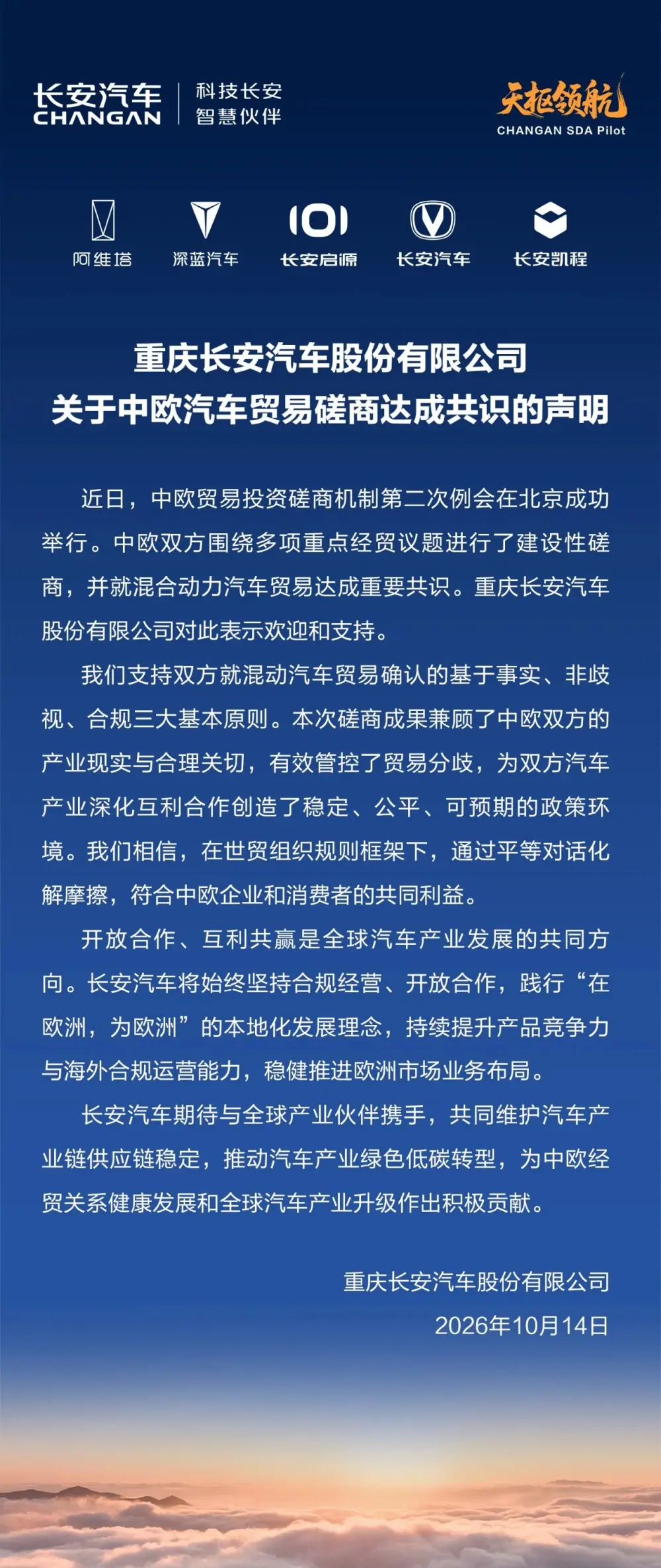
On October 14, 2025, after months of escalating trade tensions, the European Commission and China's Ministry of Commerce announced a consensus framework to replace punitive countervailing duties on Chinese-built electric vehicles with a negotiated minimum price undertaking. The immediate market reaction was relief — but sophisticated observers should recognize this is not a de-escalation. It is a managed trade architecture that preserves European market access for Chinese OEMs at a cost: pricing discipline that eliminates the aggressive undercutting that defined the 2023–2025 import surge.
The deal's structural mechanics matter more than its headline. Brussels has effectively converted a tariff wall into a price floor, and Beijing has accepted it to avoid losing European market share entirely. For Western investors and supply chain strategists, the critical question is not whether Chinese EVs will continue entering Europe — they will — but at what price, with what margins, and under what regulatory constraints.
From Punitive Tariffs to Price Floors: How We Got Here
The EU's October 2024 imposition of countervailing duties — ranging from 7.8% for Tesla Shanghai to 35.3% for SAIC, on top of the standard 10% auto import tariff — was intended to level a playing field that European OEMs argued was distorted by state subsidies, cheap land, and below-market battery input costs. Chinese brands responded by absorbing some costs, passing others to consumers, and accelerating local production plans in Hungary, Spain, and Turkey.
By mid-2025, it became clear the tariffs were not stopping Chinese EV imports. They were merely raising prices while European consumers bore the cost. Meanwhile, Beijing's retaliatory probe into European brandy and pork threatened escalation. The consensus framework announced in October 2025 avoids that spiral but imposes a different discipline: Chinese OEMs must now price above a negotiated floor — reportedly benchmarked to comparable European models — which structurally caps their historical cost advantage.
Inside the Engineering and Cost Trade-Offs Driving the Undertaking
The minimum price mechanism is not merely a political tool. It interacts directly with the bill-of-materials economics of Chinese EV platforms. Chinese OEMs have built their European cost advantage on three pillars: LFP battery packs at $60–$75/kWh ex-cell (versus $90–$110 for NCM in Europe), vertically integrated motor and inverter production, and labor costs 40–60% below German levels.
Under a price floor, these advantages cannot be fully passed to consumers. The OEM must either absorb the margin compression or de-content the vehicle. Neither is attractive. BYD's Atto 3, which entered Europe at €38,000 in 2023, now faces a floor that could push transaction prices above €42,000 — territory where it competes directly with the Volkswagen ID.4 and Skoda Enyaq, both of which benefit from EU content and brand equity.
| Model | Origin & EU Tariff | Battery Type / Capacity | Starting Price (€) | Key Margin Pressure |
|---|---|---|---|---|
| BYD Atto 3 | China; previously 17.4% CVD | LFP / 60.5 kWh | 38,000 (pre-floor) | Price floor lifts to ~42,000; loses undercut advantage |
| MG4 Electric (SAIC) | China; previously 35.3% CVD | LFP / 51 kWh | 32,000 (pre-floor) | Largest tariff exposure; price floor may exceed €36,000 |
| Volkswagen ID.4 | Germany; 0% tariff | NCM / 77 kWh | 42,000 | Benefits from floor; brand and service network premium |
| Tesla Model 3 RWD | Shanghai; 7.8% CVD | LFP / 60 kWh | 40,000 | Lowest CVD; floor less disruptive, but margin still pressured |
| Photon E5 (Changan) | China; ~20% CVD | LFP / 58 kWh | 35,000 (pre-floor) | Undercut strategy eliminated; brand awareness remains weak |
Note: Tariff rates reflect 2024–2025 CVD schedule. Price floor levels are indicative based on industry reporting; final undertaking terms have not been fully published.
Supply Chain Anatomy: Who Captures the Margin Under a Price Floor
Under a minimum price framework, margin distribution across the value chain shifts. Battery cell suppliers — CATL, BYD's FinDreams, EVE Energy — have historically compressed cell prices to enable OEM undercutting. With a floor in place, OEMs may push back on cell pricing, arguing that the tariff relief should be shared. CATL's European LFP cell contracts, already priced at a premium to domestic Chinese supply, may face renegotiation.
Tier-1 suppliers with European content — Bosch, ZF, Continental — benefit indirectly when Chinese OEMs localize assembly to qualify for favorable treatment. Changan, Leapmotor, Dongfeng, and GAC have all signaled European production plans, with Leapmotor's Stellantis partnership in Spain representing the most advanced. Under the undertaking, local assembly reduces tariff exposure but does not eliminate the price floor if the vehicle's origin remains Chinese.
- CATL (Battery): Supplies LFP cells to multiple Chinese OEMs exporting to Europe. Margin retention depends on its ability to pass floor-induced price cuts upstream to lithium and cathode material suppliers.
- FinDreams (BYD): Captive supplier; benefits from vertical integration but absorbs consolidated margin pressure at the group level.
- Stellantis (Local Assembly Partner): Leapmotor's T03 and C10 assembly in Spain provides EU content, potentially qualifying for reduced tariff treatment. This partnership could evolve into a template for GAC and Dongfeng.
- Bosch / ZF (Tier-1 ADAS & Powertrain): Benefit from Chinese OEM localization but face pricing pressure as OEMs seek cost offsets for floor-induced margin compression.
BOM estimates for a compact Chinese EV crossover in Europe: LFP pack (55–65 kWh) at $70/kWh = $3,850–$4,550; e-motor and inverter (SiC MOSFET) = $1,200–$1,600; ADAS sensor suite (L2+) = $800–$1,200; body and interior = $6,000–$8,000; assembly and logistics = $2,500–$3,500. Total ex-works BOM: $14,350–$18,850. At a €40,000 retail price, the margin structure leaves little room for floor-induced compression without de-contenting.
Competitive Fallout: Who Wins and Who Bleeds in the Undertaking Era
The minimum price undertaking disproportionately benefits European mass-market OEMs. Volkswagen, Stellantis, and Renault no longer face the threat of Chinese EVs priced €8,000–€12,000 below comparable models. The floor restores a degree of pricing rationality to the compact and crossover segments.
But this is not a zero-sum victory. Chinese OEMs with strong brand equity and technology differentiation — particularly NIO and Zeekr — may actually thrive under a price floor, since their vehicles were never priced to undercut. BYD, whose European strategy relied on aggressive pricing, faces the sharpest adjustment. SAIC's MG brand, with its largest tariff exposure, confronts a potential existential challenge in Europe if the floor pushes the MG4 above €36,000.
Western OEMs with significant Chinese production exposure — Tesla (Shanghai), BMW (iX3 from China), and Volvo (EX30 from China) — navigate a more complex calculus. Tesla's 7.8% CVD is the lowest; a price floor could actually stabilize its European Model 3 margins by reducing Chinese competitor undercutting.
Decoupled players such as Hyundai-Kia, which have minimal Chinese retail exposure and produce EVs for Europe in Korea and the Czech Republic, are largely insulated. Their E-GMP platform (800V, 350 kW charging) competes on technology rather than price, and the floor removes the threat of a low-cost Chinese alternative below their price point.
Reality Check: The Price Floor Is Not a Free Lunch for Anyone
The consensus announcement has been framed by both Brussels and Beijing as a de-escalation. It is more accurately a managed trade arrangement that postpones structural conflict. The engineering and economic realities suggest three critical caveats.
First, enforcement remains ambiguous. A minimum price undertaking requires monitoring of transaction prices across thousands of dealerships and online sales channels. Chinese OEMs could comply on paper while offering discounts through trade-in bonuses, financing subsidies, or software feature bundling. The European Commission's ability to police these mechanisms is unproven. If enforcement is weak, the floor becomes a fig leaf, and the underlying price war continues beneath the surface.
Second, the floor may accelerate local production, not reduce imports. To escape both tariffs and the price floor, Chinese OEMs have strong incentives to localize assembly. Leapmotor's Stellantis partnership in Spain is the template. If Changan, Dongfeng, and GAC follow, Europe could see a wave of Chinese-branded, European-assembled EVs that qualify as EU-origin yet retain Chinese technology, battery supply chains, and BOM advantages. This may be Brussels's intended outcome — replace imports with local production — but it also risks hollowing out European OEM market share in their home market.
Third, the floor does not address the underlying cost asymmetry. Chinese LFP battery costs remain structurally lower than European NCM. Labor costs are lower. Vertical integration is deeper. A price floor merely redistributes the benefit of these advantages from consumers to OEM margins — or to government coffers if the undertaking includes a payment mechanism. It does not eliminate the competitive threat; it delays it.
The historical analogy is Japan's Voluntary Export Restraints (VERs) of the 1980s. Those agreements temporarily slowed Japanese market share gains in the US but ultimately accelerated Japanese local production, which eventually displaced domestic OEMs. The EU minimum price undertaking risks a similar outcome: short-term relief for European OEMs, long-term acceleration of Chinese localization.
Regulatory and Geopolitical Fault Lines Beyond the Undertaking
The EU-China consensus does not resolve broader trade tensions. The United States maintains a 100% tariff on Chinese EVs under Section 301, and the Inflation Reduction Act's FEOC rules effectively exclude Chinese battery components from consumer tax credits. Chinese OEMs cannot access the US market at scale regardless of the EU deal.
Within Europe, the undertaking must be reconciled with the EU's evolving Battery Regulation, which imposes carbon footprint disclosure, recycling content requirements, and supply chain due diligence. Chinese LFP supply chains, heavily concentrated in China and reliant on coal-heavy grid electricity, face compliance costs that could add $10–$20/kWh to battery packs destined for Europe.
China's response to the undertaking also matters. Beijing has approved the framework, but domestic political pressure to support exporters remains intense. If Chinese OEMs perceive the floor as a ceiling on their European ambitions, they may redirect export volumes to Southeast Asia, the Middle East, and Latin America — markets where no such floor exists. This could accelerate a bifurcated global EV market: a managed-trade Europe, a protected North America, and a free-for-all Global South.
Strategic Outlook: Three Scenarios for the Undertaking Era
Bull Case
The price floor is cleanly enforced, Chinese OEMs localize assembly rapidly, and European consumers gain access to competitive EVs at sustainable prices. European OEMs use the breathing room to accelerate their own LFP and solid-state programs. BYD, Changan, and Leapmotor establish European production hubs, creating jobs and supply chain investment. The undertaking becomes a model for managed trade in other sectors.
Base Case
Enforcement is patchy. Chinese OEMs comply with the letter of the undertaking while finding creative ways to offer value. European OEMs regain some pricing power but continue losing share in the compact EV segment. Localization proceeds slowly due to regulatory complexity and capital constraints. The competitive dynamic shifts from price to technology and brand, favoring NIO, Zeekr, and Tesla over mass-market Chinese brands.
Bear Case
The undertaking collapses under enforcement disputes. Chinese OEMs redirect exports to non-EU markets, leaving European consumers with fewer affordable EV options. European OEMs fail to close the cost gap, and the continent's EV transition slows. Beijing retaliates against European luxury and agricultural exports, triggering a broader trade conflict. The minimum price framework becomes a footnote in a larger decoupling narrative.
- For investors: The undertaking is a margin event, not a volume event. BYD and SAIC face the sharpest margin compression; Tesla and NIO are relatively insulated. European OEMs get a temporary reprieve but no structural solution.
- For supply chain strategists: Localization is the only durable response to both tariffs and price floors. Companies with EU assembly capacity or credible plans — Leapmotor-Stellantis, BYD's Hungary plant — are best positioned.
- For European OEM executives: The floor buys time, not salvation. Accelerating LFP battery production and cost reduction is the only path to long-term competitiveness against Chinese imports and Chinese-localized production.
- For Chinese OEMs: The European market remains accessible but no longer a profit pool for aggressive undercutting. Brand building, technology differentiation, and local partnerships become essential.
- For policymakers: The undertaking's success depends on enforcement credibility and whether it accelerates or delays the structural adjustment of Europe's auto industry. A weak enforcement regime risks repeating the VER precedent with the same long-term outcome.
The EU-China minimum price undertaking is a significant milestone in managed trade, but it resolves nothing fundamental. The cost gap between Chinese and European EV production persists. The technology gap in LFP and solid-state batteries remains. The competitive pressure on European OEMs continues. What has changed is the mechanism: from tariff walls to price floors, from confrontation to negotiation. For investors and strategists, the prudent posture is to assume the undertaking buys a two-to-three-year window of relative stability, during which the structural battle for the European EV market will be fought primarily on technology, brand, and local supply chain depth.