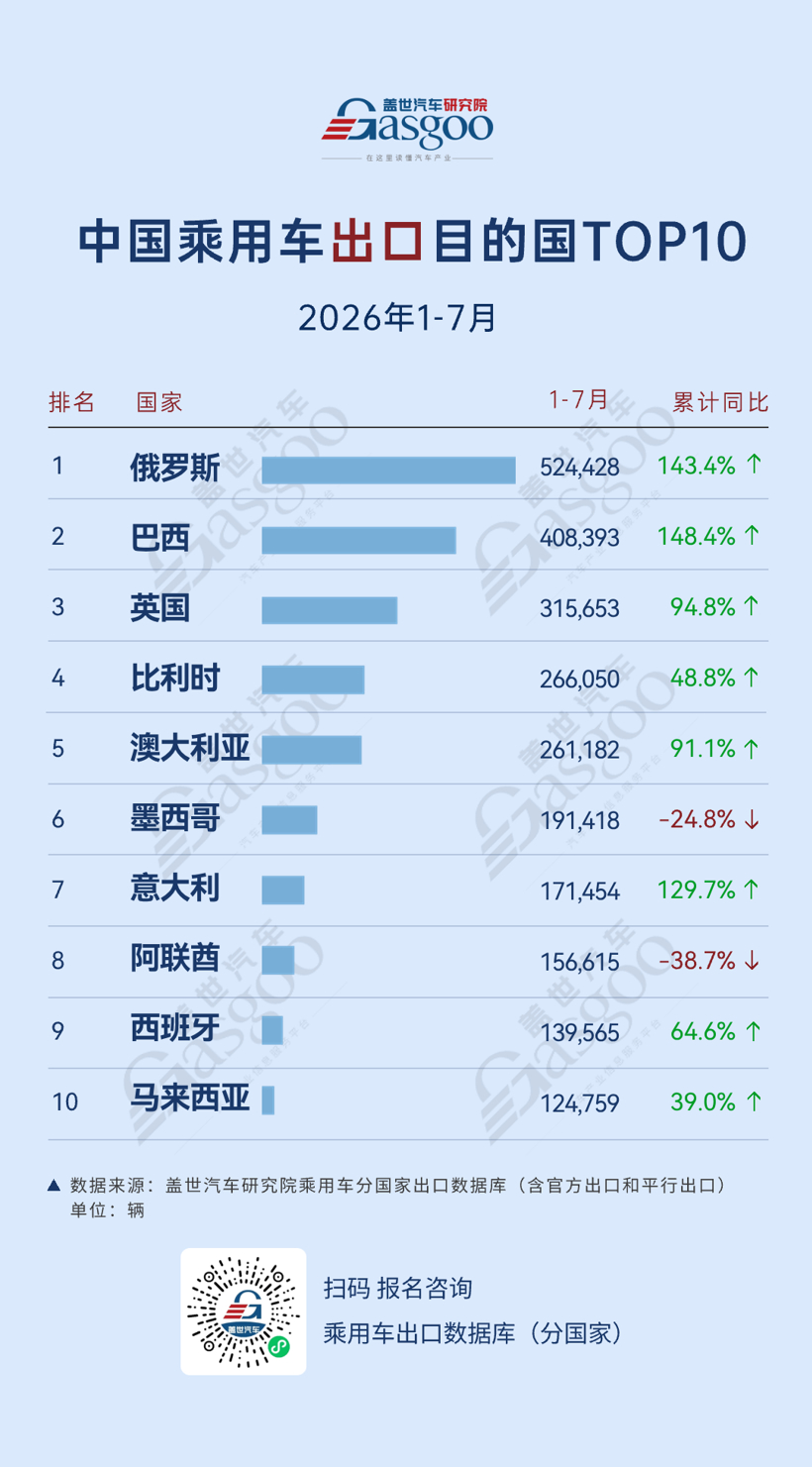
As the global automotive landscape undergoes a profound structural shift, analyzing Chinese car export trends 2026 offers crucial insights for investors and legacy automakers. According to the latest comprehensive data from the Gasgoo Research Institute covering January to July 2026, Chinese passenger vehicle exports have maintained a resilient growth trajectory. Despite tightening regulatory conditions in the US and the European Union, Chinese original equipment manufacturers (OEMs) have successfully optimized their global layouts, demonstrating remarkable trade adaptability by pivoting to high-growth, high-reception corridors.
Divergent Paths: Russia's Volume Dominance vs. Brazil's NEV Leadership
The Jan-Jul 2026 export data highlights a highly targeted, bifurcated strategy among Chinese exporters. On one side, traditional internal combustion engine (ICE) and hybrid vehicles continue to dominate specific high-volume corridors. On the other, advanced battery-electric and plug-in hybrid models are establishing strong, localized footprints in rapidly decarbonizing emerging markets.
1. Russia: A Maturing Market for Volume Stability
With exports breaking through the 520,000-unit mark in the first seven months of 2026, Russia continues to serve as a massive volume anchor for Chinese passenger vehicles. This segment is characterized by a strong mix of premium ICE SUVs and hybrid models. Chinese brands have successfully transitioned from entry-level market entrants to dominant, mainstream household names in the region, capturing market share left vacant by departing Western legacy brands.
2. Brazil: The Vanguard of South American Electrification
While Russia dominates in sheer volume, Brazil has secured its position as the undisputed leader for Chinese New Energy Vehicles (NEVs). This surge is not accidental; it is the result of a deliberate alignment with Brazil's localized green mobility policies and a robust consumer appetite for technologically advanced, cost-effective transport. Major Chinese players like BYD and Great Wall Motor (GWM) are transitioning from direct exporters to localized manufacturers, establishing assembly facilities in Camaçari and Iracemápolis to foster deep domestic supply chain integration.
Strategic Trade Adaptability and Localized Footprints
A key takeaway from the 2026 data is the relative insulation of Chinese export growth from highly publicized Western trade disputes. Rather than confronting direct headwind structures, Chinese OEMs are focusing on global diversification, cross-border technology partnerships, and regional manufacturing hubs.
| Export Destination | Key Volume Segment (Jan-Jul 2026) | Primary Strategic Driver |
|---|---|---|
| Russia | 520,000+ Units (ICE/HEV Dominant) | Market share capture and volume consolidation. |
| Brazil | Top NEV Destination (BEV/PHEV) | Alignment with green incentives & strategic localized manufacturing. |
| Southeast Asia (ASEAN) | Rapid NEV Assembly Growth (e.g., Thailand) | Regional trade agreements and supply chain proximity. |
The Analytical Verdict: What This Means for Western Competitors
For Western automakers and strategy directors, the 2026 export data serves as a critical signal. Chinese OEMs are not relying solely on mature Western economies to fuel their global expansion. By securing strong positioning in the Global South, Latin America, and Eastern Europe, they are building resilient, diversified revenue streams. These regional bases provide the necessary scale and capital to fund ongoing technological innovations in software-defined vehicles, ADAS platforms, and next-generation battery chemistries—strengthening their global competitive posture for decades to come.