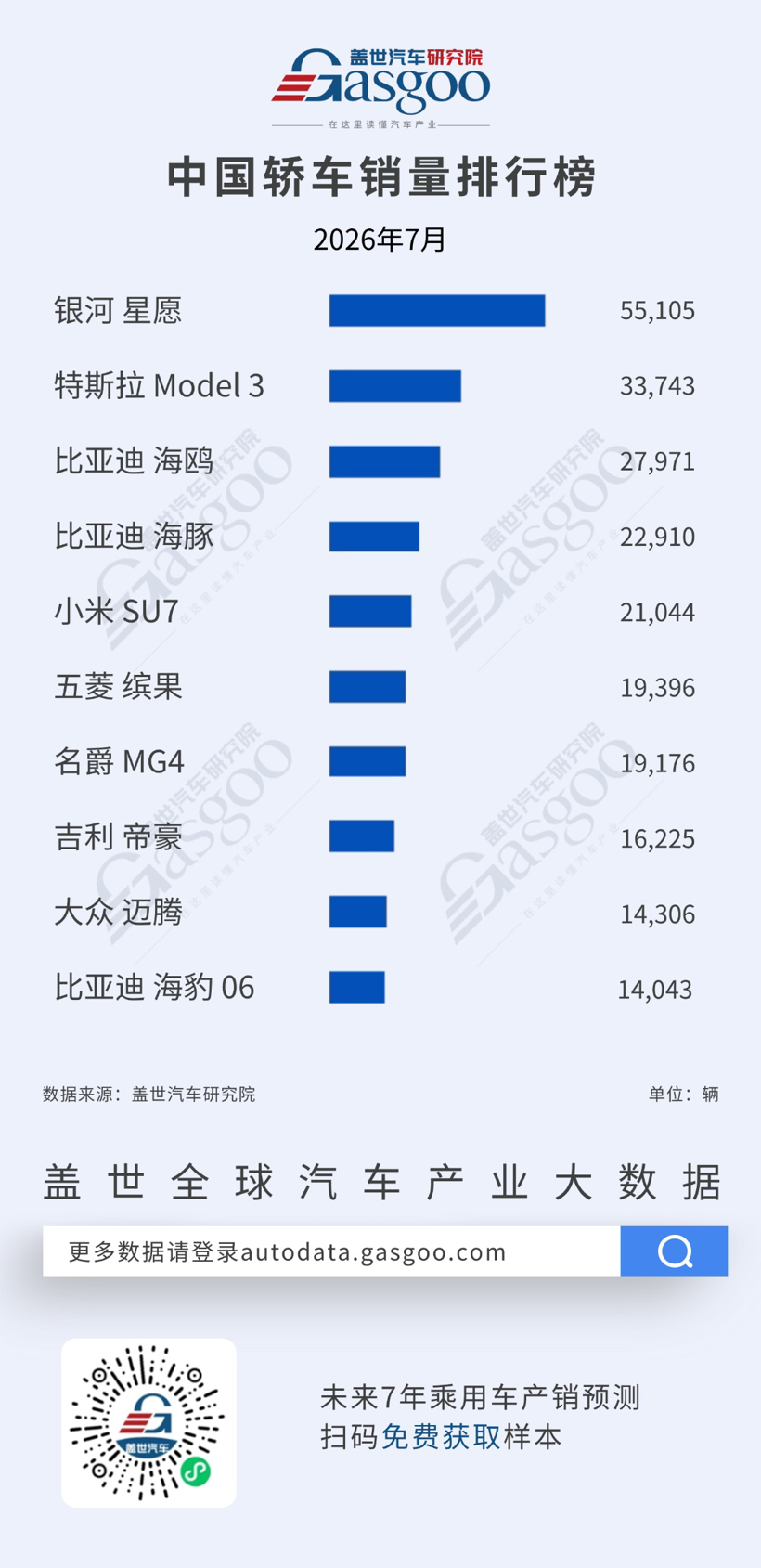
As global trade dynamics shift, the latest July 2026 sales data from China showcases a staggering reality: the sheer scale of Chinese EV market volume dominance is providing domestic OEMs with unparalleled financial leverage. Leaders like BYD and Geely are capturing massive market share in both the sedan and SUV segments, generating the robust cash flows and economies of scale needed to fund their highly strategic, long-term global expansion.
Segment Analysis: The Models Driving the Volume
According to the latest data from the Gasgoo Auto Research Institute, July 2026 marked another month of intense market differentiation in the Chinese passenger vehicle sector. New Energy Vehicles (NEVs) have firmly cemented their position as the dominant force across both sedan and SUV categories.
Two models have particularly stood out as volume leaders:
- Geely Galaxy Star Wish & E5: Geely's strategic pivot toward its Galaxy series has paid off handsomely, capturing massive consumer interest with competitive pricing and advanced software integration.
- BYD Yuan UP: Positioning itself as an affordable, high-utility subcompact SUV, the Yuan UP continues to drive astronomical volumes, serving as a primary entry point for younger demographics entering the EV ecosystem.
| Segment | Leading Model | Parent Brand | Core Competitive Advantage |
|---|---|---|---|
| A0-Class Sedan / Hatchback | Geely Galaxy Star Wish | Geely Group | Advanced vehicle OS, aggressive price-to-spec ratio |
| A0-Class SUV | BYD Yuan UP | BYD Auto | Vertical integration, e-Platform 3.0 efficiency, high battery safety profile |
Strategic Localization: Funding Global Compliant Footprints
As a senior market analyst specializing in APAC automotive supply chains, I see these massive domestic sales numbers as more than just a local victory. They represent the financial war chest required to navigate increasingly complex global regulatory environments.
Establishing localized manufacturing operations—such as BYD's upcoming plants in Hungary, Brazil, and Turkey, and Geely's extensive global partnerships—requires immense capital expenditure. The high-margin domestic volume generated by cars like the Yuan UP and Galaxy E5 allows these automakers to absorb the high upfront costs of building localized regional footprints. This strategic localization ensures supply chain compliance and long-term trade adaptability in regions like the European Union and Latin America, contributing directly to local economies and ESG initiatives.
Market Implications for Western OEMs and Investors
Rather than viewing this shift as a threat, forward-thinking Western automakers and investors are increasingly identifying opportunities for cross-border collaboration and technology integration. By leveraging global supplier expertise and entering strategic sourcing alliances with scaled Chinese players, Western legacy OEMs can accelerate their own electrification and decarbonization timelines.
For investors seeking market alpha, tracking domestic sales rankings remains the single best leading indicator for predicting which Chinese EV players will possess the financial durability to successfully establish multi-billion dollar manufacturing operations abroad.