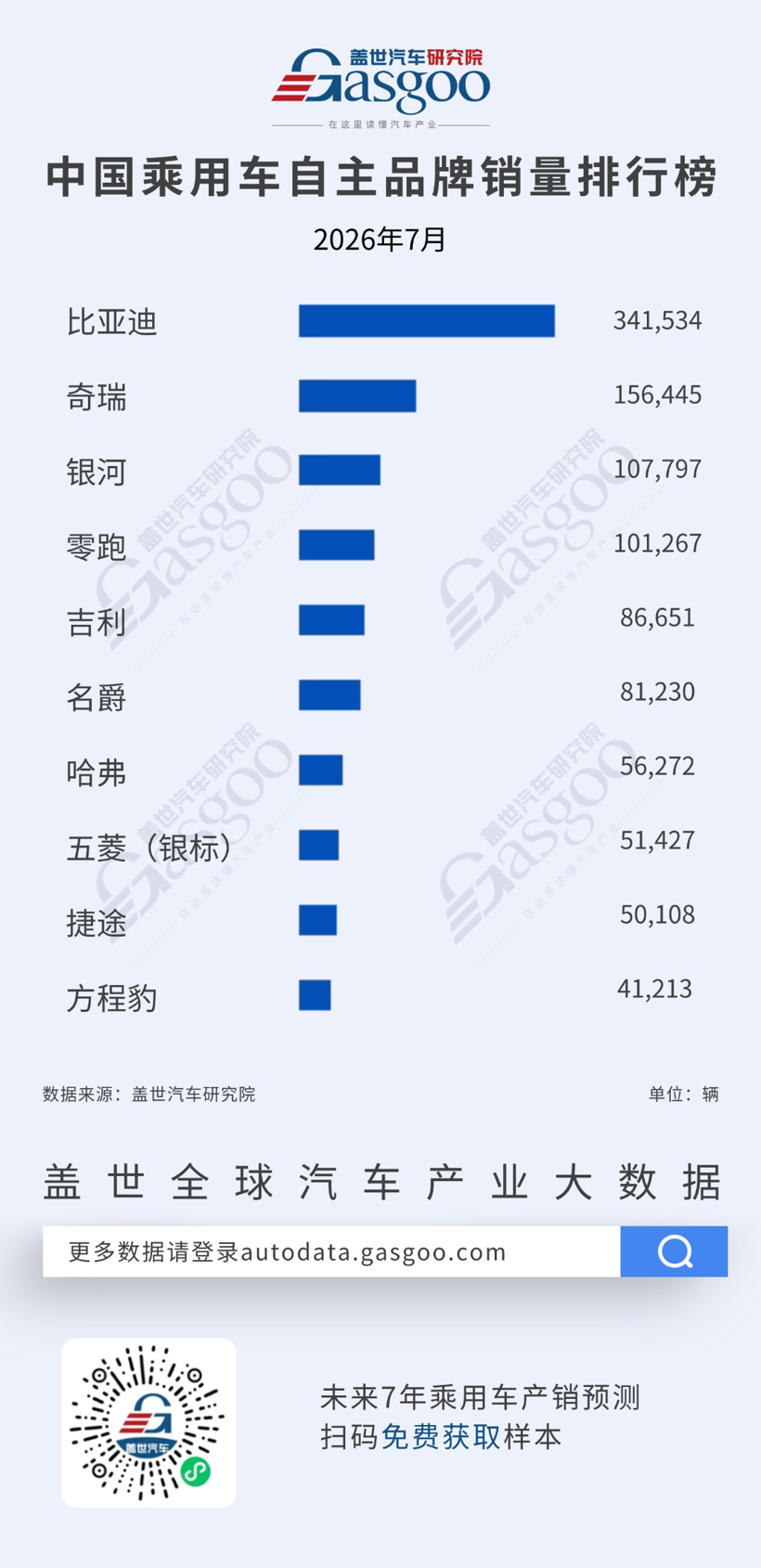
As the global automotive landscape rapidly shifts, keeping a pulse on the Chinese domestic EV market share offers critical foresight into international trends. In July 2026, China's domestic passenger vehicle market demonstrated robust resilience and growth, logging total sales of 1,749,773 units—a steady 9.56% year-over-year increase. While the overall market expanded, the real story lies in the widening structural chasm between the undisputed market leader, BYD, and an increasingly crowded second-tier competitive field.
The July 2026 Numbers: BYD's Domestic Dominance
According to the latest retail and registration data compiled by the Gasgoo Auto Research Institute, BYD has secured a historically dominant position in the domestic market. Unlike mature Western markets where market share is typically distributed evenly among three or four major OEMs, China's current NEV (New Energy Vehicle) sector exhibits a 'super-heavy' leader-follower dynamic.
While second-tier domestic giants—such as Geely, Chery, and Changan—continue to register solid volumes, their primary challenge is navigating intense pricing competition among themselves. This secondary cohort is actively investing in technical differentiation, particularly in hybrid powertrains and localized software integration, to retain market relevance.
Scale as a Global Geopolitical Lever
For Western investors and automotive executives, analyzing Chinese domestic EV market share is not merely an academic exercise in regional sales tracking. Domestic volume is the direct driver of international cost competitiveness. Here is how BYD’s domestic scale translates to global strategic advantages:
- Vertical Integration Economics: Massive domestic volume allows BYD and its battery division, FinDreams, to operate factories at near-maximum capacity utilization. This brings battery cell production costs down to levels that are highly challenging for lower-volume competitors to match.
- Subsidized R&D: High domestic cash flow funds rapid iteration cycles in advanced ADAS, smart cabin architectures, and structural battery packs, giving vehicles a tech-forward appeal in export markets.
- Strategic Localization Capabilities: Rather than relying solely on direct exports, Chinese OEMs are leveraging their strong domestic balance sheets to fund regional localization efforts. This includes setting up compliant manufacturing footprints in markets like Hungary, Brazil, and Southeast Asia.
Strategic Realities for Western OEMs
The intensifying competition within the Chinese domestic market emphasizes the need for global players to adopt highly adaptable strategies. Rather than viewing the market through a defensive lens, forward-thinking Western automakers are pursuing deep cross-border collaboration and strategic sourcing alliances. By integrating highly competitive Chinese battery technology and localized software ecosystems, global OEMs can enhance their own product offerings while maintaining strict compliance with local regulatory frameworks in Europe and North America.
The path forward is defined by supply chain adaptability. While BYD's domestic lead remains formidable, the global market will ultimately favor OEMs that can successfully bridge local market requirements with highly optimized regional supply chains.