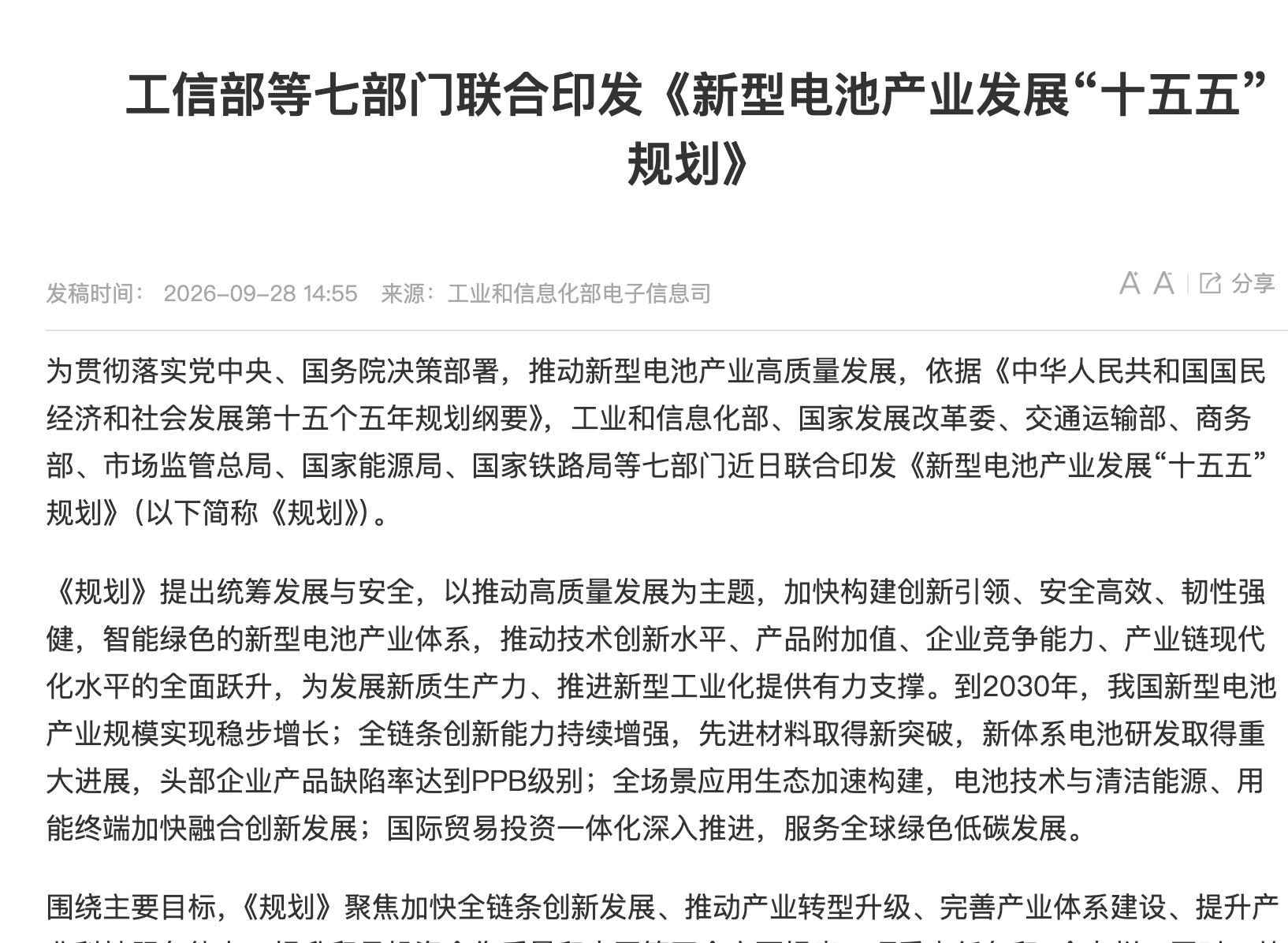
On May 6, 2026, China's Ministry of Industry and Information Technology (MIIT), alongside six other government ministries, jointly issued the 15th Five-Year Plan for the New-Type Battery Industry. The headline target: initial large-scale application of all-solid-state batteries by 2030. For Western investors and auto executives, this is not just another industrial policy document—it is a direct challenge to the global battery status quo, signaling that Beijing intends to own the next generation of energy storage technology just as it dominates the current lithium-ion era.
The plan arrives at a pivotal moment. China already controls over 70% of global lithium-ion battery production and an even higher share of cathode and anode material refining. Yet the current generation of lithium iron phosphate (LFP) and nickel-cobalt-manganese (NCM) batteries is approaching its theoretical energy density limits. Solid-state batteries promise higher energy density, faster charging, and improved safety—but they also represent a technological leap that could disrupt China's own incumbent supply chain. The seven-ministry plan is Beijing's attempt to ensure that disruption happens on Chinese soil, not in Japan, Korea, or the United States.
Inside the 15th Five-Year Plan: What Beijing Actually Committed To
The document, jointly issued by MIIT, the National Development and Reform Commission (NDRC), the Ministry of Science and Technology, the Ministry of Finance, the Ministry of Ecology and Environment, the National Energy Administration, and the Standardization Administration, outlines a multi-phase roadmap. According to the original Gasgoo report, the plan calls for:
- By 2027: Establish a preliminary solid-state battery supply chain, including key materials, equipment, and recycling infrastructure.
- By 2030: Achieve initial large-scale application of all-solid-state batteries, with targeted energy density of 500 Wh/kg at the cell level.
- By 2035: Full industrial-scale production and global market leadership.
The 500 Wh/kg target is notable. Current mass-produced NCM cells typically achieve 250–300 Wh/kg, while LFP cells hover around 160–200 Wh/kg. A jump to 500 Wh/kg would represent a 67–100% improvement in energy density, enabling electric vehicles with ranges exceeding 1,000 km (CLTC) without significantly increasing battery weight. But achieving this in a commercially viable, mass-produced solid-state cell is a different matter entirely.
The plan also emphasizes domestic supply chain self-sufficiency for critical materials, including lithium, nickel, cobalt, and rare earth elements. It calls for accelerated development of sulfide and oxide solid electrolytes, advanced lithium metal anodes, and dry electrode manufacturing processes. Notably, the document does not specify a single dominant chemistry pathway—suggesting Beijing is hedging its bets across multiple technical routes.
The Engineering Reality: Why 500 Wh/kg Solid-State Is Harder Than It Sounds
Solid-state batteries replace the liquid or gel electrolyte in conventional lithium-ion cells with a solid material—typically a sulfide, oxide, or polymer. The theoretical benefits are substantial: higher energy density (lithium metal anodes can store far more energy than graphite), faster charging (no flammable liquid to overheat), and improved safety (no thermal runaway from liquid electrolyte fires).
But the engineering challenges are equally substantial. Sulfide electrolytes are highly reactive with moisture, requiring dry-room manufacturing environments that add significant capital expenditure. Oxide electrolytes are more stable but have lower ionic conductivity, limiting fast-charging capability. Polymer electrolytes are easier to process but require elevated temperatures to function, making them impractical for automotive applications in cold climates.
Furthermore, the interface between the solid electrolyte and the lithium metal anode is prone to dendrite formation—tiny lithium spikes that can short-circuit the cell. Solving this requires advanced interfacial coatings, pressure management systems, and precision manufacturing tolerances that are difficult to scale. Toyota, which has been researching solid-state batteries since the 1990s, has repeatedly pushed back its commercialization timeline. QuantumScape, a US-based startup backed by Volkswagen, has faced similar delays.
From our analysis of patent filings and technical conference presentations, Chinese battery makers including CATL, BYD, and CALB are pursuing sulfide-based solid-state cells for automotive applications, while others like WeLion are focusing on hybrid semi-solid-state designs. CATL has publicly stated that its solid-state battery will enter small-batch production by 2027, with mass production targeted for 2030. The seven-ministry plan appears designed to align these private-sector timelines with state-backed infrastructure and funding.
Comparison: Solid-State Battery Targets vs. Current Production Cells
| Parameter | Current NCM (Mass Production) | Current LFP (Mass Production) | China 2030 Solid-State Target | Toyota Solid-State Target (2027-2028) |
|---|---|---|---|---|
| Cell Energy Density (Wh/kg) | 250–300 | 160–200 | 500 | 400–500 (claimed) |
| Charging Rate (C-rate) | 1–3C | 1–2C | Not specified | 10C (claimed) |
| Cycle Life (cycles to 80% capacity) | 1,500–2,500 | 3,000–5,000 | Not specified | Not disclosed |
| Estimated Pack Cost ($/kWh) | $110–$130 | $70–$90 | Not publicly disclosed | Not publicly disclosed |
| Commercial Status | Mature | Mature | Lab/pilot | Pilot (delayed) |
The comparison reveals a stark gap between current production reality and the 2030 target. Even Toyota, which holds more solid-state patents than any other automaker, has struggled to move beyond pilot production. The Chinese plan's 500 Wh/kg target is theoretically achievable in a laboratory setting—but scaling to millions of cells per year with acceptable yield and cost is an entirely different challenge.
Supply Chain & Cost Structure: Who Builds the Solid-State Future?
The seven-ministry plan explicitly names several key technology providers and research institutions, though it does not disclose specific funding amounts. Based on the original Gasgoo report and supplementary industry sources, the following entities are expected to play central roles:
- CATL: The world's largest battery maker has a dedicated solid-state research team and has announced plans for a 2027 pilot line. Its condensed matter battery technology, unveiled in 2023, is a semi-solid-state intermediate step.
- BYD: Primarily focused on LFP and sodium-ion chemistries, but has patent filings related to sulfide solid electrolytes. BYD's vertically integrated model could give it a cost advantage if it successfully transitions.
- CALB: Has partnered with several Chinese universities on solid-state electrolyte research and aims for 2025 pilot production of semi-solid cells.
- WeLion: A Beijing-based startup backed by NIO, focused on semi-solid-state batteries. Its 150 kWh pack for NIO's ET7 achieved a 1,044 km range in a 2023 demonstration, but at a cost estimated at over $200/kWh.
- Ganfeng Lithium: A key lithium supplier investing in solid-state electrolyte materials and recycling infrastructure.
Industry estimates suggest that a 500 Wh/kg solid-state cell, if produced at scale, could cost between $150 and $250 per kWh in the first generation—significantly higher than current LFP packs at $70–$90/kWh. The plan's emphasis on domestic supply chain development is partly aimed at driving these costs down through economies of scale and vertical integration.
However, the cost structure is complicated by the need for new manufacturing equipment. Solid-state cells require dry-room environments, advanced sintering furnaces for oxide electrolytes, and precision stacking equipment for lithium metal anodes. Much of this equipment is currently sourced from Japan and Germany, meaning China's solid-state ambitions could initially increase, not decrease, its dependence on foreign machinery imports.
From a bill-of-materials perspective, solid-state cells eliminate the need for separators and liquid electrolyte, potentially reducing material costs. But they introduce new costs for solid electrolyte materials, interfacial coatings, and pressure management systems. The net effect on cost is highly uncertain and will depend on manufacturing yield—a metric that Chinese battery makers have historically excelled at optimizing.
Competitive Impact: Who Gains, Who Loses in the Solid-State Race
The seven-ministry plan is not merely a domestic industrial policy—it is a competitive signal to the global battery industry. If China succeeds in commercializing solid-state batteries at scale by 2030, it could extend its dominance into the next technology generation, leaving Japanese and Korean competitors scrambling to catch up.
Chinese battery makers are the obvious beneficiaries. CATL, BYD, and CALB would gain access to state-backed R&D funding, preferential land and energy pricing, and coordinated supply chain development. The plan also calls for standardization of solid-state battery testing and safety protocols, which could accelerate adoption by reducing uncertainty for automakers.
Japanese and Korean battery makers—including Panasonic, LG Energy Solution, Samsung SDI, and SK On—face a strategic dilemma. They have invested heavily in solid-state research but have been slower to scale. If China sets the standard for solid-state battery performance and cost, these companies could find themselves relegated to niche markets.
Western OEMs are both potential customers and competitors. Volkswagen's partnership with QuantumScape, Ford's investment in Solid Power, and GM's collaboration with POSCO are all attempts to secure solid-state technology outside of China. But these programs are years behind Chinese efforts in terms of scale and government support. If Chinese solid-state batteries achieve cost parity with conventional lithium-ion, Western OEMs may face pressure to source from Chinese suppliers despite geopolitical tensions.
Tesla, which has focused on 4680 cells and LFP chemistry, has been notably quiet on solid-state. Elon Musk has repeatedly dismissed solid-state as overhyped, arguing that current lithium-ion technology is sufficient for mass-market EVs. If China's solid-state bet pays off, Tesla could find itself at a technological disadvantage in the premium segment.
The competitive landscape is further complicated by export controls. The US Inflation Reduction Act (IRA) and EU battery regulations increasingly restrict Chinese battery content in vehicles sold in Western markets. A Chinese solid-state battery, even if technically superior, could face steep tariffs or outright exclusion from these markets—limiting its commercial impact outside of China and allied countries.
The Reality Check: Why 2030 May Slip to 2035
The seven-ministry plan is an aspirational document, not a binding production schedule. History is littered with government technology roadmaps that failed to materialize on time. Japan's 2010 plan to have solid-state batteries in mass production by 2020 is a cautionary tale. Toyota, which was supposed to lead that effort, has yet to deliver a commercially available solid-state vehicle.
The fundamental physics and chemistry challenges remain unresolved at scale. Sulfide electrolytes degrade in humid air, requiring manufacturing environments that are expensive to build and maintain. Lithium metal anodes, while theoretically superior, suffer from dendrite formation that can cause short circuits and fires. Oxide electrolytes have low ionic conductivity, limiting fast-charging performance. Polymer electrolytes require operating temperatures of 60–80°C, which is impractical for passenger vehicles.
Furthermore, the cycle life of solid-state cells is unproven. A passenger vehicle battery must endure 1,000–2,000 full charge-discharge cycles over its lifetime. Most solid-state prototypes demonstrated in laboratories have achieved fewer than 500 cycles before significant degradation. If solid-state batteries cannot match the durability of current lithium-ion cells, they will not be commercially viable for automotive applications, regardless of energy density.
The plan's 500 Wh/kg target is also worth scrutinizing. This figure refers to cell-level energy density, not pack-level. When accounting for cooling systems, pressure management, and battery management electronics, pack-level energy density is typically 20–30% lower. A 500 Wh/kg cell might translate to 350–400 Wh/kg at the pack level—still impressive, but not the transformative leap that the headline number suggests.
From our analysis of Chinese battery industry sources, the 2030 target is best understood as a policy aspiration designed to mobilize resources and coordinate private-sector R&D. The actual commercialization timeline for mass-market solid-state EVs is more likely to be 2032–2035, with initial deployment limited to premium vehicles and niche applications. Investors should treat any company claiming 2027–2028 solid-state mass production with skepticism unless independent verification is provided.
Regulatory & Geopolitical Landscape: Export Controls and the Solid-State Arms Race
The seven-ministry plan cannot be understood in isolation from the broader geopolitical context. The United States, European Union, and China are engaged in a strategic competition over battery technology that has become as much about national security as commercial advantage.
In the US, the IRA's Foreign Entity of Concern (FEOC) rules effectively exclude Chinese battery components from qualifying for consumer tax credits. The EU's recent anti-subsidy investigation into Chinese EVs has led to countervailing duties that could reach 25–35% on Chinese-made batteries. These measures are designed to protect Western battery industries, but they also raise the cost of Chinese solid-state batteries in export markets.
China's response has been to accelerate domestic supply chain development and to pursue strategic localization in friendly markets. The seven-ministry plan calls for international cooperation on solid-state battery standards, but it also emphasizes self-sufficiency in critical materials. This dual approach—engagement abroad, self-reliance at home—is consistent with China's broader industrial strategy.
For Western OEMs, the solid-state battery race presents a difficult choice. Partnering with Chinese battery makers could provide access to cutting-edge technology, but it also risks deepening dependence on a geopolitical rival. Developing in-house solid-state capabilities is expensive and time-consuming. The most likely outcome is a bifurcated supply chain: Chinese solid-state batteries for the Chinese market, and non-Chinese solid-state batteries for Western markets, with limited crossover.
The plan also has implications for critical mineral supply chains. Solid-state batteries require lithium metal anodes, which demand high-purity lithium—a material where China currently dominates refining. If China captures the solid-state supply chain, it could extend its leverage over global battery markets for another decade.
Strategic Outlook: Three Scenarios for China's Solid-State Ambitions
Bull Case
China's coordinated industrial policy accelerates solid-state commercialization faster than expected. CATL and BYD achieve 500 Wh/kg cells with acceptable cycle life by 2028, enabling premium EVs with 1,200 km range. Domestic supply chains for sulfide electrolytes and lithium metal anodes scale rapidly, driving costs below $120/kWh by 2032. Chinese automakers gain a decisive advantage in the premium EV segment, and solid-state batteries become a major export category—albeit primarily to markets without restrictive trade barriers. Western OEMs are forced to license Chinese technology or cede the high-end market.
Base Case
Solid-state batteries enter initial production around 2030, but at low volumes and high costs. They are limited to flagship vehicles and niche applications, with pack costs exceeding $200/kWh. Conventional lithium-ion and semi-solid-state batteries continue to dominate the mass market. Chinese battery makers make incremental progress but face persistent challenges in manufacturing yield and cycle life. Export restrictions limit the global reach of Chinese solid-state technology, and Western battery makers maintain a competitive presence in their home markets. The 2030 target is partially met, but full-scale deployment slips to 2035.
Bear Case
Technical hurdles prove insurmountable at scale. Solid-state batteries remain confined to laboratories and limited pilot production. The seven-ministry plan is quietly revised, with timelines extended and targets reduced. Chinese battery makers pivot to semi-solid-state and advanced lithium-ion chemistries as interim solutions. Western investments in solid-state startups yield disappointing results, and the automotive industry settles on incremental improvements to existing lithium-ion technology. The solid-state revolution is delayed by a decade or more.
Key Takeaways for Executives and Investors
- Treat 2030 as a policy target, not a production date. The seven-ministry plan is designed to mobilize resources, not to guarantee commercial outcomes. Independent verification of solid-state battery performance and cost is essential before making investment decisions.
- Monitor CATL and BYD's pilot production timelines. These two companies are the most likely to commercialize solid-state batteries first. Their pilot line announcements in 2027–2028 will provide critical data on manufacturing yield and cost.
- Assess export market access. Even if China succeeds in solid-state commercialization, US and EU trade barriers could limit its global impact. Strategic localization and technology licensing may be necessary for Chinese battery makers to access Western markets.
- Watch for supply chain bottlenecks in solid electrolyte materials. Sulfide and oxide electrolyte production requires specialized equipment and high-purity raw materials. Companies that control these inputs could capture significant value.
- Do not underestimate incumbent lithium-ion. LFP and NCM batteries continue to improve, with costs declining faster than solid-state. The mass market may remain dominated by conventional chemistries well into the 2030s, limiting the addressable market for early solid-state batteries.
The seven-ministry plan is a bold statement of intent. But intent is not the same as execution. The solid-state battery race is a marathon, not a sprint, and China's 2030 target is best understood as a starting gun—not a finish line. Western investors and executives should watch the engineering data, not the policy rhetoric.