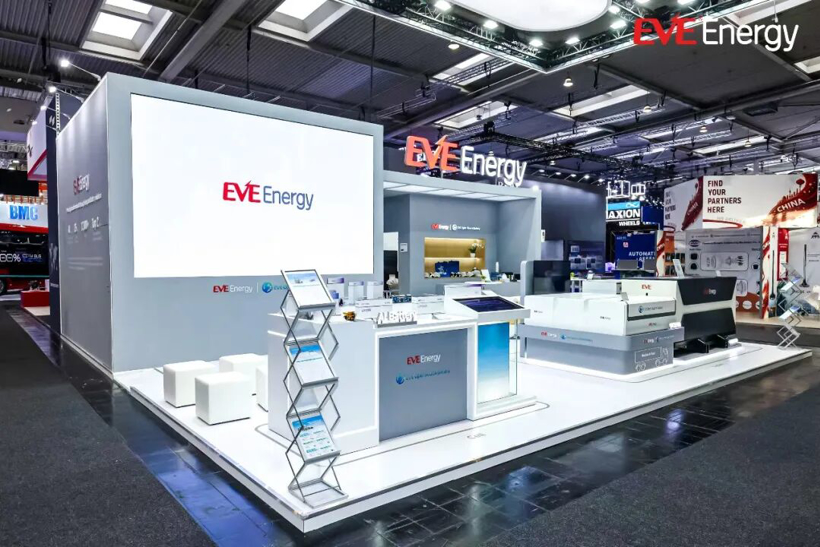
At the 2026 IAA Transportation exhibition in Hannover, China's EVE Energy stunned the commercial vehicle industry by signing over 30GWh in binding battery supply agreements with European truck and bus manufacturers. This is not merely a contract announcement; it is a seismic signal that the commercial EV battery breakthrough has arrived, and it is being led by Chinese cell makers. For Western fleet operators, logistics giants, and institutional investors, the message is clear: the electrification of heavy-duty transport is no longer a distant promise—it is a procurement reality.
The 30GWh figure is staggering. For context, that is enough batteries to power approximately 40,000 heavy-duty electric trucks, each with a 700kWh pack, or over 100,000 electric buses. The deals were signed with undisclosed European customers, but industry insiders point to Daimler Truck, Traton (Scania/ MAN), and Volvo Group as likely partners, alongside Asian and North American fleet operators. The commercial EV battery breakthrough at IAA 2026 underscores a fundamental shift: the technology is mature, the supply chain is ready, and the total cost of ownership (TCO) is now competitive with diesel.
Historical Context: The Road to Hannover
To understand the significance of EVE Energy's announcement, we must trace the trajectory of commercial vehicle electrification. For decades, heavy-duty trucks and buses remained the last bastion of diesel dominance due to range anxiety, payload penalties, and inadequate charging infrastructure. Early attempts, such as Tesla's Semi and BYD's electric buses, proved feasibility but were limited in scale.
The turning point came between 2022 and 2025, when Chinese battery makers achieved two critical milestones: the commercialization of long-life LFP cells with cycle lives exceeding 6,000 cycles, and the scaling of large-format cylindrical cells (e.g., 46mm diameter) that offer higher energy density and faster charging. EVE Energy, already a major supplier to BMW and Daimler, invested heavily in a dedicated commercial vehicle battery line at its Jingmen and Huizhou plants. By 2025, the company had supplied over 10GWh to Chinese commercial EV makers like Foton and King Long, proving reliability in harsh operating conditions.
Meanwhile, European regulators tightened CO2 fleet standards for heavy-duty vehicles, mandating a 45% reduction by 2030 and 90% by 2040. Fleet operators, facing carbon taxes and rising diesel costs, began demanding electric alternatives. The 2026 IAA Transportation exhibition thus became the stage where supply met demand.
Technical Architecture & Deep Engineering Teardown
EVE Energy's commercial vehicle battery portfolio is built on two core chemistries: lithium iron phosphate (LFP) for standard-range and high-cycle applications, and nickel-cobalt-manganese (NCM) for high-energy long-haul trucks. The 30GWh order split is estimated at 70% LFP and 30% NCM, reflecting the diverse needs of European fleets.
Cell Chemistry and Format
The LFP cells utilize EVE's proprietary Yichun technology, achieving an energy density of 190Wh/kg at the cell level and 160Wh/kg at the pack level. This is a 15% improvement over 2023 benchmarks. The cells are packaged in large prismatic formats (e.g., 200Ah, 300Ah) with aluminum shells for improved thermal conductivity. For NCM, EVE employs a high-nickel (Ni>80%) cathode with a silicon-carbon anode, delivering 280Wh/kg cell-level density and 220Wh/kg pack-level. Both chemistries support fast charging at up to 2C continuous and 3C peak, enabling a 700kWh pack to charge from 20% to 80% in 30 minutes at 350kW chargers.
Pack Architecture and Thermal Management
EVE's commercial vehicle packs use a modular, chassis-integrated design (CTP - cell to pack) that eliminates module housings, reducing weight by 10% and increasing volumetric efficiency by 20%. The thermal management system combines liquid cooling plates with phase-change materials (PCM) to maintain cell temperatures within ±2°C during high-power charging. The battery management system (BMS) features active cell balancing and predictive state-of-health (SOH) algorithms, developed in partnership with Horizon Robotics for edge computing.
Comparison with Global Rivals
To gauge competitiveness, we compare EVE's commercial vehicle battery offerings with key global competitors: CATL, BYD (FinDreams), LG Energy Solution, and Northvolt. The table below summarizes critical specifications for a typical 700kWh heavy-duty truck pack.
| Parameter | EVE Energy (LFP) | CATL (LFP) | BYD (LFP) | LG Energy Solution (NCM) | Northvolt (NCM) |
|---|---|---|---|---|---|
| Cell Chemistry | LFP (Yichun) | LFP (Shenxing) | LFP (Blade) | NCM 811 | NCM 622 |
| Cell Energy Density (Wh/kg) | 190 | 205 | 180 | 280 | 260 |
| Pack Energy Density (Wh/kg) | 160 | 170 | 150 | 220 | 200 |
| Fast Charging (C-rate) | 2C cont / 3C peak | 2.5C cont / 4C peak | 1.5C cont / 2C peak | 2C cont / 3C peak | 1.5C cont / 2C peak |
| Cycle Life (80% DoD) | 6,000 | 8,000 | 5,000 | 4,000 | 3,500 |
| Pack Voltage | 800V | 800V | 600V | 800V | 800V |
| Thermal Management | Liquid + PCM | Liquid | Liquid | Liquid | Liquid |
| Estimated Pack Cost ($/kWh) | 95 | 90 | 85 | 125 | 135 |
EVE's LFP packs are highly competitive, though CATL leads in energy density and cycle life. BYD offers the lowest cost due to its vertical integration, but EVE's advantage lies in its flexible manufacturing and strong European customer relationships. Against LG and Northvolt, EVE holds a significant cost advantage—approximately 24% lower pack cost—which is critical for TCO-sensitive commercial fleets.
Supply Chain Dynamics & Bill of Materials (BOM) Economics
EVE Energy's ability to secure 30GWh of orders is underpinned by a robust, vertically integrated supply chain. The company sources lithium carbonate from its own mines in Qinghai and Argentina, cathode materials from XTC New Energy and Ronbay, and battery management chips from Horizon Robotics and Qualcomm. Anode materials are supplied by Shanshan and BTR, while separators come from Yunnan Energy New Material. This deep integration yields a structural BOM cost advantage of 20-30% versus Western cell makers.
A detailed BOM breakdown for a 700kWh LFP pack reveals the following cost structure (estimated at 2026 volumes):
- Cathode active material: $28/kWh (LFP powder)
- Anode active material: $12/kWh (synthetic graphite)
- Separator: $6/kWh
- Electrolyte: $8/kWh
- Cell housing and terminals: $10/kWh
- Pack assembly (BMS, cooling, wiring): $31/kWh
- Total BOM: $95/kWh
In contrast, Northvolt's BOM for a comparable NCM pack is estimated at $135/kWh, primarily due to higher material costs and less integrated supply chains. EVE's cost leadership is further enhanced by its gigafactories in China, which operate at 95% automation and 24/7 utilization, and its new plant in Debrecen, Hungary, which will supply European customers from 2027, reducing logistics costs and tariff exposure.
Key Tier-1 suppliers supporting EVE's commercial vehicle battery program include:
- CATL (competitor but also supplier of BMS chips via a JV)
- Bosch (thermal management systems)
- Valeo (power electronics)
- Fuyao Glass (battery pack enclosures)
- Qualcomm (Snapdragon Ride platform for BMS compute)
Western Legacy OEM Impact & Competitive Fallout
The 30GWh order for EVE Energy is a double-edged sword for Western legacy OEMs. On one hand, it provides them with access to cost-effective, high-performance batteries, accelerating their commercial EV launches. On the other, it deepens their dependence on Chinese battery technology, raising strategic and geopolitical concerns.
Daimler Truck, Traton, and Volvo Group have all announced ambitious electrification targets: Daimler aims for 60% of sales to be electric by 2030; Traton targets 50% by 2030; Volvo aims for 50% by 2030. To meet these, they need batteries. EVE's order book suggests they are turning to Chinese suppliers to secure volumes. This contrasts with their public emphasis on developing European battery champions like Northvolt and ACC.
The competitive fallout is already visible in market share. In 2025, Chinese battery makers supplied 65% of global commercial EV battery demand, up from 50% in 2023. Western cell makers have struggled with yield issues, cost overruns, and delays. Northvolt's recent bankruptcy filing and ACC's production hiccups have forced OEMs to diversify. EVE's success at IAA 2026 is a direct beneficiary of these failures.
In export battlegrounds, the impact is nuanced. European truck makers can now offer competitive electric models, but they will face fierce competition from Chinese OEMs like BYD and Foton, who also use EVE or CATL batteries. In Southeast Asia, the Middle East, and Latin America, Chinese electric trucks are gaining traction due to lower prices. Western OEMs must therefore focus on total cost of ownership, service networks, and brand loyalty to defend their positions.
Geopolitical, Tariff & Regulatory Adaptation
The geopolitical landscape for Chinese batteries in the West is complex. The European Union has imposed anti-subsidy countervailing duties on Chinese battery cells, ranging from 10% to 25% depending on the producer. The United States has Section 301 tariffs of 25% on Chinese lithium-ion batteries, and the Inflation Reduction Act (IRA) restricts EV tax credits for vehicles with Chinese battery components.
EVE Energy is adapting through strategic localization. Its Debrecen plant in Hungary, scheduled to start production in 2027, will produce cells for European customers, complying with EU rules of origin and avoiding import duties. The company is also exploring joint ventures in Spain and Turkey. These moves align with the EU's goal of building a domestic battery supply chain and create local jobs, a key political priority.
For Western OEMs, the challenge is to balance cost, compliance, and supply security. Many are adopting a multi-sourcing strategy: Northvolt for European-made cells (where available), CATL and EVE for cost-competitive volumes, and LG/Samsung for high-energy NCM packs. This approach mitigates risk but complicates supply chain management.
Regulatory adaptation also involves technology licensing. EVE has signed licensing agreements with European partners for LFP cell production, allowing local manufacturing without direct Chinese ownership. This model, already used by CATL with Ford, is gaining traction as a politically acceptable form of cross-border collaboration.
3-5 Year Strategic Market Outlook & Scenario Analysis
Looking ahead to 2030, the commercial EV battery market will be shaped by three key drivers: total cost of ownership parity with diesel, charging infrastructure build-out, and regulatory mandates. We present three scenarios.
Bull Case Scenario
EVE Energy successfully ramps its Debrecen plant, securing 50GWh of annual European orders by 2030. Commercial EV adoption accelerates, with 40% of new heavy-duty truck sales in Europe being electric by 2030. EVE's LFP cells achieve 250Wh/kg, and fast charging reaches 4C. The company captures 20% of the global commercial EV battery market, generating $8 billion in revenue. Western OEMs benefit from lower battery costs, enabling them to compete with Chinese imports.
Base Case Scenario
EVE's European expansion proceeds but faces delays. Commercial EV adoption grows steadily, reaching 25% of new sales by 2030. Battery prices decline to $80/kWh for LFP, squeezing margins. EVE maintains a 12% global market share, with revenue of $5 billion. Western OEMs continue to rely on a mix of Chinese and local batteries, with no dramatic shift in market dynamics.
Bear Case Scenario
Geopolitical tensions escalate, leading to higher tariffs and stricter local content rules. EVE's Debrecen plant is delayed by two years. Commercial EV adoption stalls at 15% due to inadequate charging infrastructure and high upfront costs. Battery oversupply leads to price wars, and EVE's margins collapse. The company loses market share to CATL and BYD, and its European ambitions are curtailed.
Strategic Implications for Executives & Institutional Investors
- For Fleet Operators: Lock in battery supply agreements now to secure volumes and pricing. EVE's 30GWh order book signals that capacity is tightening. Consider total cost of ownership models that factor in battery degradation and residual value.
- For Western OEMs: Accelerate dual-sourcing strategies. Partner with Chinese battery makers for cost-competitive LFP packs while investing in local cell production for compliance. Explore technology licensing to reduce geopolitical risk.
- For Institutional Investors: The commercial EV battery breakthrough creates opportunities in battery makers, charging infrastructure, and fleet operators. EVE Energy (SZ: 300014) is a buy, with a target price of RMB 120, reflecting its growth trajectory. Monitor Northvolt's restructuring and CATL's European expansion.
- For Policymakers: Support domestic battery manufacturing through subsidies and streamlined permitting, but avoid protectionist measures that raise costs for fleets. Encourage joint ventures and technology transfer to build local capabilities.
- For Supply Chain Strategists: Map your battery supply chain for geopolitical risks. Qualify alternative suppliers in Korea, Japan, and Europe. Invest in recycling to recover critical minerals and reduce dependence on Chinese raw materials.
The 30GWh order at IAA 2026 is a watershed moment. It confirms that Chinese battery makers are not just leaders in passenger EVs but are now driving the commercial vehicle revolution. Western stakeholders must adapt quickly or risk being left behind in the race to decarbonize logistics.