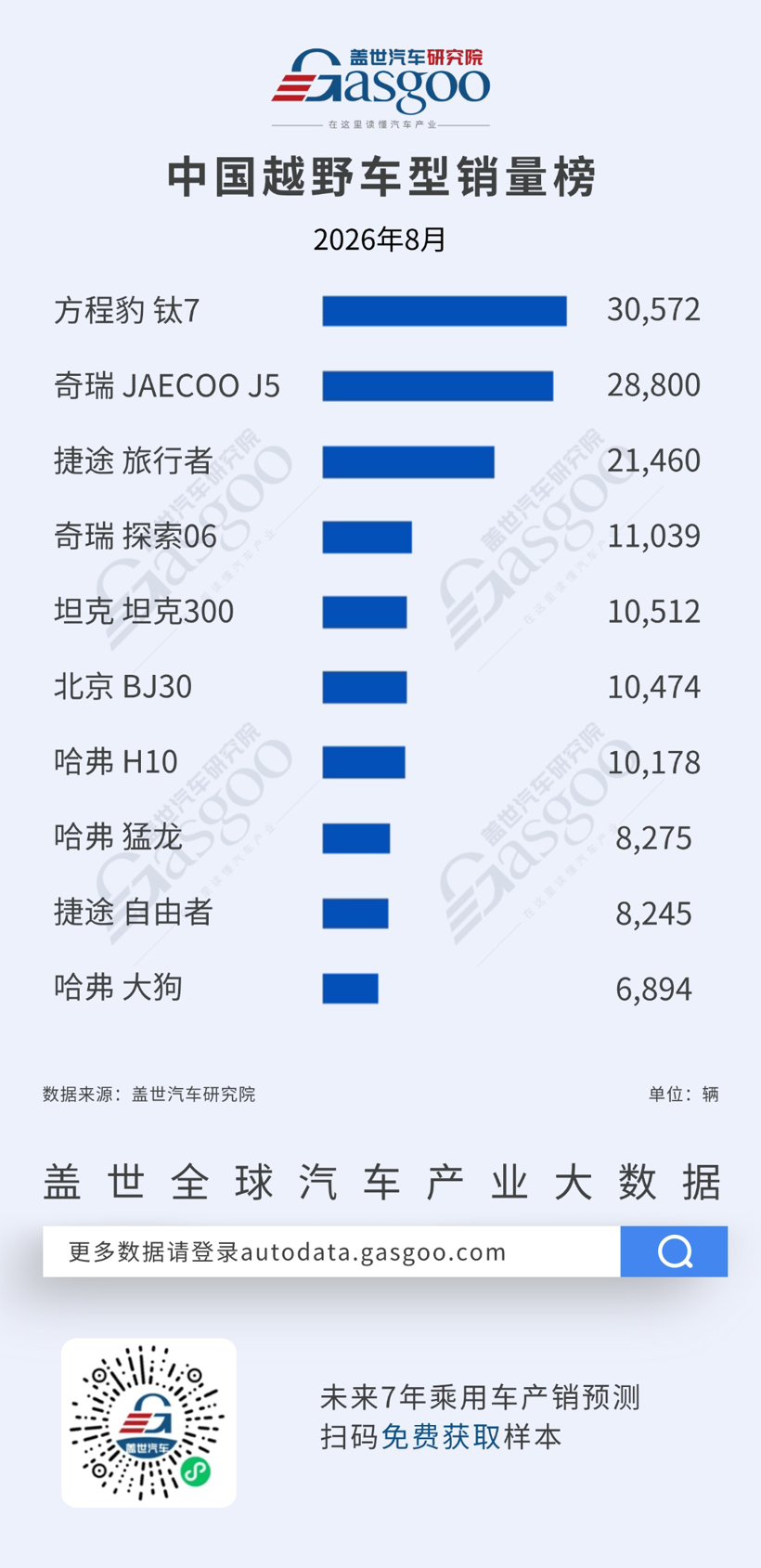
The August 2026 domestic sales tallies compiled by Gasgoo Research Institute confirm an uncomfortable inflection point for Western automotive executives monitoring the Chinese automotive theater. While Tesla's aging Model Y continues to defend top-line volume leadership in the broader high-end crossover bracket through persistent retail subsidies and financing incentives, the real profit-pool migration is happening across China's hyper-specialized sub-segments: rugged off-road new energy vehicles (NEVs), executive shooting brakes, and lifestyle multi-purpose platforms. Foremost among the disruptors is BYD's specialized sub-brand Fangchengbao, whose Tai 7 (Titanium 7) and expanded Bao series have posted formidable registration figures, signaling that domestic OEMs have successfully transitioned from competing purely on entry-level cost to dismantling the foreign brand premium in lifestyle-oriented, high-margin vehicle categories.
Historically, the luxury off-road and specialized enthusiast segments inside mainland China operated as exclusive margin goldmines for foreign legacy nameplates. Mercedes-Benz with its iconic G-Class, Jaguar Land Rover with the Defender family, and Toyota with the Prado enjoyed immense pricing power, routinely commanding dealer markups of 15% to 30% above MSRP. For decades, domestic Chinese manufacturers were deemed incapable of mastering the chassis rigidity, mechanical differential lockers, and thermal durability required for authentic off-road applications. However, the aggressive electrification of the Chinese domestic market has systematically redefined consumer expectations. By substituting cumbersome multi-speed transfer cases with responsive dual-motor electric all-wheel-drive (E-AWD) platforms and hydraulic active suspension, Chinese automakers are convincing domestic consumers that mechanical legacy hardware is obsolete.
Dissecting the Architecture: DMO Platform vs. Monocoque Crossovers
To understand why specialized vehicles like the Fangchengbao Tai 7 are capturing market share from traditional premium vehicles, one must analyze the stark architectural divergence between mass-market unibody crossovers like the Tesla Model Y and purpose-built dual-mode off-road architectures. The Fangchengbao portfolio is anchored on BYD’s proprietary Dual Mode Off-road (DMO) super hybrid architecture, a clean-sheet platform specifically engineered to reconcile structural off-road demands with high-voltage electrification.
Unlike conventional monocoque unibody electric vehicles that route torsion directly through the cabin floor, the DMO architecture incorporates Cell-to-Chassis (CTC) integration within a rigid ladder frame. The traction battery pack—a reinforced Lithium Iron Phosphate (LFP) Blade battery assembly—is suspended between high-strength longitudinal steel beams. BYD’s chassis engineers claim a 34% increase in frame torsional stiffness compared to standard ladder-frame architectures, reaching roughly 28,000 Nm/degree. This arrangement allows the vehicle to absorb severe torsional forces during extreme articulation without transmitting structural stress into the passenger greenhouse or warping glass panels.
Powertrain architecture reveals an equally calculated departure from Western hybrid conventions. Rather than adapting a legacy mechanical all-wheel-drive system with longitudinal prop shafts and mechanical center differentials, the platform utilizes a longitudinal 1.5-liter or 2.0-liter turbocharged high-compression Miller-cycle internal combustion engine paired with high-power front and rear silicon carbide (SiC) electric drive units. The front electric drive integrates a 200 kW motor alongside a specialized electronic continuously variable transmission (E-CVT), while the rear axle integrates a dedicated 285 kW drive unit with an integrated electronic differential lock. Peak system output exceeds 500 kW (670 horsepower), yielding an instantaneous wheel torque metric that eliminates the necessity of multi-ratio crawler gears for amateur off-roading.
| Metric / Specification | Tesla Model Y Performance | BYD Fangchengbao Tai 7 (DMO) | Land Rover Defender 110 P400e (PHEV) | Great Wall Tank 500 Hi4-T |
|---|---|---|---|---|
| Chassis Architecture | Monocoque Unibody | Ladder Frame with CTC Integration | Monocoque (D7x Platform) | Traditional Ladder Frame |
| Powertrain Topology | Dual-Motor Pure EV (E-AWD) | 1.5T/2.0T PHEV Dual-Motor (E-AWD) | 2.0T PHEV Single Motor (Mechanical 4WD) | 2.0T PHEV P2 Hybrid (Mechanical 4WD) |
| Battery Chemistry | High-Nickel Ternary (NCA/NCM) | LFP (FinDreams Blade) | NCM Lithium-ion | Ternary Lithium (SVOLT) |
| Pack Capacity (kWh) | 78.1 kWh | 31.8 – 38.8 kWh | 19.2 kWh | 37.1 kWh |
| Total System Power | 337 kW (450 hp) | 505 kW (677 hp) | 297 kW (398 hp) | 300 kW (402 hp) |
| Suspension Hardware | Front Double Wishbone / Rear Multi-link | Front/Rear Double Wishbone + Disus-P | Air Suspension + Adaptive Dynamics | Front Double Wishbone / Rear Multi-link |
| Starting Price (RMB) | ~280,000 - 350,000 | ~289,800 - 360,000 | ~780,000 - 850,000 | ~335,000 - 380,000 |
A critical technical differentiator elevating the Fangchengbao lineup above standard Chinese domestic SUVs is the Disus-P intelligent hydraulic body control system. Operating at pressures exceeding 20 MPa, Disus-P replaces conventional coil springs and electro-pneumatic air dampers with an active hydraulic circuit capable of adjusting independent wheel travel by up to 200 mm. The system can execute millisecond-level stiffness variations across three stages, dynamically mitigating off-camber rollover risks while providing instantaneous anti-dive and anti-squat compensation during aggressive tarmac maneuvers.
Supply Chain Decoupling and Bill of Materials Reality
The aggressive commercial positioning of China's premium off-road EV cohort stems entirely from acute domestic supply chain verticalization. When examining the Bill of Materials (BOM) of a foreign platform like the Land Rover Defender PHEV or an imported Mercedes GLE, Tier-1 European components—such as ZF transmissions, Continental air suspension modules, and Bosch braking systems—incur significant margins and import tariffs. By contrast, the Fangchengbao supply chain represents an almost closed-loop internal ecosystem within the broader BYD industrial complex.
Battery cells, thermal management manifolds, and cell-to-chassis structural trays are supplied internally by FinDreams Battery. By utilizing proprietary LFP chemistry rather than high-nickel ternary formulations, pack-level cell costs are estimated by local supply chain telemetry at approximately $58 to $64 per kWh at the factory gate, compared to European ternary pack costs exceeding $95 to $110 per kWh. The SiC power modules driving the front and rear inverters are fabricated in-house by BYD Semiconductor, insulating the vehicle architecture from Western semiconductor price spikes and external foundries.
For advanced driver assistance hardware and intelligent cockpits, however, the domestic landscape remains more nuanced. While entry-tier variants deploy in-house compute solutions, higher-trim configurations rely heavily on Horizon Robotics Journey 6 processors or Nvidia Drive Orin silicon paired with LiDAR hardware supplied by RoboSense or Hesai Technology. This reality indicates that while powertrain and structural hardware are heavily localized and vertically integrated, high-end autonomous computing continues to depend on specialized fab capacity and cross-border silicon architectures.
Industry BOM modeling indicates that the total manufacturing cost of a vehicle like the Fangchengbao Tai 7 sits between RMB 195,000 and RMB 215,000 ($27,500 – $30,300). When retailed at an average transaction price of RMB 310,000 ($43,700), gross vehicle margins appear mathematically robust at roughly 28% to 32% on paper. However, as analyzed below, these theoretical manufacturing margins are heavily diluted when amortizing the immense research, sub-brand retail infrastructure, and promotional capital expenditure deployed across China's fragmented multi-brand landscape.
The Multi-Brand Encirclement of Foreign Premium Players
The August 2026 sales distribution highlights a calculated competitive strategy executed by top-tier Chinese automotive groups: multi-brand niche encirclement. Foreign automakers—most notably Tesla, BMW, Audi, and Mercedes-Benz—have historically relied on a consolidated product portfolio. Tesla’s domestic China volume is heavily dependent on just two core nameplates: the Model Y crossover and the Model 3 sedan. German premium OEMs have similarly leaned on standard long-wheelbase executive sedans (3 Series, C-Class, A4L) and compact utility vehicles (X3, GLC, Q5).
BYD and its domestic competitors, including Geely Holding and Great Wall Motor (GWM), have rejected this monolithic approach. Instead, they are segmenting the RMB 250,000 to 800,000 market into hyper-specific behavioral categories:
- Mass-Market Electrification (RMB 100k - 200k): Dominated by BYD Dynasty and Ocean series, squeezing foreign volume mass brands (Toyota, Volkswagen, Nissan).
- Executive Shooting Brakes & Wagons (RMB 250k - 350k): Pioneered by Zeekr (001) and Denza (N7/Z9), targeting design-conscious urban professionals who would otherwise lease an Audi Avant or BMW Touring.
- Hardcore Lifestyle & Off-Road (RMB 280k - 450k): Contested between Fangchengbao (Bao 5, Tai 7, Bao 8) and GWM’s Tank sub-brand (Tank 400, Tank 500, Tank 700 Hi4-T), directly intercepting buyers from Jeep, Land Rover, and Toyota Prado.
- Ultra-Luxury Halo Vehicles (RMB 1,000k+): Spearheaded by Yangwang (U8, U9), aimed at breaking the psychological glass ceiling historically defended by the Mercedes G-Wagon and Porsche Cayenne.
By surrounding Tesla’s Model Y with specialized products, domestic OEMs force Tesla into an asymmetric defensive posture. To preserve its factory capacity utilization at Giga Shanghai, Tesla has been compelled to slash financing rates, offer localized software packages, and sacrifice operating margins. The Model Y may continue to top the consolidated single-model sales leaderboard purely due to brand equity and global fleet familiarity, but the high-margin periphery is rapidly eroding. Foreign legacy OEMs are experiencing the sharpest contraction: joint-venture luxury sales dropped by double digits year-over-year in August 2026, as domestic business owners and affluent suburban buyers swap legacy prestige badges for domestic platforms loaded with active suspension and high-output electric torque.
The Reality Check: Interrogating the Off-Road Electrification Narrative
While domestic industry press releases celebrate these registration surges as decisive technological victories over Western engineering, institutional investors and market analysts must critically interrogate the operational, engineering, and economic realities underpinning the off-road EV segment.
First, consider the unyielding laws of vehicle mass and off-road physics. The integration of a 35+ kWh protective battery pack, dual high-power electric drive units, an internal combustion engine, auxiliary fuel tanks, and heavy-duty ladder-frame steel pushes the curb weight of vehicles like the Fangchengbao Tai 7 and GWM Tank Hi4-T beyond 2,850 to 3,100 kilograms (6,300 to 6,800 lbs). In extreme off-road scenarios—such as traversing deep desert sand dunes or ascending loose scree—excessive vehicle mass is a severe liability. While instantaneous electric torque can temporarily mask weight on flat surfaces, kinetic energy requirements escalate dramatically. Heavy off-road NEVs risk severe kinetic entrapment in soft substrates, placing extraordinary thermal strain on electric inverters and planetary reduction gears.
Second, the electrochemistry limitations of LFP batteries in remote off-road environments cannot be ignored. While LFP Blade cells offer superior thermal stability during catastrophic casing punctures compared to nickel-rich ternary chemistries, their open-circuit voltage discharge curve is notoriously flat, and low-temperature performance remains structurally flawed. In sub-zero environments—such as the mountainous terrain of Western China, Northern Europe, or North America—usable battery capacity can degrade by 35% to 45%. When high-draw E-AWD demands coincide with cold-soaked LFP packs, the vehicle is forced to lean entirely on its compact 1.5-liter or 2.0-liter turbocharged engine to simultaneously propel a three-ton chassis and generate buffer electricity. The resulting operating state, commonly dubbed 'limp mode under depletion,' destroys fuel economy, elevates combustion engine thermal stress, and degrades off-road throttle modulation precision.
Third, the volume-versus-profit paradox remains unresolved. While retail sales volumes in August 2026 appear robust, the operating margins of these dedicated off-road sub-brands are heavily obscured within consolidated corporate filings. Establishing dedicated direct-to-consumer dealership networks, building branded off-road experience centers, and offering lifetime warranty guarantees on high-stress hydraulic suspension components represent substantial recurring overhead. Industry observers must ask: Is the growth of specialized sub-brands generating genuine free cash flow, or are corporate parents absorbing suppressed divisional returns to wage a territorial war of attrition against Tesla and foreign legacy incumbents?
Regulatory Firewalls and Overseas Export Impediments
For Chinese automakers relying on specialized sub-brands like Fangchengbao to drive corporate growth, the domestic market is ultimately a cage match characterized by chronic overcapacity. Long-term commercial survival necessitates rapid globalization. However, expanding specialized off-road and premium electric platforms into Western jurisdictions faces unprecedented geopolitical and regulatory barriers.
Under current trade policies, the United States market is effectively barricaded. Section 301 tariffs on Chinese-manufactured electric vehicles exceeding 100%, coupled with strict Foreign Entity of Concern (FEOC) restrictions under the Inflation Reduction Act, preclude direct export of platforms utilizing Chinese battery cells and domestic software architectures. Even if a vehicle like the Fangchengbao Tai 7 could theoretically undercut a Jeep Wrangler 4xe on hardware specifications, American federal retail entry is non-viable without profound, cost-prohibitive supply chain decoupling.
In the European Union, countervailing duties applied to Chinese NEV imports impose significant additive tariff burdens on BYD and its peers. While pure luxury off-road vehicles possess higher gross margins capable of absorbing some duty friction compared to budget hatchbacks, the European market presents regulatory hurdles regarding data sovereignty, homologation of active hydraulic chassis, and pedestrian impact safety standards for heavy, high-hooded ladder-frame SUVs. Furthermore, Western autonomous driving and software-defined vehicle standards require local data hosting and stringent cybersecurity compliance under UNECE R155 and R156, preventing direct deployment of Chinese domestic software ecosystems.
Consequently, the primary export battlegrounds for China's premium off-road EV cohort are restricted to non-aligned markets: the Middle East (specifically Saudi Arabia and the UAE), Central Asia, Latin America, and Australia. In these territories, Chinese OEMs are utilizing strategic localization, establishing assembly joint ventures, and deploying regional distribution partnerships with legacy dealer conglomerates to bypass the direct scrutiny facing them in Brussels and Washington.
Strategic Outlook & Investor Implications
As the Chinese premium EV market fragments into hyper-specialized sub-segments, institutional investors and global automotive strategists must evaluate three diverging multi-year trajectories.
Bull Case: Structural Niche Domination and Global Margin Export
In the optimistic scenario, domestic specialized sub-brands solidify their domestic dominance, completely dislodging foreign Tier-1 off-road and executive nameplates. As production scales through 2027, manufacturing efficiencies and vertical integration drive unit BOM costs down an additional 12%. Chinese OEMs successfully leverage the Middle East, Southeast Asia, and Australian markets to export high-margin off-road hybrids, generating foreign currency operating profits that compensate for domestic price war compression. Western legacy luxury automakers are forced into retreat, licensing Chinese electric chassis architectures to maintain relevance in emerging markets.
Base Case: Fragmented Attrition and Protracted Margin Pressure
The baseline outlook anticipates that domestic specialized sub-brands continue to peel off market share from the Tesla Model Y and German luxury crossovers within China, but at a diminishing marginal return. High marketing overhead, warranty liabilities associated with complex active hydraulic suspensions, and relentless domestic discounting cap operational operating margins below 6%. Abroad, Western regulatory tariffs successfully restrict Chinese premium models to secondary developing markets, forcing domestic brands into fierce price wars against one another in places like Dubai, Sydney, and Santiago.
Bear Case: The Oversaturation Trap and Residual Value Collapse
Under the pessimistic trajectory, the aggressive rollout of overlapping sub-brands results in severe domestic cannibalization. Consumer novelty regarding heavy off-road PHEVs fades as real-world maintenance costs, insurance premiums, and cold-weather battery degradation issues emerge on the secondary market, triggering a collapse in three-year vehicle residual values. Concurrently, tightening domestic environmental auditing and grid load management policies penalize ultra-heavy, high-capacity hybrid platforms. Several speculative sub-brands are abruptly shuttered or consolidated into parent group portfolios, inflicting steep capital write-downs on parent balance sheets.
- Tesla's Moat Shifts to Software and Scale: The Model Y’s hardware proposition is being surpassed by specialized domestic platforms, forcing Tesla to rely almost entirely on full self-driving monetization, supercharging infrastructure scale, and brand equity to defend market share.
- European Luxury Face High Margin Erosion: German and British premium manufacturers must rapidly accelerate the localization of their software and powertrain engineering inside China; relying on imported prestige badges is no longer a viable commercial defense.
- Capital Discipline Over Headline Volume: Institutional equity analysts must look past high single-model delivery announcements and demand audited segment-level EBIT margins from Chinese OEMs managing sprawling, multi-brand portfolios.
- Supply Chain Geopolitics Restrict Upside: Until Chinese automakers successfully construct fully decoupled, compliant supply chains in target regions, their highest-margin off-road and luxury products will remain largely landlocked within domestic and secondary emerging markets.