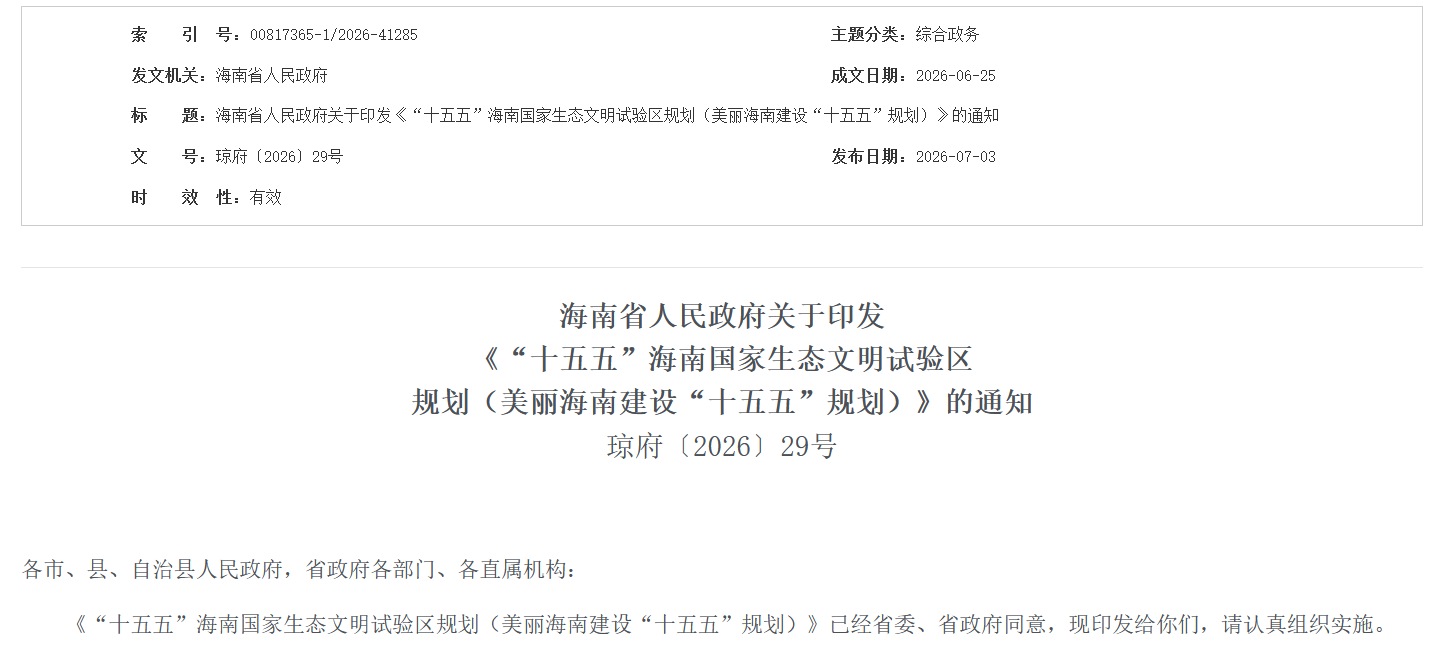
As global automotive markets navigate fluctuating electrification targets, China is doubling down on its aggressive transition roadmaps. The Hainan Provincial Government recently formalized its strategic framework for the '15th Five-Year Plan' (2026–2030), officially confirming its position as the first Chinese province to mandate a complete phase-out of internal combustion engine (ICE) passenger car sales by 2030. This landmark decision cements the China ICE ban Hainan timeline as a critical regulatory bellwether for global automakers and institutional investors monitoring the world's largest automotive market.
Decoding Hainan's 2030 Zero-Emission Mandate
Hainan's commitment is not merely an environmental statement; it is a structured policy directive integrated into its regional economic development. Under the new guidelines, the province aims to achieve 100% NEV market share for all newly registered and replacement vehicles across public, commercial, and private sectors by 2030. This transition is being supported by a robust expansion of charging infrastructure, smart grid integration, and fiscal incentives tailored to clean energy transport.
For strategic analysts, Hainan serves as a real-world testing ground. Because it is an island province with a highly concentrated highway network and moderate driving distances, it bypasses the traditional 'range anxiety' challenges that plague larger, geographically diverse markets. The lessons learned here are expected to inform national-level policies across mainland China in the post-2030 era.
Why Hainan is the Ideal Regulatory Sandbox
The acceleration of the China ICE ban Hainan timeline is bolstered by several structural advantages that make the island uniquely suited for rapid electrification:
- Free Trade Port (FTP) Incentives: Hainan's unique economic status offers favorable tax structures and simplified import-export regulations, facilitating strategic sourcing alliances and cross-border technology integration.
- Infrastructural Density: The province is targeting a comprehensive charging network with a highly accessible service radius in urban areas, ensuring seamless utility for both consumer and commercial EVs.
- Geographical Isolation: As an island, Hainan can control vehicle inflows and outflows more effectively than landlocked provinces, allowing for clean-energy corridors and strict emissions zones.
Strategic Implications for Western OEMs and Global Investors
The formalization of the 2030 timeline presents both challenges and strategic opportunities for Western legacy OEMs and international suppliers. Rather than viewing the transition as a barrier, forward-looking automakers are engaging in strategic localization and technological partnerships within China to maintain their competitive edge.
| Metric / Target Area | Hainan Target (By 2030) | National Context / Comparison |
|---|---|---|
| New Passenger Vehicle Sales | 100% New Energy Vehicles (NEVs) | Targeting over 50% NEV penetration nationwide ahead of schedule |
| Public & Commercial Fleets | 100% Electrified (Taxis, Buses, Logistics) | High-priority transition across all major Tier 1 and Tier 2 cities |
| Charging Infrastructure | Ultra-dense, integrated smart charging grid | Rapid expansion of highway fast-charging and battery-swapping networks |
By treating Hainan as a localized benchmark, global automakers can refine their software-defined vehicle capabilities, ADAS integration, and localized supply chain compliance. This proactive approach ensures that Western OEMs can leverage joint-venture partnerships and regional R&D centers to export advanced EV expertise back to Western markets, aligning with global decarbonization initiatives.