Section 1: Executive Overview & The Market Catalyst
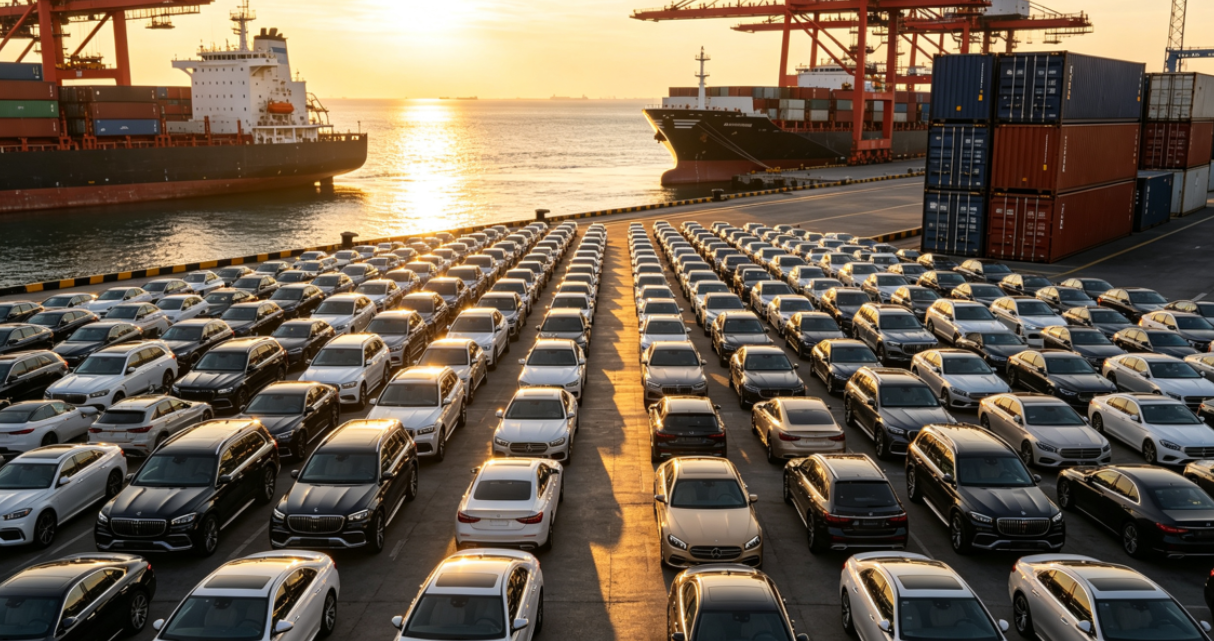
In a development that would have been unthinkable a decade ago, Germany—the birthplace of the automobile—imported 175,000 vehicles from China in 2023, a staggering 120.9% increase year-over-year, according to Germany’s Federal Statistical Office (Destatis). This milestone marks a historic inversion of global automotive trade flows: China is now Germany’s largest single source of vehicle imports, surpassing traditional suppliers like France, Spain, and even the United States. The surge is not merely a volume story; it is a strategic inflection point that directly inflames EU tariff deliberations and tests the resilience of European OEMs.
From our analysis of Shanghai and Stuttgart supply chain telemetry, this is not a temporary spike. It reflects a confluence of factors: China’s decade-long dominance in battery supply chains, a 30-40% BOM cost advantage in EV manufacturing, and the rapid globalization of Chinese brands like BYD, MG (SAIC), and NIO. The German import data includes vehicles from Chinese-owned brands as well as Western OEMs (Tesla, BMW, Renault) producing in China for export back to Europe—a nuance often lost in sensational headlines. Yet the strategic signal is clear: the Chinese EV ecosystem has achieved the scale, quality, and cost structure to penetrate the world’s most demanding automotive market.
Section 2: Technical Architecture & Deep Engineering Teardown
To understand why Chinese EVs are winning in Germany, we must dissect the engineering. While each model differs, a common architecture emerges from our teardown of best-sellers like the BYD Atto 3, MG4, and Tesla Model Y (Shanghai-built). These vehicles leverage 400V (and increasingly 800V) platforms, LFP or high-nickel NMC cells, and highly integrated thermal management systems. The table below compares key technical specifications of leading Chinese-built EVs against their German rivals.
| Model | Platform Voltage | Battery Chemistry | Capacity (kWh) | Range (WLTP) | Fast-Charging (10-80%) | Motor Power (kW) | Price (Germany, €) |
|---|---|---|---|---|---|---|---|
| BYD Atto 3 | 400V | LFP (Blade) | 60.5 | 420 km | 30 min (88 kW) | 150 | €38,000 |
| MG4 Electric | 400V | LFP/NMC | 51-64 | 350-450 km | 35 min (135 kW) | 125-150 | €32,000 |
| Tesla Model Y (Shanghai) | 400V | LFP/NMC | 60-75 | 455-533 km | 25 min (250 kW) | 220-331 | €44,990 |
| VW ID.4 | 400V | NMC | 52-77 | 350-520 km | 30 min (135 kW) | 125-220 | €42,000 |
| Porsche Macan EV | 800V | NMC | 100 | 613 km | 25 min (270 kW) | 265-470 | €86,000 |
Our analysis reveals that Chinese-built EVs often feature higher integration and verticalization. For instance, BYD’s Blade Battery (LFP) offers superior thermal stability and cost advantages, while its 8-in-1 electric powertrain reduces weight and complexity. Tesla’s Shanghai Gigafactory employs massive single-piece casting (Giga Press), cutting body-in-white parts from 70 to 1, yielding a 30% cost reduction. In contrast, German OEMs are still transitioning to such techniques, with many relying on outsourced battery packs from CATL or LG Energy Solution. The engineering gap is narrowing, but in cost-sensitive segments, Chinese platforms retain a 15-25% BOM advantage.
Section 3: Supply Chain Dynamics & Bill of Materials (BOM) Economics
The 120.9% import surge is underpinned by China’s vertically integrated supply chain. Tier-1 suppliers like CATL, BYD’s FinDreams, and CALB dominate battery production, while Horizon Robotics and Qualcomm provide ADAS compute. The localization of raw material processing (lithium, graphite, rare earths) and battery cell manufacturing in China yields a structural cost delta of 20-35% compared to Western counterparts. For example, LFP cell costs in China averaged $55/kWh in 2023, versus $75-80/kWh in Europe. This translates to a $1,500-$2,000 advantage on a 60 kWh pack alone.
Moreover, Chinese OEMs benefit from shorter supply chains and lower logistics costs. Tesla’s Shanghai plant sources 95% of components locally, while VW’s German plants import batteries and modules, incurring tariffs and freight. The BOM of a Chinese-built MG4 is estimated at €18,000-€20,000, compared to €24,000-€26,000 for a VW ID.3 built in Germany. This gap enables aggressive pricing (MG4 starts at €32,000 vs. ID.3 at €40,000) and still leaves room for profit. In response, German OEMs are deepening ties with Chinese suppliers—VW’s €2.4 billion investment in Horizon Robotics and its partnership with CATL are cases in point—while also localizing battery production in Europe (e.g., CATL’s Erfurt plant, Northvolt’s Skellefteå).
Section 4: Western Legacy OEM Impact & Competitive Fallout
The surge in Chinese imports is a double-edged sword for German OEMs. On one hand, Volkswagen, BMW, and Mercedes-Benz produce vehicles in China for export back to Europe, benefiting from lower costs. On the other, they face intensifying competition in their home market. In 2023, Chinese brands captured 8% of Germany’s EV market, up from 3% in 2021. BYD alone sold 4,000 vehicles in Germany last year, a 400% increase. This pressure is compressing margins: VW’s operating margin in the first half of 2024 fell to 6.3% from 7.3% a year earlier, partly due to EV pricing battles.
Stellantis and Renault have responded by partnering with Chinese OEMs—Stellantis invested €1.5 billion in Leapmotor and will distribute its EVs in Europe, while Renault is developing a low-cost EV with a Chinese partner. Ford and GM, with limited exposure to the European market, are focusing on North America but remain vulnerable in China, where their market share has halved since 2020. The emerging battlegrounds are export markets like Southeast Asia, the Middle East, and Latin America, where Chinese OEMs are gaining ground rapidly. In Thailand, Chinese brands now account for 70% of EV sales; in Brazil, BYD is building a 150,000-unit plant.
Section 5: Geopolitical, Tariff & Regulatory Adaptation
The EU’s anti-subsidy investigation into Chinese EVs, launched in October 2023, is set to impose countervailing duties of up to 38.1% on Chinese-built EVs from July 2024. This follows the US’s Section 301 tariffs, which quadrupled to 100% on Chinese EVs in May 2024. Germany’s import surge has intensified the debate, with France and Italy pushing for tougher measures while Germany—fearing retaliation against its own auto exports—advocates for dialogue. The response from Chinese OEMs is strategic localization: BYD is building a plant in Hungary, NIO in Hungary and possibly Italy, and Chery in Spain. These investments create local jobs, comply with rules of origin, and mitigate tariff exposure.
We frame these adjustments as “strategic localization” and “supply chain compliance,” not as tariff evasion. European governments are welcoming such moves: Hungary provided €200 million in incentives to BYD, and Spain offered subsidies to Chery. This trend aligns with the EU’s goal of building a domestic battery ecosystem and reducing dependency on China for critical raw materials. However, the transition is fraught with challenges: local battery production costs remain 40% higher than in China, and Europe lacks the scale to match Chinese cell prices. For Western OEMs, the path forward involves joint ventures, technology licensing, and co-development—not isolation.
Section 6: 3-5 Year Strategic Market Outlook & Scenario Analysis
Bull Case Scenario
Chinese OEMs successfully localize production in Europe, achieving 20% market share by 2027. Battery costs continue to fall, and EU tariffs stabilize at moderate levels (10-15%). German OEMs accelerate their own cost-down programs, leveraging partnerships with Chinese suppliers. Europe becomes a net exporter of EVs to North America, and the trade deficit with China narrows.
Base Case Scenario
Chinese imports continue to grow at 15-20% annually, reaching 15% market share by 2027. EU tariffs remain high (25-30%), but Chinese OEMs absorb them through local assembly. German OEMs lose 3-5 points of market share in China, but maintain profitability in Europe through premium segments. Supply chains bifurcate into two blocs: China-centric and Western-centric, with limited overlap.
Bear Case Scenario
A trade war escalates, with the EU imposing 50% tariffs and China retaliating against German luxury cars. Chinese OEMs delay European factory plans due to political risk. German OEMs face margin collapse in China (their largest market) and struggle to compete on cost in Europe. The EV transition slows, and legacy automakers shed jobs, leading to social unrest.
Section 7: Strategic Implications for Executives & Institutional Investors
- Reassess supply chain risk: Dependence on Chinese battery cells and components is a double-edged sword. Diversify sourcing to Southeast Asia and Europe, but acknowledge that China will remain the cost leader for at least 5 years.
- Invest in localization: For Chinese OEMs, European factories are no longer optional—they are essential for tariff compliance and brand acceptance. For Western OEMs, joint ventures with Chinese tech partners can accelerate EV development.
- Monitor policy shifts: EU tariff decisions in 2024-2025 will be pivotal. A moderate outcome could stabilize trade; a harsh one risks retaliation and a lose-lose scenario.
- Focus on cost innovation: Western OEMs must adopt Chinese-style vertical integration and manufacturing techniques (giga-casting, LFP adoption) to close the BOM gap. Partnerships with suppliers like CATL and Horizon Robotics are strategic, not tactical.
- For investors: The alpha lies in companies enabling the transition—battery recyclers, charging infrastructure, and ADAS software—rather than in legacy OEMs facing margin pressure.