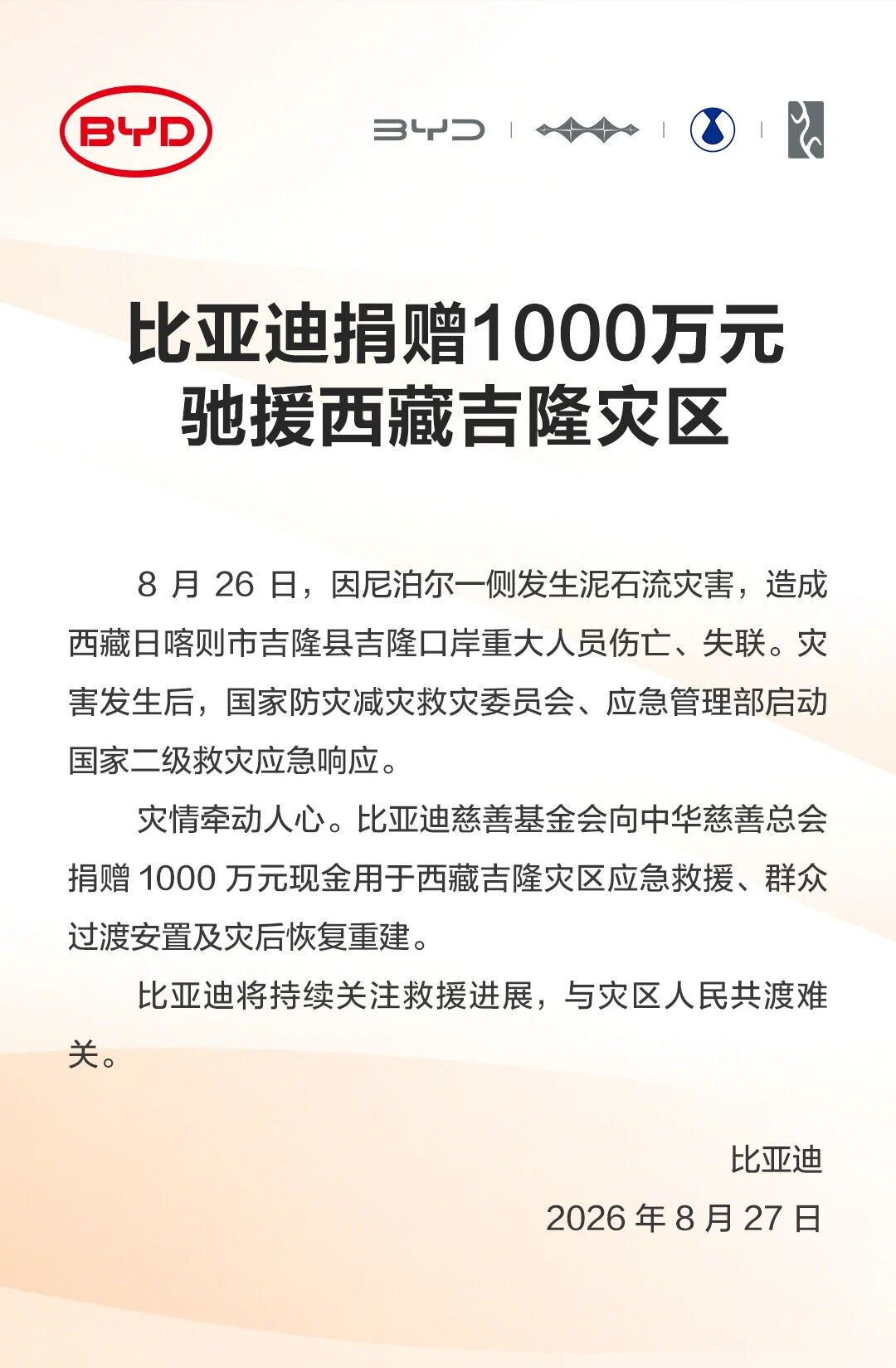
As Western institutional investors increase their exposure to global electric vehicle leaders, understanding the intricacies of the BYD ESG strategy becomes paramount. On August 27, 2026, the BYD Charity Foundation announced a 10 million RMB (approximately $1.4 million USD) cash donation to the China Charity Federation to support emergency disaster relief efforts in Gyirong County, Shigatse, Tibet. While superficially a standard corporate social responsibility (CSR) initiative, this move offers deeper insight into how China's premier EV manufacturer naviagtes domestic regulatory expectations and state-aligned development goals.
Decoding the Donation: Strategic Philanthropy in Action
The funding directed to Gyirong County is earmarked for immediate disaster relief and post-disaster reconstruction. By partnering directly with the China Charity Federation—a premier state-sanctioned national charity organization—BYD ensures its capital is deployed in precise alignment with national administrative channels.
In China's high-tech and automotive sectors, corporate giving is rarely isolated from national policy. Aligning with regional stability and development goals, such as those in Tibet, demonstrates corporate utility beyond simple manufacturing metrics. For an analyst, this is a calculated component of corporate governance that mitigates regulatory risk within BYD's primary manufacturing and consumer market.
Why the BYD ESG Strategy Matters to Western Investors
For US and EU portfolio managers, evaluating Chinese equities requires a specialized ESG lens. In Western markets, ESG is heavily weighted toward environmental carbon metrics and board independence. In China, the 'Social' and 'Governance' aspects are intrinsically tied to state alignment, poverty alleviation, and rural revitalization initiatives.
By actively participating in state-supported charitable drives, BYD achieves several strategic milestones:
- Regulatory Goodwill: Continued alignment with Beijing's 'Common Prosperity' policy, securing a favorable operating environment.
- Domestic Consumer Trust: Bolstering brand loyalty among domestic consumers who view state-aligned philanthropy as a mark of corporate patriotism.
- ESG Score Optimization: Improving domestic and international ESG indices that factor in localized corporate social responsibility.
The table below highlights recent corporate social responsibility and philanthropy trends among leading Chinese EV OEMs, illustrating that BYD's strategy is part of a broader, industry-wide compliance framework:
| Company | Recent Action / Initiative | Strategic Focus Area |
|---|---|---|
| BYD | 10M RMB cash donation for Tibet emergency relief | State-aligned regional aid & disaster response |
| NIO | NIO Clean Parks global ecological initiative | Biodiversity conservation & national park support |
| Geely Group | Geely Hope School program and rural education funding | Rural revitalization and educational equity |
A Comparative Look: Western CSR vs. Chinese ESG Integration
While Western OEMs focus their ESG initiatives on localized supply chain audits and decarbonization of production facilities, Chinese market leaders must balance these global standards with highly localized political expectations. The BYD ESG strategy successfully bridges these two worlds by pursuing zero-emission technology globally while maintaining deep-seated state-aligned philanthropic practices domestically.
As BYD continues its aggressive international expansion across Europe, Latin America, and Southeast Asia, maintaining a bulletproof reputation at home ensures that its domestic operational foundation remains secure. Western analysts must view these donations not as extraneous operational expenditures, but as vital risk-mitigation investments that preserve the automaker's domestic market dominance.