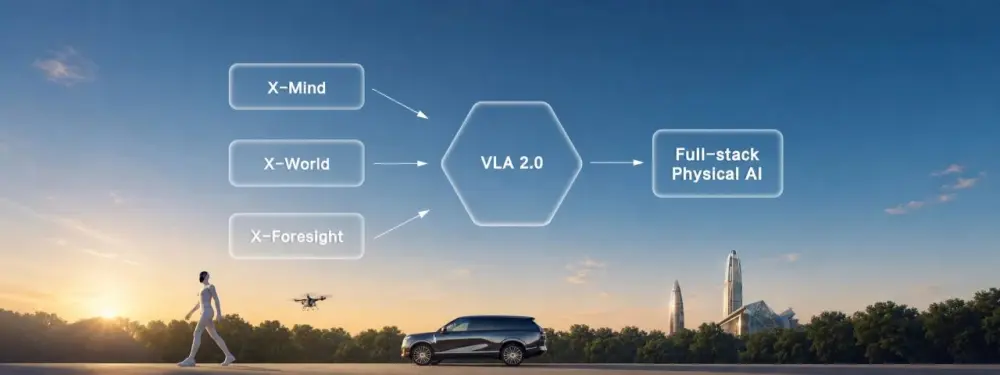
The boundary separating Electric Vehicle (EV) manufacturers from pure-play artificial intelligence firms is dissolving at China-speed. At the CVPR 2026 workshop on Embodied AI Foundation Model Deployment in Denver, Colorado, XPeng Group officially unveiled XPeng X-Mind, its highly anticipated proprietary embodied AI foundation model. Presented by Liu Xianming, Head of XPeng's General Intelligence Center, this release signals a major strategic pivot. XPeng is no longer just selling smart cars; it is building the unified cognitive brain for the next generation of physical AI agents, including humanoid robots and autonomous vehicles.
Unpacking XPeng X-Mind: The Cognitive Engine for Embodied AI
Presented at the prestigious Computer Vision and Pattern Recognition (CVPR) conference in 2026, XPeng X-Mind represents a significant leap forward in embodied AI. Unlike traditional AI models that operate strictly in digital environments (like large language models), embodied AI refers to systems that perceive, reason, and physically act in the real world.
As an industry analyst closely tracking the Chinese EV landscape, I see X-Mind as the missing logical link in XPeng's long-term play. By establishing a General Intelligence Center under Liu Xianming, XPeng has unified its software stack. Rather than maintaining separate pipelines for vehicle Advanced Driver Assistance Systems (ADAS) and humanoid robotics, X-Mind acts as a singular foundation model capable of cross-domain deployment.
Strategic Benchmarking: XPeng vs. Tesla
XPeng's technological trajectory closely mirrors Tesla's. While Elon Musk positions Tesla as an AI and robotics company rather than an automaker, XPeng is quietly executing the same playbook with distinct Chinese manufacturing advantages. XPeng's humanoid robot (PX5/Iron) and its latest EVs will run on variations of the same X-Mind architecture.
| Feature / Metric | XPeng (X-Mind Ecosystem) | Tesla (FSD & Optimus) |
|---|---|---|
| Core AI Foundation | X-Mind Multi-Model Architecture | FSD End-to-End Neural Networks |
| Hardware Synergy | SEPA 2.0 EVs + Humanoid Robots | Tesla Vehicles + Optimus Bot |
| Deployment Focus | Rapid commercialization, open ecosystem tendencies | Closed ecosystem vertical integration |
Why Western Investors and OEMs Must Pay Attention
The geopolitical implications of XPeng launching X-Mind at an American conference (CVPR in Denver) cannot be overstated. Despite ongoing tariff disputes and regulatory friction between the US and China, the technological exchange in AI remains highly globalized. Western OEMs risk falling into a 'strategic blindness' trap if they view Chinese EV players purely as mechanical assemblers of cheap battery packs.
XPeng's ability to rapidly synthesize high-level research into deployable physical models showcases 'China-speed' in action. While Western traditional automakers are still struggling to migrate to basic centralized software architectures, XPeng is already deploying multi-modal neural networks that allow machines to understand physical spatial dynamics in real-time.
Key Technical Advantages of XPeng's AI Approach:
- Unified Data Flywheel: Millions of kilometers of real-world driving data from XPeng's advanced driver-assistance systems directly train the spatial intelligence required for humanoid robots.
- Cost-Efficient Scaling: Leveraging China's ultra-dense supply chain for sensors, actuators, and high-performance compute chips allows XPeng to iterate its hardware alongside its software at a fraction of the cost of Western competitors.
- End-to-End Learning: Moving away from hard-coded rules, X-Mind processes raw sensory input (vision, lidar, tactile) and outputs direct motor control actions for both wheels and robotic limbs.
Looking Ahead: The Next Phase of Chinese EV Dominance
The launch of XPeng X-Mind confirms that the future of the automotive industry lies not in the drivetrain, but in the cognitive stack. Investors looking for structural alpha in the clean-tech and automation sectors must monitor how effectively XPeng commercializes X-Mind beyond the domestic Chinese market. If XPeng successfully bridges the gap between automotive intelligence and general humanoid utility, it will transcend its status as an EV challenger to become a structural pillar of the global AI economy.