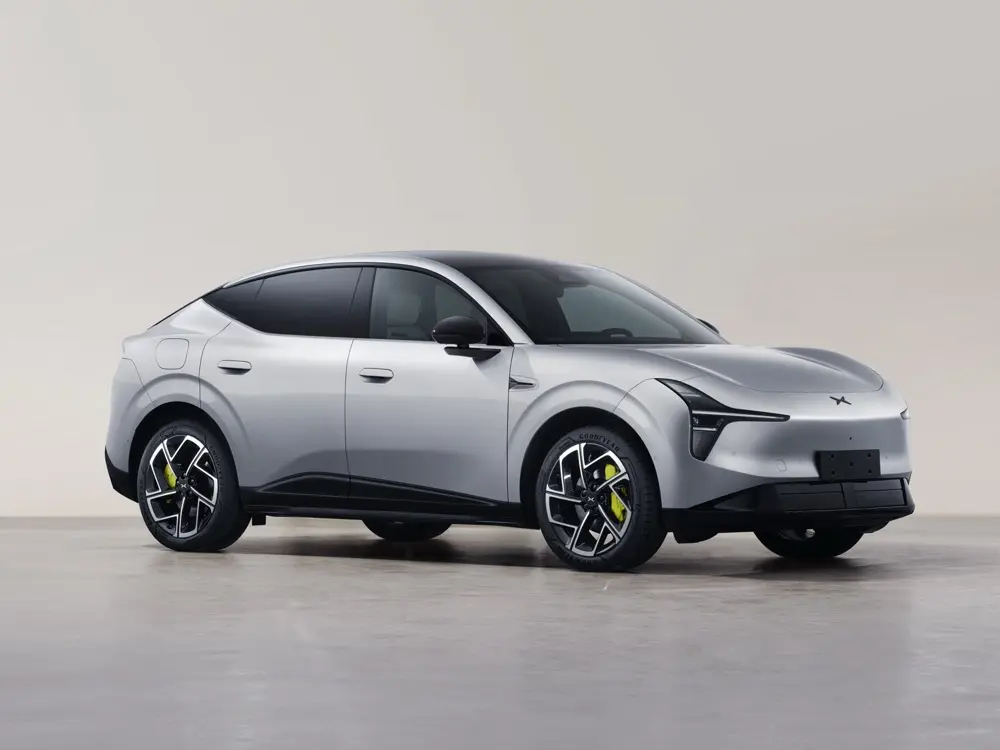
What happens when one sedan carries nearly half your entire company’s sales volume? For XPeng, the answer was staring them in the face: structural collapse. The XPeng MONA L03 SUV, freshly revealed in China’s MIIT filing directory on April 9, isn’t just another electric crossover—it is an emergency parachute designed to break the M03 dependency cycle before it snaps.
With the MONA M03 sedan accounting for a staggering 46% of XPeng’s total sales volume (197,500 units in the previous cycle), the Chinese EV maker has found itself in a precarious hero-product trap. But as M03 deliveries slipped from their monthly peaks in early 2026, XPeng is betting that diversification—not just facelifts—will stabilize its trajectory. The L03 represents that crucial pivot from single-product vulnerability to portfolio resilience.
The M03 Problem: Structural Risk in Plain Sight
XPeng’s MONA sub-brand launched with explosive success. The M03 sedan democratized premium EV features at mass-market prices, becoming the company’s volume anchor. However, automotive strategists recognize this concentration as a liability, not an asset.
- 2025 M03 sales: 197,500 units (46% of XPeng total)
- Early 2026 trend: Monthly volumes declining from 10,000+ peaks
- April 2026 facelift: 10,000 orders in 37 minutes, yet insufficient to reverse portfolio imbalance
See our analysis on how Chinese EV brands navigate the hero-product trap for context on NIO and Li Auto’s diversification strategies.
MONA L03 SUV: Technical Deep Dive
The MIIT filing reveals a vehicle engineered to slot precisely between the compact M03 sedan and XPeng’s established G6 mid-size SUV. Here is the technical breakdown Western investors and industry watchers need to understand:
Dimensions and Platform Strategy
At 4,650–4,672mm length, 1,920mm width, and 1,600mm height, the L03 occupies the compact coupe SUV segment—China’s most contested EV battleground. The 2,850mm wheelbase (3.5cm longer than M03) suggests a dedicated effort to maximize interior volume despite the fastback silhouette.
Notably, the L03 sits smaller than the G6 but larger than European equivalents like the Volkswagen ID.4. Four distinct curb weights (1,855kg to 1,942kg) indicate multiple battery configurations, likely mirroring the M03’s tiered range strategy.
Powertrain and Supply Chain Independence
XPeng is making a significant battery pivot with the L03. While the M03 utilizes BYD’s FinDreams blade batteries, the L03 switches to CALB (China Aviation Lithium Battery) LFP chemistry—a strategic diversification that reduces dependency on rival BYD’s supply chain.
- Motor: Single rear-mounted unit, 183kW (245hp)
- Range projection: 500–650km CLTC (310–404 miles)
- Top speed: 180km/h
- Tire options: 18-inch or 20-inch alloys
This power output positions the L03 above the M03 but below the 218kW G6, creating clear product differentiation without internal cannibalization.
Design Evolution: From Sedan to Coupe SUV
The L03 maintains MONA’s T-shaped starship lighting signature but introduces critical SUV-specific adaptations:
- Aerodynamic focus: Active grille shutters and a pronounced hood rake optimize for drag coefficient
- Fastback profile: Roofline descends from the B-pillar, more aggressively than competitors
- Premium details: Flush door handles, frameless mirrors, privacy glass
- Rear differentiation: Full-width light bar replaces M03’s T-tail lamps, with integrated aerodynamic vents
Autonomous Driving: The VLA 2.0 Gambit
Perhaps the most significant technical disclosure involves XPeng’s pure-vision autonomous strategy. The L03 launches with VLA (Vision-Language-Action) 2.0, eschewing lidar entirely—a bold move contrasting with Li Auto and Huawei’s sensor-heavy approaches.
Hardware configurations suggest a tiered system:
- Standard: Pure camera-based VLA 2.0
- Max variant: Single Turing AI chip
- Ultra SE variant: Dual Turing chips delivering 1,500 TOPS combined compute
This computational headroom positions the L03 to handle urban navigation-assisted driving without expensive lidar hardware, potentially undercutting Western rivals on price while matching functionality.
2026 Market Context: Why Timing Matters
XPeng projects a 2026 official launch for the L03, placing it at a critical industry inflection point. China’s NEV penetration exceeds 50% nationally, but the compact SUV segment—particularly coupe variants targeting younger demographics—remains the fastest-growing volume pool.
External validation comes from XPeng’s recent delivery resilience. Despite M03’s deceleration, the company maintained growth through G6 and G9 sales, demonstrating that SUV demand remains robust. The L03 specifically targets the 150,000–200,000 RMB ($20,500–$27,400) price bracket, where Tesla’s Model Y and BYD’s Sealion 7 currently dominate.
Implications for Western Markets and Investors
For US and European stakeholders, the L03 signals three critical trends:
- Portfolio Maturation: XPeng is transitioning from startup volatility to sustainable product planning, addressing the one-hit wonder risk that has plagued NIO and other Chinese EV entrants.
- Technology Export Potential: The VLA 2.0 system represents China’s most advanced vision-only ADAS attempt. If successful, this architecture could underpin future European-market vehicles, challenging Mobileye and Tesla’s FSD dominance.
- Supply Chain Decoupling: The shift from BYD to CALB batteries illustrates the fracturing of China’s EV supply monolith, creating opportunities for Western battery makers to insert themselves into Tier 2 supplier roles.
Sources: Reuters Automotive, Bloomberg EV Coverage
Recommended Reading
The Powerhouse: America, China, and the Great Battery War by Steve LeVine
This investigative chronicle details the geopolitical and industrial maneuvering behind lithium-ion battery dominance—essential context for understanding why XPeng’s CALB pivot matters beyond simple specification sheets.