XPeng Carbon Credit Revenue Tops RMB 1 Billion: How Chinese EV Makers Are Monetizing European Emissions Rules
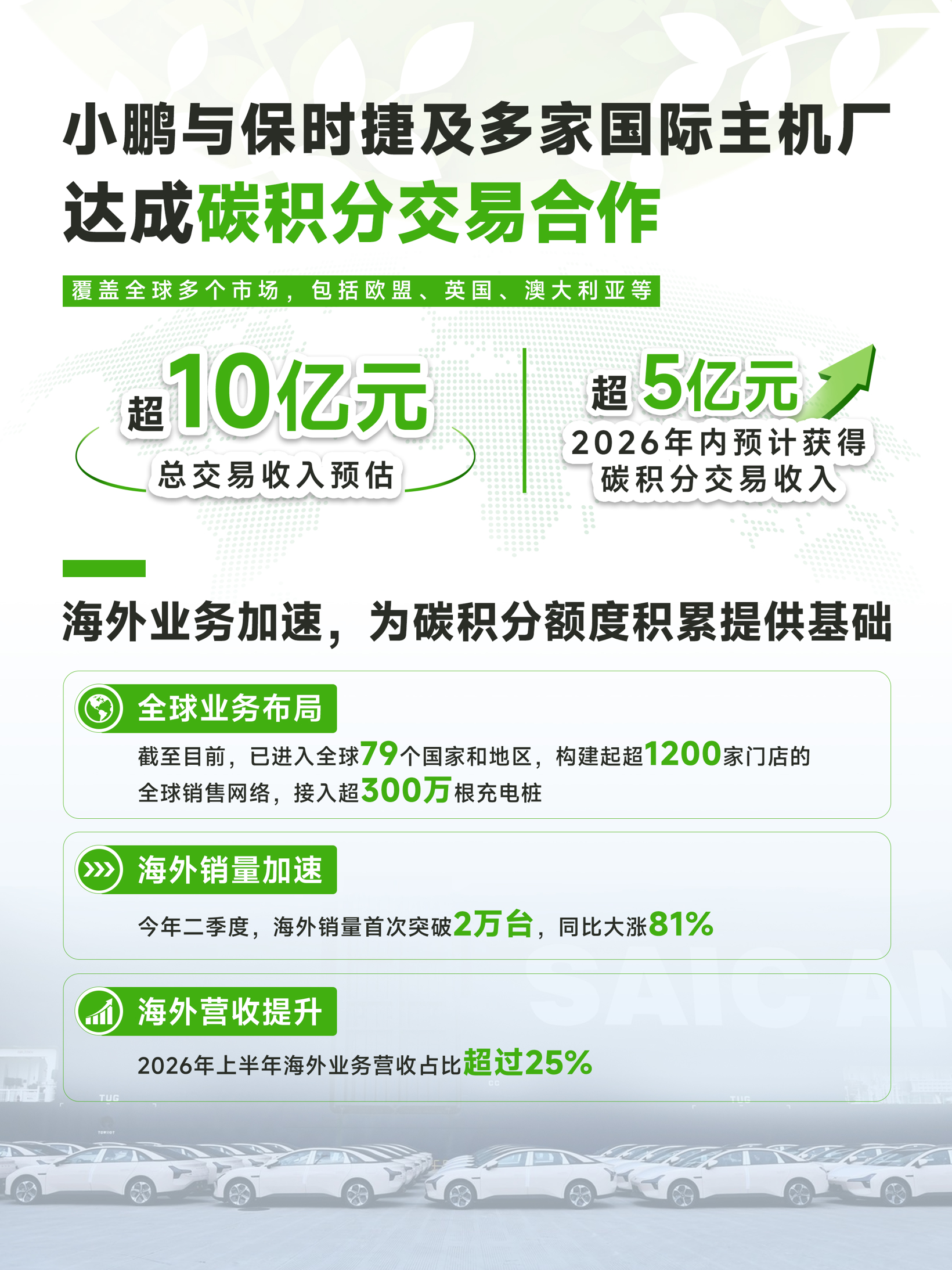
In a development that underscores the unintended financial flows created by Europe's climate policy, Guangzhou-based XPeng Motors has reportedly generated more than RMB 1 billion (approximately $138 million) from selling carbon credits to Porsche and several other international automakers, according to Gasgoo Automotive News. The deals, covering compliance obligations in the European Union, the United Kingdom, and Australia, represent one of the most significant monetization events of regulatory arbitrage in the global auto industry this decade.
The headline number is striking. But as with most things in China's EV sector, the surface story obscures a more complicated reality. XPeng's carbon credit windfall is not simply a story of Chinese technological superiority—it is a story of regulatory fragmentation, European OEM compliance desperation, and the lumpy, uncertain nature of a revenue stream that could evaporate as quickly as it emerged.
Why European Emissions Rules Created a Market for XPeng's Regulatory Surplus
The European Union's passenger car CO2 regulation—Regulation (EU) 2019/631—sets fleet-average emissions targets that tighten annually. For the 2025-2029 period, the EU-wide fleet target is 93.6 g CO2/km under WLTP, a 15% reduction from the 2021 baseline of 110.1 g/km. Each manufacturer must meet its own specific target, which is adjusted by vehicle mass and other parameters.
The penalty structure is brutal: €95 per gram of CO2 per kilometer exceeded, multiplied by the number of vehicles sold in the compliance year. For a manufacturer selling one million vehicles in Europe and missing its target by 5 g/km, the fine would be €475 million ($520 million). This creates an overwhelming incentive to buy credits rather than pay fines.
The EU's credit system operates through two mechanisms: (1) pooling arrangements among manufacturers, and (2) the purchase of "super-credits" or transfers from manufacturers with surplus credits. Under the current framework, manufacturers exceeding their targets generate credits that can be sold to deficit manufacturers. The price is negotiated privately, with industry estimates ranging from €2,000 to €4,000 per credit, though exact pricing in XPeng's deals has not been disclosed.
XPeng's advantage comes from its pure-EV product mix and its relatively low European sales volume. Under EU rules, a manufacturer's target is based on its fleet average, and since XPeng sells only BEVs, its "emissions" are effectively zero. This generates a massive surplus of credits. By contrast, Porsche—whose lineup remains heavily weighted toward high-performance ICE and plug-in hybrid vehicles with relatively high real-world emissions—faces significant deficit obligations.
The UK operates a similar but separate regime under its ZEV mandate and CO2 emissions regulations, while Australia introduced its New Vehicle Efficiency Standard (NVES) in 2024, which began applying penalties from January 1, 2025. XPeng's ability to sell into all three markets suggests a coordinated compliance strategy rather than a one-off transaction.
Inside the Deal: What We Know, What We Don't, and Why It Matters
According to the Gasgoo report, XPeng's carbon credit transactions have targeted multiple international OEMs across the EU, UK, and Australia. Porsche is the only named counterparty, which is significant: Porsche is among the most emissions-intensive major European manufacturers when measured on a fleet-average basis.
Porsche's 2024 global deliveries totaled 310,718 vehicles. In Europe, the company delivered roughly 90,000-100,000 units in 2023. Its lineup includes the 911 (high CO2), Cayenne (heavy SUV), Panamera, Macan (now available as BEV), and Taycan (BEV). The Macan Electric and Taycan together accounted for roughly 25-30% of European volumes in 2024—not enough to offset the ICE-heavy balance of the fleet.
XPeng's European sales volumes remain modest. In 2024, XPeng delivered approximately 20,000-25,000 vehicles in Europe, primarily the G6 SUV and P7 sedan. Under EU credit rules, however, even modest volumes generate surplus credits if the fleet is 100% electric. The company's credit surplus is therefore disproportionately large relative to its actual market presence.
Prior to the XPeng deal, several Chinese EV makers have monetized carbon credits in Europe. Tesla has long been the dominant seller of regulatory credits globally, generating $1.79 billion in regulatory credit revenue in 2023 alone. NIO and other Chinese entrants have also explored credit sales, though at smaller scales.
This table compares the carbon credit positioning of key players:
| Company | 2024 European Fleet CO2 Position | Credit Status | Estimated Credit Revenue/Value (2024) | Primary Compliance Strategy |
|---|---|---|---|---|
| XPeng | ~0 g/km (100% BEV) | Large Surplus | RMB 1 billion+ ($138M+) from carbon credit sales | Sell credits to deficit OEMs |
| Porsche | ~180-200 g/km (est.) | Deficit | Buying credits; undisclosed cost | Purchase credits + increase BEV mix |
| Tesla | ~0 g/km (100% BEV) | Large Surplus | $1.79 billion globally | Sell credits globally |
| Volkswagen Group | ~120-130 g/km (est.) | Moderate Deficit | Not publicly disclosed | Pooling + credit purchases + BEV ramp |
| Stellantis | ~115-125 g/km (est.) | Moderate Deficit | Not publicly disclosed | Pooling with Leapmotor + credit purchases |
| BYD | ~0 g/km (100% BEV/PHEV) | Surplus | Not publicly disclosed | Sell credits selectively |
Note: Fleet CO2 figures are industry estimates based on WLTP data. Credit prices are privately negotiated and not publicly disclosed.
The financial significance for XPeng is substantial. The company reported a net loss of RMB 10.4 billion in 2023 and RMB 5.8 billion in 2024 (approximately $800 million). The RMB 1 billion+ in credit revenue represents roughly 17% of the company's 2024 net loss—meaningful, but far from a path to profitability.
The Cash Flow Mirage: Why Carbon Credits Are Not a Business Model
From our analysis of XPeng's financial disclosures and the European regulatory calendar, the carbon credit windfall presents a dangerous illusion of financial health. Three structural factors undermine its durability:
First, the revenue is inherently non-recurring. Carbon credits are generated annually based on fleet average performance. Once Porsche, or any other OEM, brings its fleet average into compliance—whether through BEV launches, hybrid adoption, or pooling arrangements—the demand for purchased credits collapses. Porsche's Macan Electric and upcoming electric Cayenne will dramatically improve its fleet average by 2026-2027. The window for XPeng to monetize its surplus is narrow.
Second, the credit price is negotiable and declining. As more Chinese BEV makers enter Europe, the supply of surplus credits increases. XPeng, BYD, NIO, Zeekr, and others all generate credits. The buyers—European OEMs—have alternatives. Industry estimates suggest credit prices have already softened from peaks of €4,000-5,000 in 2021-2022 to €2,000-3,000 in 2024. This puts downward pressure on future revenues.
Third, and most critically, the revenue does not address XPeng's core problem: vehicle gross margins. XPeng's automotive gross margin was 8.3% in Q4 2024, a figure that remains well below the 15-20% range that would indicate a sustainable, self-funding business. The company's RMB 1 billion credit revenue is equivalent to boosting gross margin by roughly 1.5-2 percentage points on its 2024 vehicle sales volume—helpful, but insufficient to change the fundamental economics.
The deeper issue is the "volume vs. profit" paradox that characterizes much of China's EV sector. XPeng sold 190,068 vehicles in 2024, a 34% year-over-year increase. Yet the company lost RMB 5.8 billion. The carbon credit revenue, while welcome, masks the fact that XPeng's core vehicle business does not generate positive operating cash flow.
Who Wins, Who Loses, and the Coming Credit Market Correction
The carbon credit transaction creates a complex set of winners and losers across the global auto industry.
XPeng is an obvious short-term winner. The RMB 1 billion+ injection provides liquidity and signals to investors that the company has a non-dilutive funding source. But the strategic value is limited: it does not improve product competitiveness, brand equity, or manufacturing efficiency.
Porsche is a short-term loser on cost but a winner on compliance. The company avoids paying EU fines that would be far more expensive than purchasing credits. Porsche's parent, Volkswagen Group, has its own compliance challenges, and the decision to purchase credits from a Chinese competitor is politically sensitive in Germany. However, it is financially rational.
European legacy OEMs that rely on credit purchases face a structural disadvantage. Each euro spent buying credits from competitors is a euro not invested in BEV development. The need to purchase credits is a symptom of BEV portfolio weakness, not a cause. For companies like Stellantis, which has pursued pooling arrangements with Leapmotor, the dependency on external credits is a strategic vulnerability.
Tesla is a potential loser. Tesla has dominated the global credit sales market for years. As Chinese BEV makers enter the credit supply side, they compete directly with Tesla for deficit OEM customers. The entry of XPeng into the European credit market erodes Tesla's pricing power.
Chinese competitors like BYD, NIO, and Zeekr are positioned to enter the same market. BYD's European sales are growing rapidly—it sold approximately 50,000 vehicles in Europe in 2024 and is targeting 150,000+ in 2025. BYD's credit surplus is likely larger than XPeng's, though the company has not disclosed credit revenue. NIO and Zeekr also generate credits, though their smaller European volumes limit the scale.
The critical strategic question is whether the credit market will remain large enough to support multiple Chinese sellers. The answer is probably no. As European OEMs improve their fleet averages—through BEV launches, PHEV adoption, and efficient ICE improvements—the deficit shrinks. By 2027-2028, the EU credit market may be substantially smaller than it is today.
The Reality Check: Interrogating XPeng's Carbon Credit Windfall
The press release narrative would have you believe that XPeng has discovered a lucrative new business model: selling regulatory compliance to Western automakers. The engineering and financial reality is more nuanced, and several claims require rigorous interrogation.
First, is the RMB 1 billion figure recurring or one-time? The Gasgoo report does not specify the time period. If the revenue was recognized over multiple years (2023-2024), the annual run-rate could be RMB 300-500 million—substantial but not transformative. If the figure represents a single year, it is a windfall that will not repeat. Neither XPeng nor Porsche has provided clarification.
Second, what is the actual price per credit? Industry estimates of €2,000-4,000 per credit are loosely sourced. The actual transaction price could be lower, particularly if XPeng negotiated a volume discount to secure a large, credible counterparty like Porsche. Without disclosure, we cannot assess the margin on these sales—though for XPeng, the cost basis is essentially zero, making any price profitable.
Third, does this deal create dependency? For XPeng, the answer is no—the company is the seller, not the buyer. But for Porsche, the dependence on credit purchases to meet regulatory obligations raises questions about its long-term compliance strategy. Porsche has publicly committed to having 80% of its deliveries be BEVs by 2030, but its current trajectory lags that target. The credit purchases are a stopgap, not a solution.
Fourth, is the EU carbon credit system itself sustainable? The EU is set to review the CO2 regulation for 2025-2030 and may tighten rules further. The 2026 revision could alter the credit transfer mechanism, potentially capping the volume of credits that can be purchased or setting a floor price. Such changes would reduce the value of XPeng's surplus. Regulatory risk is high.
Fifth, what happens when XPeng's own European volumes scale? As XPeng sells more vehicles in Europe, its surplus credits will increase—but so will the scrutiny. European regulators may question whether Chinese-produced BEVs should generate credits that European OEMs can purchase, particularly if the vehicles are imported rather than locally produced. This is a political risk that could materialize as early as 2026.
The honest assessment: XPeng's carbon credit revenue is real money, but it is not a business. It is a temporary financial bridge that reflects European regulatory failure more than Chinese technological superiority. Investors should treat it as a non-recurring item, not a valuation driver.
Trade Barriers, Regulatory Arbitrage, and the Geopolitics of Carbon Credits
The carbon credit transaction sits at the nexus of two conflicting policy trends: Europe's aggressive climate regulation and the West's increasing trade barriers against Chinese EVs.
On one hand, the EU's CO2 fleet regulation creates a legal mechanism for Chinese BEV makers to profit from European climate policy. The credits are a legitimate compliance tool within the EU framework. There is no legal barrier to XPeng selling credits to Porsche.
On the other hand, the EU has imposed countervailing duties on Chinese BEVs, ranging from 7.8% to 35.3% depending on the manufacturer. XPeng faces a 20.7% duty (on top of the standard 10% auto tariff). The credit revenue partially offsets these duties—RMB 1 billion across 20,000-25,000 vehicles is equivalent to roughly RMB 40,000-50,000 per vehicle, or €5,000-6,500. This is a meaningful offset to the countervailing duty burden.
But the offset is coincidental, not strategic. XPeng's credit revenue is generated by regulatory compliance, not by competitive advantage in manufacturing or technology. If the EU were to eliminate the credit transfer mechanism—or cap it—XPeng would lose the revenue with no recourse.
The US market is entirely closed to XPeng due to Section 301 tariffs (100% on Chinese EVs) and IRA FEOC rules that exclude Chinese battery components from consumer tax credits. XPeng has no path to monetizing carbon credits in the US, as the US does not have a fleet-average CO2 credit trading system comparable to the EU's.
Australia's NVES is a new and evolving regime. The credit market there is smaller and less liquid than Europe's. XPeng's participation is a positive signal, but the revenue from Australia is likely marginal compared to the EU and UK.
The strategic implication is clear: XPeng's carbon credit revenue is a European regulatory phenomenon. It is not a global business model. It is dependent on the continuation of a specific policy framework that could change at any time.
Strategic Outlook: Three Scenarios for XPeng's Carbon Credit Revenue
Bull Case
XPeng continues to generate RMB 500 million to RMB 1 billion annually from carbon credit sales through 2027, as European OEMs struggle to meet tightening CO2 targets. The company uses the proceeds to fund BEV platform development and expand its European sales network. Credit revenue, combined with improving vehicle gross margins (reaching 12-15% by 2026), brings XPeng to breakeven by 2027. The company becomes a case study in how Chinese EV makers can leverage regulatory compliance as a bridge to profitability.
Probability assessment: 20-25%. This scenario requires European OEMs to remain significantly off-track on their CO2 targets, which is unlikely given the pace of BEV launches from Volkswagen, Stellantis, and others.
Base Case
XPeng's carbon credit revenue declines to RMB 200-400 million annually by 2026 as European OEMs improve their fleet averages and more Chinese BEV makers enter the credit supply side. The revenue remains a modest but helpful contributor to XPeng's cash flow, equivalent to 3-5% of vehicle revenue. XPeng does not achieve breakeven until 2028-2029. The credit sales are viewed by investors as a one-time benefit, not a recurring revenue stream.
Probability assessment: 50-60%. This aligns with the expected trajectory of European CO2 compliance and the competitive dynamics of the credit market.
Bear Case
The EU revises its CO2 regulation in 2026 to restrict credit transfers to domestically produced vehicles or caps the volume of purchasable credits. European OEMs accelerate their BEV transitions, reducing credit demand faster than expected. XPeng's credit revenue collapses to near zero by 2027. The company faces a funding gap and is forced to raise capital at dilutive valuations. This scenario coincides with intensifying EU trade barriers and a slowdown in European BEV demand.
Probability assessment: 20-25%. Regulatory risk is real, and the political environment in Europe is increasingly hostile to Chinese EV imports.
Key Takeaways for Executives and Investors
- Treat XPeng's carbon credit revenue as non-recurring, not recurring. The RMB 1 billion+ figure is a windfall that reflects European regulatory pressure, not a durable competitive advantage. Valuation models should assign zero terminal value to this revenue stream.
- Carbon credits are a symptom, not a solution, for European OEMs. Porsche's purchase of credits from XPeng is a temporary compliance measure. The real solution is accelerating BEV development and improving fleet efficiency. Investors should scrutinize which European OEMs are buying credits versus investing in their own electrification.
- The credit market will shrink, not grow. As European OEMs improve their compliance and more Chinese BEV makers enter the supply side, credit prices will decline and the addressable market will contract. This is not a growth industry.
- Regulatory risk is the dominant factor. The EU's CO2 regulation is subject to revision in 2026. Any change to the credit transfer mechanism could eliminate XPeng's revenue overnight. Investors should not underwrite this revenue stream without a clear understanding of the regulatory calendar.
- Watch for BYD's entry into the credit market. BYD's larger European sales volume and lower cost structure make it a more formidable credit seller than XPeng. If BYD begins disclosing credit revenue, it will confirm that the market is becoming commoditized and margins are compressing.