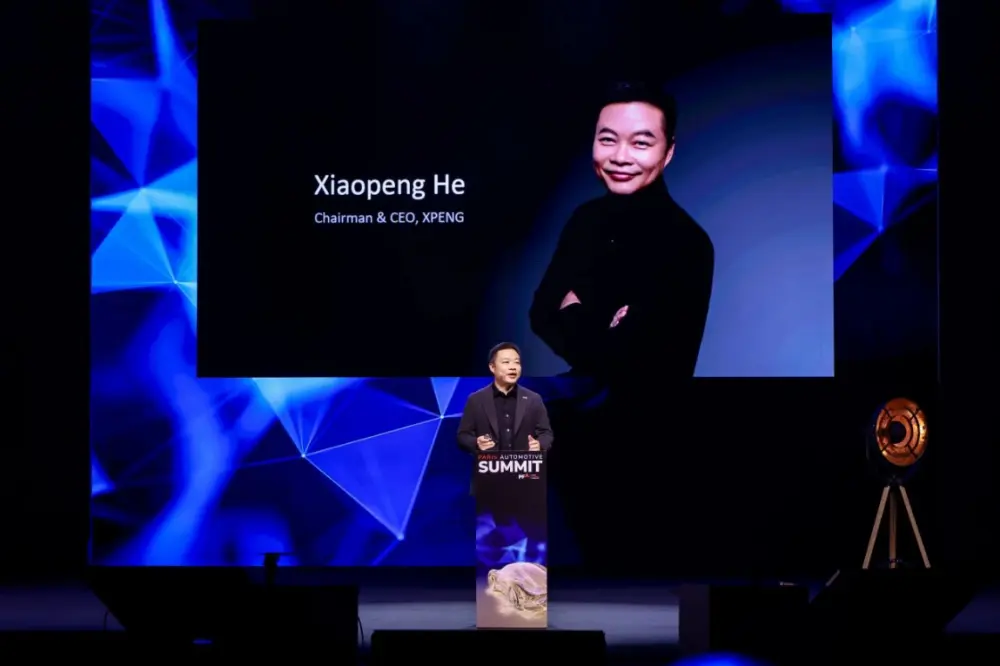
At the 2026 Paris Automotive Summit, XPeng Chairman and Chief Executive He Xiaopeng stood as the sole Chinese automaker chief invited to deliver a keynote address, pitching what the company terms XPeng AI Engineering. Rather than simply showcasing another export-ready electric sedan to dodge escalating European Union countervailing duties, XPeng unveiled a far more ambitious strategic gambit: opening its proprietary physical AI, custom silicon, and full-stack software architecture to legacy Western automakers as a licensed technology provider. The presentation sought to recast XPeng from an embattled domestic electric vehicle manufacturer into an indispensable tier-0.5 technology partner for an international auto industry struggling with software-defined vehicle transitions.
The geopolitical backdrop in Paris could not have been more fraught. With Brussels enforcing targeted countervailing tariffs ranging up to 35.3% on Chinese-built electric vehicles atop standard 10% import duties, shipping stamped metal across oceans has become an increasingly capital-destructive endeavor. XPeng's countermove—licensing XPeng AI Engineering capabilities directly to European incumbents—is designed to convert geopolitical hostility into recurring, high-margin software royalties. Yet beneath the polished summit presentation lies a fundamental operational question: Can an architecture engineered around Chinese traffic dynamics, domestic infrastructure, and localized data sets realistically survive the regulatory and engineering scrutiny of Western legacy automotive boards?
Dissecting XPeng AI Engineering: Inside the Turing SoC and End-to-End VLA Stack
To understand the engineering scope of XPeng's open-platform proposition, one must examine the specific computing hardware and neural network stack underpinning the ecosystem. At the core of the announcement is the proprietary 'Turing' AI silicon, a custom application-specific integrated circuit (ASIC) engineered specifically for physical AI workloads, autonomous driving, and humanoid robotics. Designed with a 40-core processor architecture capable of sustaining local computation for large vision-language-action (VLA) neural network models exceeding 30 billion parameters, the Turing chip represents XPeng's bid to decouple from total reliance on Nvidia's Drive Thor merchant silicon while tailoring memory bandwidth directly to transformer-based spatial reasoning.
Unlike conventional autonomous driving architectures that rely on rigid, rule-based heuristics spliced together with distinct perception and trajectory planning sub-modules, XPeng's AI Engineering framework is built around an integrated end-to-end foundation model. The system ingests raw camera feeds and multimodal sensor telemetry, mapping visual inputs directly into vehicle control vectors via unified spatial representations. According to technical documentation shared in Paris, this architecture delivers a threefold improvement in edge-case resolution speeds over the company's previous XNet deep-learning pipelines, supported by the integration of custom neural network compilers inside the XOS Tianji operating system.
| Platform / Provider | Primary Compute Architecture | Perception Philosophy | Model Topology | Commercial Licensing Model | Western Regulatory Clearance |
|---|---|---|---|---|---|
| XPeng AI Engineering | In-house Turing ASIC (40-core, ~30B parameter local model support) | Vision-centric with targeted solid-state LiDAR redundancy | End-to-End Vision-Language-Action (VLA) foundation network | Tier-0.5 Full-stack license / CEA architecture co-development | Limited to controlled pilot testing; UNECE DCAS Phase 2 pending |
| Tesla FSD (Hardware 4.0 / AI5) | Custom FSD Silicon (~500 TOPS per node; AI5 target ~4nm) | Pure Vision (Zero LiDAR, Zero Ultrasonic sensors) | Monolithic End-to-End neural network (photons-to-control) | Closed vertical stack (Wholesale licensing offered, zero takers) | Self-certification in North America; restricted in EU under UN-R79 |
| Mobileye (SuperVision / Chauffeur) | EyeQ6 High (Dual-SoC, 7nm, ~134 TOPS equivalent) | True Redundancy (Independent camera and radar/LiDAR subsystems) | RSS (Responsibility-Sensitive Safety) mathematical rule bounds + deep networks | Traditional Tier-1 component and software bundle supply | Full UNECE approval; integrated by multiple European legacy OEMs |
| NVIDIA DRIVE (Thor Platform) | Blackwell architecture (Up to 1,000–2,000 TFLOPS FP4) | Sensor-agnostic (Supports heterogeneous camera, radar, LiDAR arrays) | Open modular foundation (Supports proprietary OEM models & DRIVEOS) | Merchant silicon and middleware development kit license | ISO 26262 ASIL-D system compliant; broad global deployment |
By contrasting these four engineering methodologies, the industrial divergence becomes apparent. While Nvidia sells open compute platforms without dictating software topology, and Mobileye delivers rigid black-box systems with established regulatory compliance, XPeng is attempting to occupy a precarious middle ground. It is offering an end-to-end vertical stack—encompassing the electronic/electrical architecture, low-level operating system, and high-level behavioral models—to third-party automakers who possess neither the balance sheets to outspend Silicon Valley nor the internal software capability to match Chinese development velocity.
Dismantling the Tier-1 Hierarchy: The Economics of the White-Label Strategy
The strategic pivot embedded within XPeng's Paris presentation represents a calculated assault on traditional automotive supply chain economics. For decades, legacy Western automakers have procured electronic and electrical components through an entrenched hierarchy of Tier-1 integrators—such as Bosch, Continental, ZF, and Denso. In this legacy arrangement, automakers paid substantial markups on physical electronic control units (ECUs), resulting in highly fragmented distributed vehicle architectures containing between 70 and 100 disparate microcontrollers from dozens of competing vendors. The consequence for Western OEMs has been catastrophic: bloated bill-of-materials (BOM) costs, software integration gridlock, and an inability to deliver cohesive over-the-air (OTA) updates.
XPeng's CEA (China Electrical Architecture), developed initially in partnership with Volkswagen for its Hefei-produced MEB and CMP vehicle platforms, serves as the operational prototype for this commercial offensive. By centralizing vehicle computing into a consolidated zonal architecture controlled by just three central computing nodes—driving, cockpit, and body domain controllers—XPeng asserts that partner automakers can strip out up to 30% of wiring harness weight, eliminate dozens of redundant secondary microcontrollers, and compress electronics procurement costs by roughly $1,200 to $1,800 per vehicle. For an automaker producing 500,000 units annually, that margin delta represents real operating profit in an era where EV divisions are bleeding billions in capital.
However, the economic upside for XPeng is arguably even more compelling. Manufacturing finished passenger vehicles is an inherently low-margin, capital-intensive business, burdened by plant depreciation, raw material price shocks, warranty liabilities, and intense dealership discounting. In contrast, white-label software and architecture licensing commands software-like gross margins exceeding 70% once non-recurring engineering (NRE) costs are amortized. If XPeng can successfully institutionalize its AI Engineering framework across European OEMs, it transitions its valuation multiple from a cyclical automotive manufacturer into an intellectual property and software licensing entity.
Caught Between Wolfsburg and Silicon Valley: The Shifting Competitive Dynamics
The competitive reverberations of XPeng's open-platform AI pitch will fall unevenly across the global automotive matrix. The most direct victims of this transition are not other vehicle manufacturers, but the legacy Tier-1 suppliers. Continental's ongoing restructuring of its automotive group and Bosch's targeted software division cost reviews reflect an uncomfortable reality: traditional automotive software consultancies cannot match the iterative development pace of Chinese engineering teams operating on six-month release cadences. If Western legacy brands embrace Chinese domain controllers and operating stacks, incumbent Tier-1 component providers face rapid margin erosion and disintermediation.
Conversely, independent global automakers that have pursued a decoupled supply chain strategy—most notably the Hyundai Motor Group—find themselves operating from a position of relative structural insulation. By consciously avoiding heavy retail dependency on the Chinese domestic market and building out proprietary high-margin, dedicated 800V architectures (such as the E-GMP platform) alongside dedicated internal autonomous driving units (42dot and Motional), decoupled players have preserved operational autonomy. They are neither exposed to the margin-crushing domestic Chinese price wars nor dependent on licensing critical neural-network software architectures from Chinese technological competitors.
For mid-tier European brands, the calculus is fraught with operational peril. Adopting XPeng's full-stack architecture solves their immediate technological deficiency in advanced driver assistance systems (ADAS) and intelligent cockpits within an accelerated 18-to-24-month vehicle development cycle. Yet it surrenders their software soul in the process. Once an OEM commits its zonal wiring, sensor interfaces, and compute controllers to another manufacturer's proprietary operating system, the switching costs become prohibitive. The licensee ceases to be a true technological innovator, functioning instead as a contract manufacturing shell and marketing brand wrapped around an external digital core.
The Reality Check: Can XPeng AI Engineering Survive Sovereign Data Firewalls?
Beyond the polished stagecraft in Paris, XPeng's global AI vision collides head-on with immutable engineering, geopolitical, and data sovereignty barriers. The corporate narrative asserts that physical AI foundation models can simply be mapped onto global vehicle fleets to unlock ubiquitous autonomy. Engineering first principles suggest otherwise. Machine learning models trained on millions of hours of Chinese traffic video feeds—characterized by high-density scooter interactions, complex mixed-traffic roundabouts, and non-standard road construction markers—do not possess innate spatial zero-shot transferability to European or North American road regimes without extensive, localized edge-case re-training.
This reality exposes the profound data decoupling trap. Under the European Union General Data Protection Regulation (GDPR) and the newly enacted EU Artificial Intelligence Act, raw optical telemetry and high-resolution driving video collected on European roads cannot be casually ingested and transferred to server clusters in Guangzhou or Hefei for model weight training. Brussels categorizes real-time biometric and urban video surveillance data under severe sovereign restrictions. To deploy a viable autonomous driving stack in Europe, XPeng cannot merely import its Chinese weights; it must establish physically isolated European sovereign cloud compute nodes, rebuild localized training data pipelines from scratch, and navigate protracted third-party safety validation audits.
Furthermore, one must rigorously interrogate XPeng's brand marketing conflation of automotive ADAS with 'Physical AI'—a term popularized to encompass humanoid robotics and automated aerial vehicles alongside road passenger cars. Demonstrating pre-rendered humanoid robotics concepts such as 'Iron' or displaying modular flying car prototypes during investor roadshows serves an undeniable equity narrative pumping function, inflating company valuation multiples during an extended domestic price war. However, automotive institutional capital recognizes that consumer-grade passenger car autonomy requires deterministic, ASIL-D safety guarantees. The gap between an end-to-end neural network performing well in favorable weather conditions on a geofenced Chinese ring road and passing stringent, unmapped European winter safety audits remains vast and unbridged.
Geopolitical Obstacles: Cross-Border Model Weights and UNECE Regulations
The regulatory headwinds confronting Chinese autonomous vehicle software in Western jurisdictions are shifting from simple tariff barriers to active national security exclusions. In Washington, the United States Department of Commerce has initiated sweeping rulemaking specifically designed to ban Chinese-origin software and hardware within connected and automated vehicles operating on American roads, explicitly citing data exfiltration and vehicle control override risks. While the European Union has thus far avoided an outright software embargo, regulatory scrutiny over vehicle cybersecurity and cross-border telematics is hardening rapidly.
Automakers attempting to license XPeng AI Engineering in European markets must comply with UNECE regulations R155 (Cyber Security Management System) and R156 (Software Update Management System), as well as emerging DCAS (Driver Control Assistance Systems) Phase 2 frameworks. These regulatory mandates require granular documentation of source code provenance, transparent risk assessments of supply chain software vulnerabilities, and clear legal liability trails for automated driving incidents. If a licensed end-to-end model makes an erratic braking decision resulting in a multi-car collision on an autobahn, European courts and regulators will demand complete architectural auditability—a criteria that opaque, deep neural networks struggle to satisfy.
To navigate these structural obstacles, XPeng is forced to adopt complex, highly localized compliance strategies. Rather than operating as an exporter of direct technology, the company must structure its European engagements through legally firewalled joint ventures, cloud-hosted data rooms managed by verified European infrastructure providers, and explicit technology-licensing carve-outs. This localization effort significantly inflates operational overhead, steadily degrading the cost advantage that Chinese software engineering traditionally commanded over its Western counterparts.
Strategic Foresight: Three Trajectories for XPeng AI Engineering
As institutional investors, board-level strategists, and supply chain analysts evaluate XPeng's pivot toward an open physical AI architecture, the long-term outcomes will likely bifurcate along three distinct commercial paths.
Bull Case
XPeng successfully expands its Volkswagen joint development partnership into a broader, multiregional alliance, licensing the CEA electronic architecture and Turing compute stack across multiple global model lines. European mid-tier OEMs, unable to shoulder the multi-billion-dollar R&D burn required to build custom AI architectures, capitulate and adopt XPeng as their primary software and compute integrator. XPeng establishes compliant European sovereign data centers in Frankfurt or Dublin, clearing UNECE safety certifications. High-margin software licensing revenue scales to represent over 25% of XPeng's consolidated operating cash flows, shielding the enterprise from retail tariff wars and securing an elevated market valuation multiple.
Base Case
The licensing footprint remains largely confined to China-specific production platforms for Western joint ventures (such as Volkswagen's localized CMP models), with only modest, boutique technology integrations reaching European production lines. Western OEMs utilize XPeng's software capabilities to defend their collapsing market share inside mainland China, but staunchly resist deploying Chinese core architectures in their domestic European and North American vehicle portfolios due to board-level geopolitical risk aversion and customer data privacy sensitivities. XPeng sustains incremental licensing fees that partially offset domestic EV manufacturing losses, but fails to displace Nvidia or Mobileye as the dominant global compute supplier.
Bear Case
Tightening European Union regulations regarding connected vehicle infrastructure and AI safety transparency trigger severe regulatory delays, rendering the export of XPeng's end-to-end software stack commercially unfeasible outside China. Simultaneously, domestic Chinese OEM competitors—including Huawei's Qiankun ecosystem and BYD's in-house Xuanji architecture—aggressively undercut XPeng on computing component pricing, igniting a margin-crushing price war within China's white-label automotive software sector. Trapped under heavy R&D amortizations for the Turing ASIC and restricted from monetizing its software globally, XPeng faces ballooning operating deficits and a return to margin-diluting physical vehicle discounting.
Executive Strategic Takeaways:
- Evaluate the Sovereign Boundary: Western automotive leadership must distinguish between localized China-market joint ventures and cross-border software integration; adopting Chinese neural network stacks for Western domestic markets carries massive compliance, liability, and regulatory exposure risks.
- Scrutinize Full-Stack Vendor Lock-in: Licensing a unified electronic and software architecture (such as CEA) eliminates significant near-term BOM and development costs, but systematically strips the host OEM of long-term software sovereignty and platform flexibility.
- Look Beyond Compute Benchmarks: High claimed model parameter counts (~30B) and custom ASIC processor core numbers do not correlate directly with operational safety in unmapped export territories; insist on independently audited disengagement metrics across Western road geometries.
- Monitor Merchant Silicon Resilience: Decoupled suppliers like Nvidia and established sensor integrators like Mobileye retain substantial regulatory moats across the US and Europe that Chinese full-stack challengers will require years, and significant capital expenditure, to replicate.