Xiaomi Extended-Range Electric Vehicle Pivot: Why Lei Jun Is Building EREVs
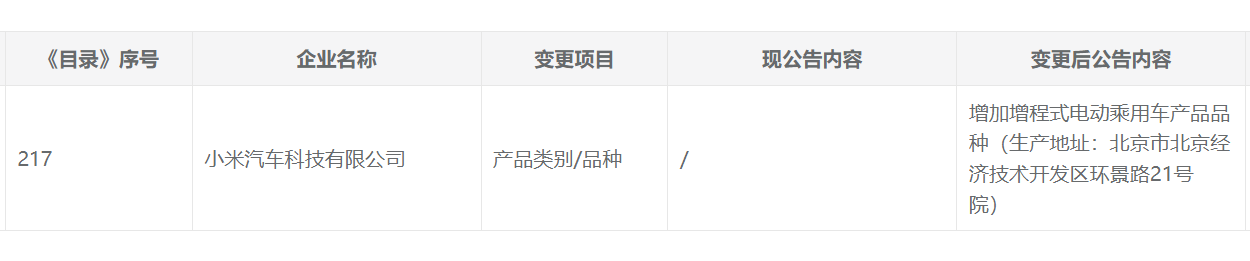
As a veteran automotive market analyst monitoring Beijing's tech-to-automotive corridor, I have watched Xiaomi's meteoric rise with its debut SU7 pure electric sedan closely. However, a major regulatory shift has just changed the playing field entirely. According to the 408th batch of the 'Public Notice of Road Motor Vehicle Manufacturing Enterprises and Products' released by China's Ministry of Industry and Information Technology (MIIT), Xiaomi has officially applied to add 'extended-range electric passenger vehicle' to its product line. This regulatory green light confirms that the rumored Xiaomi extended-range electric vehicle (EREV) strategy is no longer a plan—it is a production reality.
Decoding Xiaomi's Pivot to EREVs
According to the MIIT filing, the production location for these new hybrid-electric vehicles will remain at the Beijing Yizhuang Xiaomi EV Hyperfactory (No. 21 yard, Huanjing Road). Securing the regulatory license—often dubbed the 'birth permit' (准生证) in Chinese automotive circles—is the final formal hurdle. This indicates that Xiaomi's second and third vehicle models, heavily rumored to be SUVs, will feature EREV powertrains alongside pure electric (BEV) options.
From an investment and competitive standpoint, this is a highly logical pivot. While the pure battery-electric vehicle market in China is locked in a brutal price war, the EREV segment has emerged as a high-margin oasis. EREVs utilize a smaller, cheaper battery pack paired with an internal combustion engine (ICE) that acts solely as a generator to charge the battery. This setup eliminates range anxiety for consumer buyers in China's Tier 2 and Tier 3 cities while keeping the vehicle's bill of materials (BOM) significantly lower than a long-range BEV.
The Secret Timeline: Lei Jun's Calculated Pragmatism
To those tracking the industry's granular details, this development is not a surprise. Xiaomi's layout for EREVs began long before the SU7 even hit the streets. In the autumn of 2023, while SU7 launch preparations were in full swing, Xiaomi quietly posted job openings for 'EREV System Design and Development Engineers'.
When questioned at the time, Xiaomi CEO Lei Jun publicly asserted that the company was 'temporarily not doing EREV.' In hindsight, this was a calculated tactical diversion. Xiaomi needed to concentrate all engineering resources and public relations focus on launching the SU7 as a pure BEV technology tour-de-force to establish premium brand equity. Now that the SU7 has achieved market validation, the 'China-speed' transition to EREVs is fully underway.
Strategic Implications for Western OEMs and Investors
For Western OEMs (such as Ford, General Motors, and Volkswagen) and global automotive investors, Xiaomi's EREV expansion should sound alarm bells. EREVs are acting as the ultimate bridge technology in China, capturing family-car buyers who want the tech-forward cabin of an EV but the charging flexibility of a hybrid. Companies like Li Auto and Huawei-backed Seres (Aito) have proven that EREVs yield far superior gross margins compared to pure BEVs in the $30,000 to $50,000 price range.
| Metric | Pure BEV (Xiaomi SU7) | Upcoming Xiaomi EREV (SUV) |
|---|---|---|
| Battery Capacity | 73.6 kWh - 101 kWh | Estimated 30 kWh - 45 kWh |
| BOM / Battery Cost | High (Vulnerable to raw material swings) | Moderate (Highly optimized cost structure) |
| Target Market Segment | Urban tech-adopters, performance fans | Families, long-distance commuters, Tier 2-4 markets |
| Margin Profile | Slim (Due to aggressive market pricing) | High (Leveraging low battery size + premium features) |
As Western automakers walk back their aggressive pure-EV targets due to sluggish domestic demand, Chinese giants are not slowing down. Instead, they are diversifying. By securing the license for a Xiaomi extended-range electric vehicle, Xiaomi is positioning itself to capture both the premium urban BEV buyer and the high-volume, range-anxious suburban family. This tactical agility is precisely what defines 'China-speed' and why Xiaomi remains a formidable threat to legacy automakers worldwide.