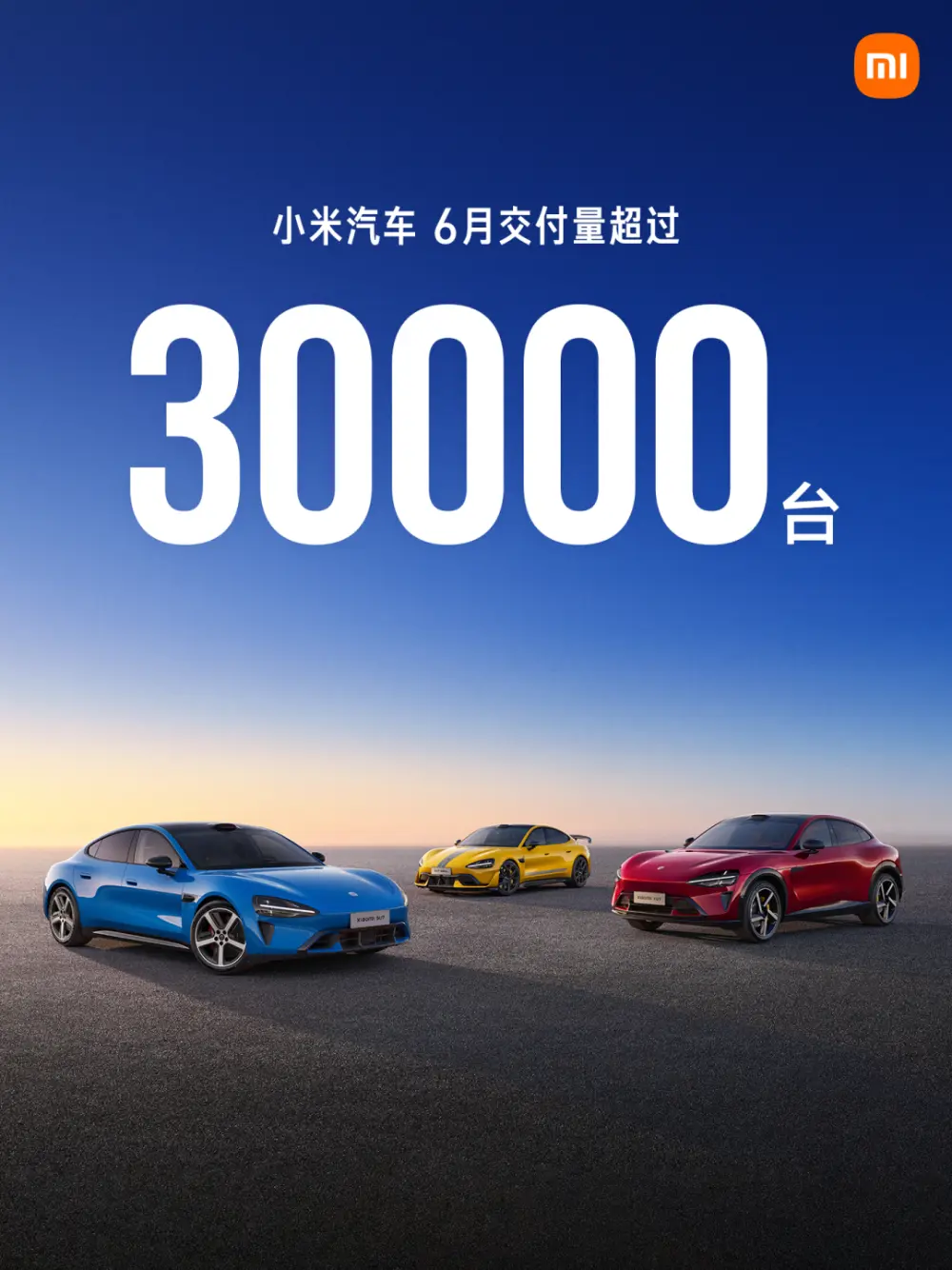
The global automotive industry is witnessing an unprecedented shift as tech giants outpace traditional carmakers in manufacturing execution. In its latest monthly update, Xiaomi EV has shattered expectations by delivering over 30,000 vehicles in June 2026. This milestone highlights a massive expansion in
Decoding Xiaomi's Hyper-Scale: The H1 2026 Deliveries
On July 1, 2026, Xiaomi officially announced its delivery metrics for June, confirming that monthly volume sustained its position above the 30,000-unit threshold. This marks the third consecutive month (April, May, and June 2026) that Xiaomi has delivered over 30,000 vehicles. Cumulatively, Xiaomi EV has delivered approximately 180,000 units in the first half of 2026 alone.
To put this in perspective, many traditional premium EV brands take several years to reach an annual run rate of 180,000 vehicles. Xiaomi has achieved an annualized run rate of nearly 360,000 vehicles within just two years of its initial product launch. This suggests that the bottlenecks limiting early Xiaomi EV production capacity have been systematically resolved.
The Secrets Behind Xiaomi's Rapid Production Scale-up
How did a consumer electronics company build a highly efficient automotive supply chain almost overnight? From our perspective as market analysts, Xiaomi's success rests on three pillars:
- The Smartphone Playbook Applied to Cars: Xiaomi treated its EV supply chain with the same rigorous component-standardization and inventory-velocity strategies it uses for smartphones. This drastically reduced lead times for critical semiconductors and smart cabin electronics.
- Advanced Smart Manufacturing (Gigacasting): Xiaomi's Beijing factory utilizes highly automated, proprietary large-scale die-casting machines (similar to Tesla's gigapresses), reducing body assembly complexity and labor costs.
- Local Ecosystem Synergies: By leveraging Beijing's highly concentrated EV supply chain cluster, Xiaomi minimized logistical friction for battery packs, electric motors, and ADAS hardware.
Xiaomi vs. Legacy OEMs: The Scaling Gap
For Western OEMs like Volkswagen, Ford, and even Tesla, Xiaomi's rapid ascent is a sobering reality check. While Western manufacturers grapple with software bugs, battery bottlenecks, and scaling delays, Xiaomi is executing with absolute precision. The table below illustrates the contrasting trajectories of modern EV scaling.
| OEM / Brand | Est. Months to Reach 30k/mo Deliveries (From Launch) | Primary Advantage | Key Bottleneck |
|---|---|---|---|
| Xiaomi EV | < 26 Months | Software-defined vehicle expertise & supply chain speed | Geopolitical trade barriers in Western markets |
| Tesla (Model 3) | ~ 36 Months | First-mover advantage & global factory footprint | Legacy factory retooling & 'production hell' phases |
| Legacy European OEMs | 48+ Months | Established global distribution & brand equity | Software integration & slow decision-making structures |
Investor & Strategic Outlook
From an investment standpoint, Xiaomi's automotive unit is transitioning from a capital-intensive cash burn to a high-volume margin contributor. The rapid optimization of Xiaomi EV production capacity means that fixed cost amortization is occurring much faster than analysts initially modeled. This puts Xiaomi in a prime position to expand its product portfolio—rumored to include a family SUV and a lower-cost model—with robust unit economics.
For Western strategy directors, the lesson is clear: compete on software and ecosystem integration, or risk being priced out. Xiaomi has proven that the 'China-speed' phenomenon is not just about cheap labor, but superior supply-chain integration and manufacturing innovation.