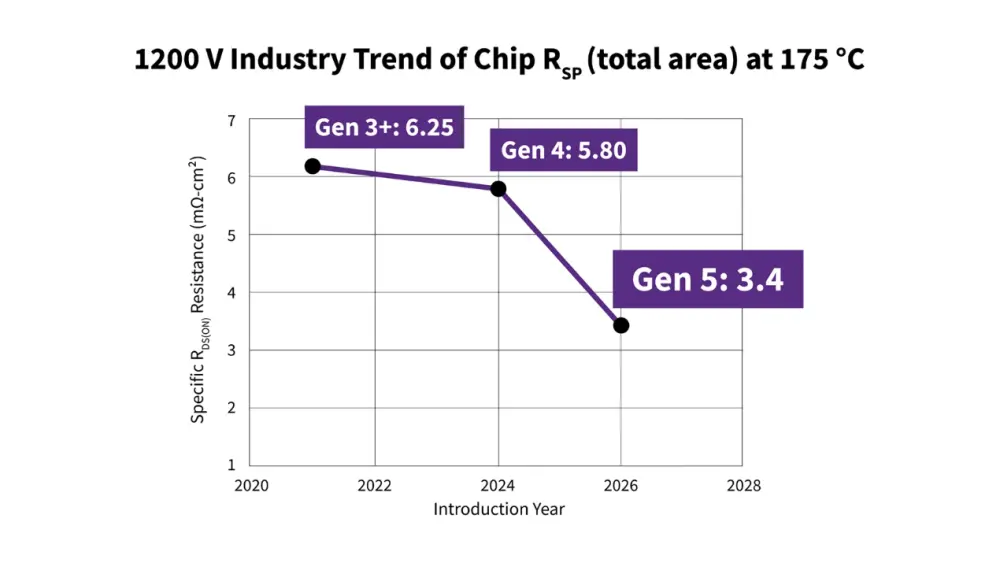
On June 9, 2026, Silicon Carbide (SiC) pioneer Wolfspeed officially unveiled its highly anticipated fifth-generation power semiconductor platform, introducing the groundbreaking Wolfspeed Gen5 SiC MOSFET. Designed specifically for next-generation 1200V and 750V power systems, this technology achieves the industry's lowest on-resistance (RDS(on)), directly tackling the critical thermal and efficiency bottlenecks currently limiting global EV range and fast-charging capabilities.
Why the Wolfspeed Gen5 SiC MOSFET Matters for EV Powertrains
In the power semiconductor landscape, on-resistance (RDS(on)) is the primary metric governing energy loss. When electric current passes through a traditional silicon chip, significant energy is wasted as heat. Silicon Carbide inherently boasts a wider bandgap, allowing for much higher voltage tolerances. However, Wolfspeed's Gen5 technology takes this further by minimizing internal resistance to unprecedented levels.
As an industry analyst observing the rapid evolution of high-voltage automotive architectures, I view this release as a critical defense play by Western semiconductor manufacturing. While Chinese tier-1 suppliers and local chipmakers are rushing to vertically integrate their SiC supply chains to support domestic brands like BYD and Xiaomi, Wolfspeed is raising the bar on sheer physical performance.
The Core Technical Breakthroughs
Wolfspeed's fifth-generation platform targets two core voltage nodes: 1200V and 750V. These targets align perfectly with the auto industry's ongoing transition to 800V high-voltage platforms and high-efficiency sub-systems.
- Industry-Lowest RDS(on): Reduced thermal losses directly translate to an estimated 3% to 5% increase in overall EV battery range without modifying the battery pack itself.
- Superior Thermal Management: Lower operating temperatures reduce the weight, complexity, and cost of external cooling loops in the inverter.
- Die Size Optimization: Higher power density means smaller chips, allowing OEMs to achieve higher power outputs within extremely tight packaging constraints.
Strategic Implications: The Western Response to 'China-Speed'
While the Chinese domestic market has been aggressively scaling its SiC footprint via local players like Sanan Optoelectronics and BYD Semiconductor, their focus has largely been on scale and cost reduction. Wolfspeed's Gen5 rollout targets premium, high-efficiency applications where Western OEMs (like Tesla, Lucid, Porsche, and Audi) require absolute technical superiority to offset higher manufacturing costs.
For Western automotive strategists, utilizing the Wolfspeed Gen5 SiC MOSFET in upcoming powertrain cycles is a viable lever to achieve class-leading charging speeds and range efficiency, keeping pace with China's highly agile EV development cycles.