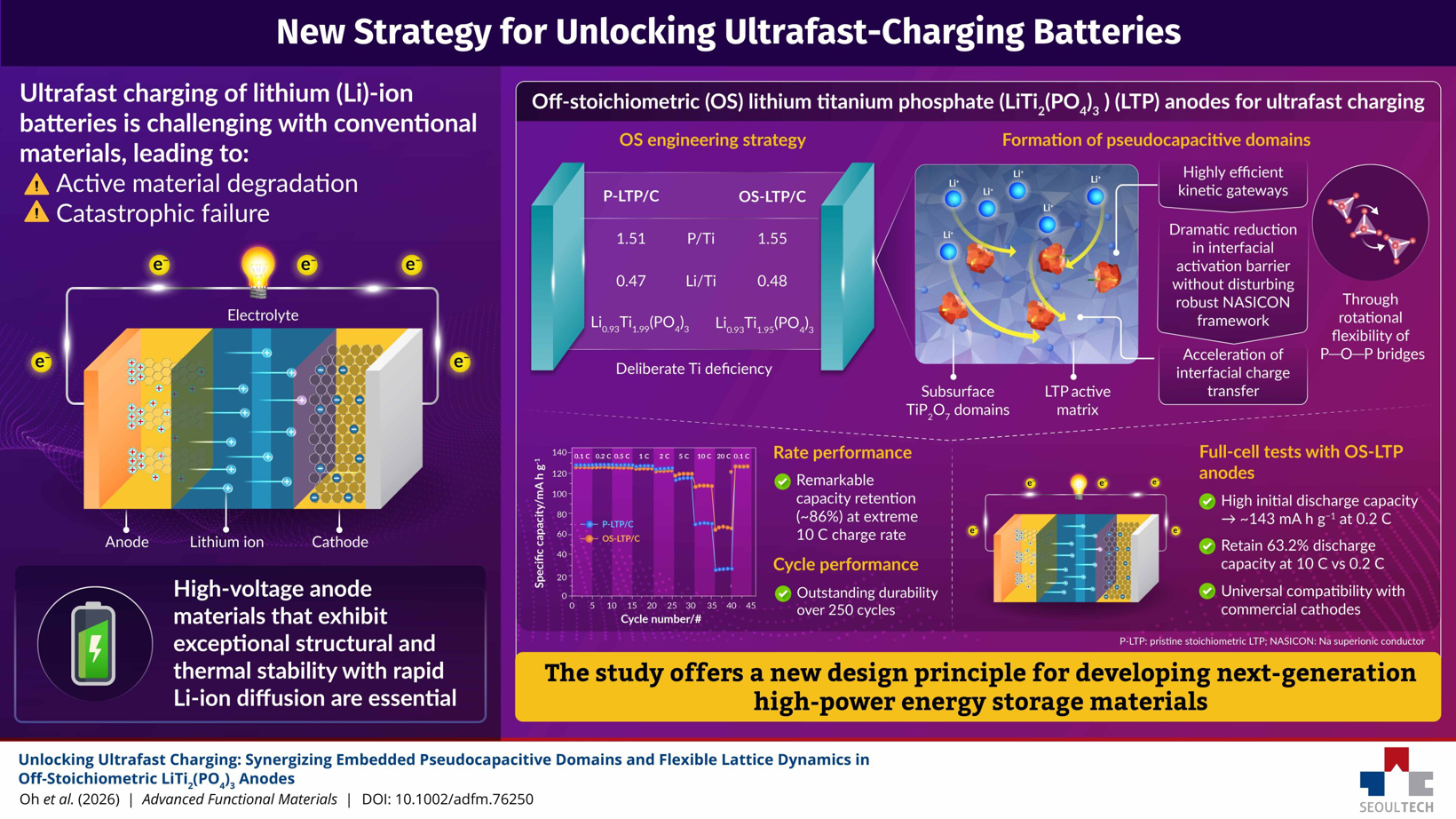
As the global electric vehicle (EV) market transitions from range anxiety to charging-speed anxiety, the race to commercialize safe, highly efficient ultra-fast charging battery technology has intensified. However, rapid charging has historically triggered a severe degradation mechanism: lithium plating. In a major technological breakthrough, researchers from the Seoul National University of Science and Technology (SeoulTech) have developed a novel design strategy that effectively suppresses harmful lithium deposition, clearing a major safety roadblock for next-generation EVs.
The Critical Bottleneck of Ultra-Fast Charging Battery Technology
To understand the significance of the SeoulTech breakthrough, we must first look at the physics of lithium-ion battery degradation during fast charging. Under standard charging conditions, lithium ions exit the cathode, migrate through the liquid electrolyte, and smoothly intercalate (insert themselves) between the layers of the graphite anode.
However, when subjected to high-current rapid charging, the rate of ion migration exceeds the rate of intercalation. This kinetic bottleneck causes lithium ions to accumulate on the surface of the anode, where they accept electrons and transform into metallic lithium—a process known as lithium plating. This phenomenon leads to several severe consequences:
- Capacity Fade: Plated lithium becomes chemically inactive ('dead lithium'), permanently reducing the battery\'s energy capacity.
- Dendrite Formation: Over time, metallic lithium deposits grow into needle-like structures called dendrites. These can pierce the separator, causing internal short circuits and thermal runaway (battery fires).
- Thermal Management Challenges: Rapid plating exacerbates localized heat generation, placing immense strain on the vehicle\'s thermal management systems.
How SeoulTech\'s Design Strategy Eliminates Lithium Plating
The SeoulTech research team addressed this challenge at the electrochemical level. Rather than relying solely on external software-based charging profiles, they focused on a structural design strategy that regulates lithium-ion flux at the anode-electrolyte interface.
By engineering a specialized, highly conductive interfacial layer and optimizing the physical structure of the anode, the researchers successfully minimized the local overpotential that triggers lithium deposition. This design ensures that even under high-current density, lithium ions are uniformly distributed and rapidly intercalated into the host material before metallic plating can occur. The result is a robust, resilient cell capable of enduring ultra-fast charging cycles without experiencing accelerated aging or safety degradation.
Market Implications: The Global Race for 5C and 6C Charging Standards
As Western OEMs and global battery manufacturers seek to accelerate consumer EV adoption, charging speed has become the key differentiator. Today\'s market is transitioning from 2C/3C standards to ultra-fast 5C and 6C charging (where 'C' denotes how many times a battery can be fully charged in one hour; 6C translates to a 10-minute charge time).
The table below highlights how SeoulTech\'s academic breakthrough aligns with existing and upcoming commercial ultra-fast charging solutions in the global ecosystem:
| Developer / Institution | Technology / Chemistry | Target Charge Rate | Primary Mechanism for Mitigating Plating |
|---|---|---|---|
| SeoulTech | Interfacial Engineering / Structured Anode | 5C - 6C+ Prototype | Interfacial flux regulation and overpotential reduction |
| CATL (Shenxing Superfast) | LFP (Lithium Iron Phosphate) | 4C - 5C Commercialized | Superelectronic network cathode & fully-plated graphite |
| Samsung SDI | Prismatic Gen 6 (High-Nickel) | 4C+ Planned (2026) | Optimized anode geometry and high-conductivity binders |
| StoreDot | Silicon-Dominant Anode (XFC) | 5C Development | Silicon active particles replacing graphite to bypass plating kinetics |
Analyst Commentary: What This Means for Western Investors and OEMs
From a market perspective, this academic milestone holds significant strategic value. As Western OEMs focus on supply chain compliance, localized regional footprints, and strategic sourcing alliances, securing proprietary intellectual property (IP) around battery safety is paramount.
While industry leaders like CATL and BYD have made massive strides in commercializing 4C and 5C LFP batteries, South Korean institutions and Tier 1 suppliers (such as LG Energy Solution, Samsung SDI, and SK On) are heavily investing in localized R&D. SeoulTech\'s research represents the high-level material science breakthroughs that Western developers can leverage through cross-border technology licensing and joint ventures. For investors, the companies capable of successfully translating these lab-scale interfacial designs into high-yield, mass-manufactured gigafactory processes will capture the premium EV segment, where safety and ultra-fast charging are non-negotiable requirements.