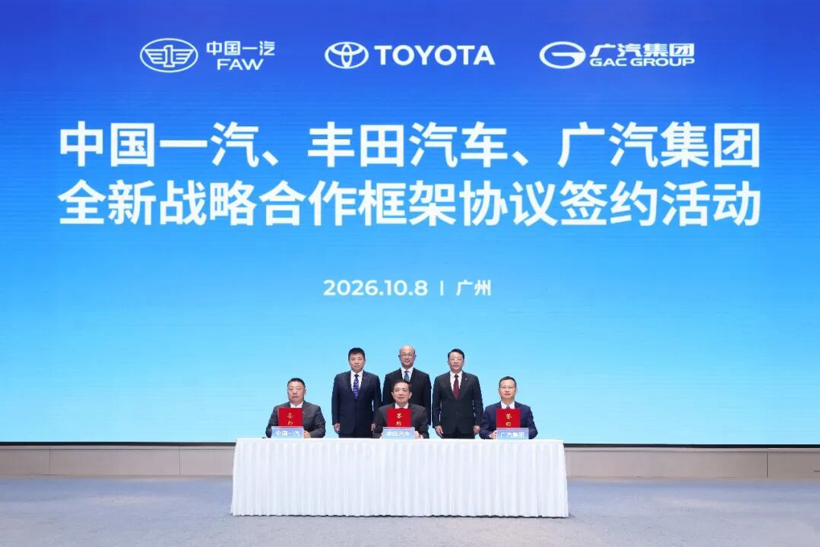
On October 8 in Guangzhou, an event unfolded that would have been unthinkable during the golden era of foreign internal combustion dominance: Toyota Motor Corporation brought its two historically adversarial Chinese joint-venture partners—China FAW Group and Guangzhou Automobile Group (GAC)—to the same negotiating table. By signing an unprecedented trilateral strategic cooperation framework, the world’s largest automaker by volume effectively tore down the operational firewall that has separated FAW Toyota in northern Tianjin from GAC Toyota in southern Guangzhou for more than two decades. Confronted by the unrelenting price war led by BYD, an aggressive domestic push into plug-in hybrids, and double-digit retail market share erosion, Toyota is attempting a historic consolidation of its Chinese engineering, procurement, and platform operations.
To grasp the magnitude of this pivot, one must look at the historical architectural doctrine of global automakers operating in the People’s Republic. Under the decades-old 50:50 joint-venture mandates, foreign auto giants deliberately maintained twin joint ventures to play provincial state-owned enterprises (SOEs) against each other, securing favorable local manufacturing concessions and maximizing dealership footprints. Volkswagen pitted SAIC against FAW; Honda divided its lineup between Dongfeng and GAC; and Toyota scrupulously partitioned its global portfolio—allocating the Corolla and Crown to FAW, while handing the Camry and Highlander to GAC. Today, that playbook of managed internal rivalry has become an unaffordable luxury. As Chinese domestic new energy vehicle (NEV) penetration hovers above 50% of monthly retail sales, the fragmented engineering pipelines and duplicate tooling investments of twin JVs have turned into structural liabilities. The newly forged trilateral agreement is nothing less than an emergency consolidation of Toyota China NEV strategy designed to salvage foreign OEM relevance.
The Engineering Teardown: Harmonizing Software-Defined Architectures Across Twin JVs
The operational core of the FAW-Toyota-GAC pact centers on standardizing the digital and electric powertrain architecture across both joint ventures, eliminating the redundant R&D spending that has hobbled Japanese automakers in the software era. Historically, FAW Toyota and GAC Toyota maintained separate localized software engineering teams, frequently contracting different tier-1 software integrators to adapt Japanese infotainment systems for Chinese consumers. The resulting products were widely criticized by local car buyers for sluggish human-machine interfaces (HMI), fragmented app ecosystems, and lagging advanced driver-assistance systems (ADAS) compared to domestic offerings from Huawei, XPeng, and Li Auto.
Under the unified framework, engineering leadership is shifting directly to the Toyota Intelligent Electro-Mobility R&D Center (China) Co., Ltd. (IEMBYD/TEMC) based in Changshu. Rather than running dual development programs for mid-cycle refreshes, Toyota will deploy a standardized centralized electronic and electrical (E/E) architecture across all upcoming BEVs and PHEVs produced by both FAW and GAC. This technical harmonization focuses heavily on integrating silicon carbide (SiC) power electronics into Toyota’s fifth-generation electronic continuously variable transmission (e-CVT) transaxles and multi-pathway hybrid powertrains, alongside adopting unified domain controllers powered by high-compute processors.
To understand where Toyota stands against the dominant players in China’s rapidly evolving electrified market, we must benchmark Toyota’s consolidated vehicle platform targets against the architectures fielded by BYD and global decoupled competitors like Hyundai Motor Group:
| Metric / Architecture Spec | Toyota Consolidated JV (e-TNGA / Next-Gen NEV) | BYD (e-Platform 3.0 Evo / DM 5.0) | Hyundai-Kia (E-GMP / 800V Architecture) |
|---|---|---|---|
| Primary Powertrain Focus | Multi-pathway: Dedicated HEV, Dual-motor PHEV, BEV | Dedicated PHEV (P1+P3) & Native 800V BEV | Dedicated 800V Ultra-Fast Charging BEV |
| E/E & Computing Architecture | Centralized Gateway + Local Tier-1 Smart Cockpit | Integrated Domain Controller + BYD DiLink OS | Integrated Domain Architecture + ccNC System |
| High-Voltage Bus Level | 400V Standard (Limited 800V deployment planned) | Native 800V with high-voltage booster charging | Native 800V Architecture (SiC Power Modules) |
| Fast-Charging C-Rate Capability | 1.5C – 2.0C Peak (Thermal conservative) | 3.0C – 4.5C (LFP Blade Pack optimization) | 4.0C – 4.5C (10% to 80% in 18 minutes) |
| ADAS Compute / Sensor Topology | Momenta integration / 30–100 TOPS (Vision-centric) | DiPilot 100/300 / Dual Orin-X (up to 508 TOPS) | Highway Driving Assist II / Continental-Mando Suite |
| Entry Retail Price Corridor (China) | 130,000 – 190,000 RMB ($18,200 – $26,600 USD) | 79,800 – 150,000 RMB ($11,200 – $21,000 USD) | 140,000 – 210,000 RMB (Global-market focused) |
As the technical comparison illustrates, Toyota is attempting to close a structural gap. While BYD has driven powertrain component integration down to 12-in-1 electric drive assemblies and native high-voltage silicon carbide systems, Toyota’s joint ventures have remained tethered to legacy 400V architectures and conservative charge-acceptance algorithms. By pooling FAW and GAC’s localized manufacturing assets, Toyota hopes to achieve the unit volumes required to justify deploying advanced localized platforms without writing off billions in existing internal combustion tooling.
Supply Chain Realignment and Bill of Materials Rationalization
The trilateral pact fundamentally alters the procurement economics of Toyota in mainland China. In the legacy combustion paradigm, Toyota relied almost exclusively on its captive keiretsu suppliers—Denso, Aisin, and Toyota Boshoku—who established dedicated production facilities adjacent to FAW in Changchun/Tianjin and GAC in Nansha. However, the localized bill of materials (BOM) cost structures of these traditional Japanese tier-1 suppliers proved structurally incapable of competing with the hyper-verticalized Chinese battery and semiconductor supply base during the brutal 2023–2025 price wars.
By harmonizing components across FAW Toyota and GAC Toyota, the Japanese OEM can now tender massive, unified procurement contracts directly to top-tier Chinese domestic component suppliers. Industry estimates indicate that unifying components across both ventures could shave 12% to 18% off electronic subsystem BOM costs through raw scale:
- Traction Battery Packs: Shifting away from small-batch imports and fragmented sourcing, Toyota is deepening its reliance on contemporary lithium iron phosphate (LFP) cells from CATL and customized Blade battery integration via its BYD Toyota EV Technology (BTET) joint venture. Consolidating cell formats across FAW and GAC manufacturing lines allows Toyota to command volume discounts that were previously unavailable to either subsidiary operating independently.
- Intelligent Cockpit Ecosystems: Both joint ventures are discarding proprietary Japanese software stacks in favor of deeply localized solutions. The trilateral agreement paves the way for standardizing Huawei’s HarmonyOS-based digital cockpits and Tencent’s automotive cloud suites across the entire domestic Toyota lineup, eliminating duplicate software license fees.
- Autonomous Driving Hardware & Algorithms: Toyota’s strategic investment in Chinese autonomous driving unicorn Momenta will now be uniformly leveraged across both FAW and GAC model lines. Standardizing Momenta’s end-to-end vision algorithms and localized sensor suites allows Toyota to deploy Level 2+ urban navigation on autopilot (NOA) capabilities across mass-market models priced beneath 160,000 RMB.
Competitive Impact Assessment: Foreign OEM Survival in a Polarized Market
The establishment of this tripartite operational pact sends shockwaves through the competitive landscape of the world’s largest auto market, realigning dynamics for legacy international brands and domestic champions alike.
For domestic Chinese EV giants like BYD, Geely, and Chery, the immediate commercial threat remains manageable. Chinese OEMs have already established dominant mindshare among Gen-Z and millennial buyers, driven by aggressive weekly software updates, integrated smartphone-to-vehicle connectivity, and unbeatable pricing structures. BYD’s DM 5.0 hybrid architecture—delivering claimed thermal efficiencies exceeding 46% and real-world ranges crossing 2,000 kilometers on paper—has directly poached Toyota’s historical core demographic: middle-class buyers seeking bulletproof reliability and ultra-low operating costs. A consolidated Toyota China NEV strategy cannot reverse this structural brand equity erosion overnight.
However, the real casualty of this trilateral alliance will likely be other legacy foreign automakers who remain paralyzed by divided joint-venture structures. Volkswagen continues to balance the complex internal political dynamics of SAIC-VW and FAW-VW, often duplicating software adaptations and tooling investments. Honda remains divided between Dongfeng and GAC, with sales volumes shrinking rapidly across both channels. By moving decisively to dissolve operational duplication, Toyota has established a blueprint for foreign OEM survival that other multinational conglomerates will be pressured to replicate.
The Reality Check: Supply Chain Realities vs. Corporate Public Relations
While corporate communications hail this trilateral pact as a bold new era of unified innovation, a rigorous engineering and economic audit reveals severe operational frictions and unavoidable strategic trade-offs.
First, corporate press releases gloss over the profound cultural and operational friction of forcing FAW and GAC—two intensely competitive state-owned enterprises controlled by different regional governments—to share engineering intellectual property and supplier allocations. FAW, headquartered in Jilin province, answers directly to SASAC (the State-owned Assets Supervision and Administration Commission) and carries distinct national political mandates. GAC, an enterprise anchored in Guangdong’s municipal economy, operates with a distinctly commercial, market-driven mindset. Over the past fifteen years, these two organizations have competed fiercely for product allocations from Toyota Japan, occasionally launching badge-engineered clones of the same vehicle within months of each other. Expecting their respective engineering divisions and local supplier networks to seamlessly integrate represents an immense operational gamble.
Second, there is the unresolved tension regarding Toyota’s core brand equity: engineering autonomy versus white-label dependency. If Toyota’s next-generation Chinese vehicles rely on CATL or BYD for battery packs, Huawei for intelligent cockpits, and Momenta for autonomous driving perception algorithms, what remains uniquely 'Toyota' beyond the badge and passive suspension tuning? By outsourcing the critical high-margin technological layers of the software-defined vehicle to Chinese domestic tier-1 suppliers, Toyota risks becoming a contract assembly shell in its largest volume market, ceding long-term IP accumulation to local tech giants.
Finally, we must critically evaluate the global OEM divergence: structural entanglement versus decoupled resilience. While Toyota doubles down on deep integration with Chinese state-backed conglomerates, decoupled players like Hyundai Motor Group have systematically reduced direct exposure to the margin-crushing Chinese domestic retail market. Automakers like Hyundai-Kia have refocused capital allocation toward high-margin dedicated 800V architectures (E-GMP) scaled across North America, Europe, and India, successfully defending double-digit operating margins while avoiding the Chinese price war. Toyota’s deepening structural commitment in China locks significant capital into a market where foreign brand equity commands an ever-shrinking retail premium.
Regulatory Pressures, Geopolitical Fault Lines, and the Global Spillover
This unprecedented restructuring cannot be analyzed in isolation from the geopolitical and regulatory landscape governing global automotive trade. As Beijing enforces stricter Corporate Average Fuel Consumption (CAFC) and NEV credit mandates, foreign automakers unable to generate sufficient positive NEV credits face punitive financial penalties or factory output throttling. By consolidating NEV engineering across FAW and GAC, Toyota is executing an urgent compliance maneuver to balance its internal NEV credit ledger and prevent regulatory caps on its profitable, high-volume hybrid production lines.
Simultaneously, the geopolitical fault lines separating China from Western automotive markets create severe compliance bottlenecks for this newly harmonized supply chain. Vehicles and architectures developed under this trilateral framework—heavily embedded with Chinese software, telematics, and battery supply chains—face strict regulatory exclusion in key Western export markets. Under the United States IRA Foreign Entity of Concern (FEOC) rules, Department of Commerce connected-vehicle technology bans, and the European Union’s countervailing anti-subsidy tariffs, platforms engineered through deep collaboration with Chinese SOEs like FAW and GAC cannot be exported back to Western shores without massive supply chain restructuring. Consequently, this trilateral pact must be viewed strictly as a localized regional defense strategy: Toyota is building a walled, China-specific engineering ecosystem designed to survive locally, while running a parallel, decoupled architecture for global developed markets.
Strategic Outlook and Multi-Year Investor Implications
The trilateral agreement between FAW, Toyota, and GAC marks a watershed moment in the retreat and regrouping of legacy foreign automakers within China. Moving forward, the trajectory of this consolidated Toyota China NEV strategy will split along three distinct scenarios over the next 24 to 36 months.
Bull Case
Platform consolidation through Changshu TEMC proceeds ahead of schedule, enabling Toyota to eliminate 15% of duplicated administrative and R&D overhead across FAW and GAC. Standardized procurement across Chinese battery and smart-cockpit tier-1s allows Toyota to launch a competitive family of unified mid-size PHEVs and BEVs priced precisely in the 120,000 to 170,000 RMB bracket. Toyota successfully halts retail market share erosion, stabilizes its Chinese sales baseline above 1.5 million units annually, and preserves vital cash flow to fund global solid-state battery commercialization.
Base Case
Engineering centralization achieves moderate BOM cost reductions, but bureaucratic inertia between FAW’s northern administrative hierarchy and GAC’s southern commercial teams delays model introductions. Toyota successfully defends a defensible 4% to 5% share of the overall Chinese passenger car market by leaning on aggressive dealer discounting and hybrid reliability, though operating margins from Chinese operations shrink permanently to low single digits.
Bear Case
Internal political conflict between FAW and GAC leads to fragmented execution, while Chinese domestic EV leaders launch next-generation 800V silicon-anode vehicles that render Toyota’s 400V centralized offerings technologically obsolete before arrival. Outsourcing core software and autonomy to Chinese third parties erodes brand equity, forcing Toyota into severe factory capacity rationalization, deep asset write-downs, and eventual structural withdrawal from mass-market passenger vehicle manufacturing in the PRC.
Executive Strategic Takeaways
- Foreign OEMs operating dual-JV frameworks must immediately evaluate operational consolidation; the luxury of maintaining competing domestic joint ventures is no longer financially viable in a market dominated by rapid NEV iteration.
- Cost rationalization in China requires decisive decoupling from legacy home-market keiretsu networks in favor of aggressive localized sourcing with Tier-1 battery and software leaders.
- Deep technology integration with Chinese state-backed partners creates severe geopolitical export walls, requiring multinational automakers to maintain strictly partitioned global and domestic technical platforms.
- Investors must scrutinize whether localized volume stabilization generates actual net operating cash flow, or merely represents capital-intensive defense of low-margin market share in an oversupplied theater.