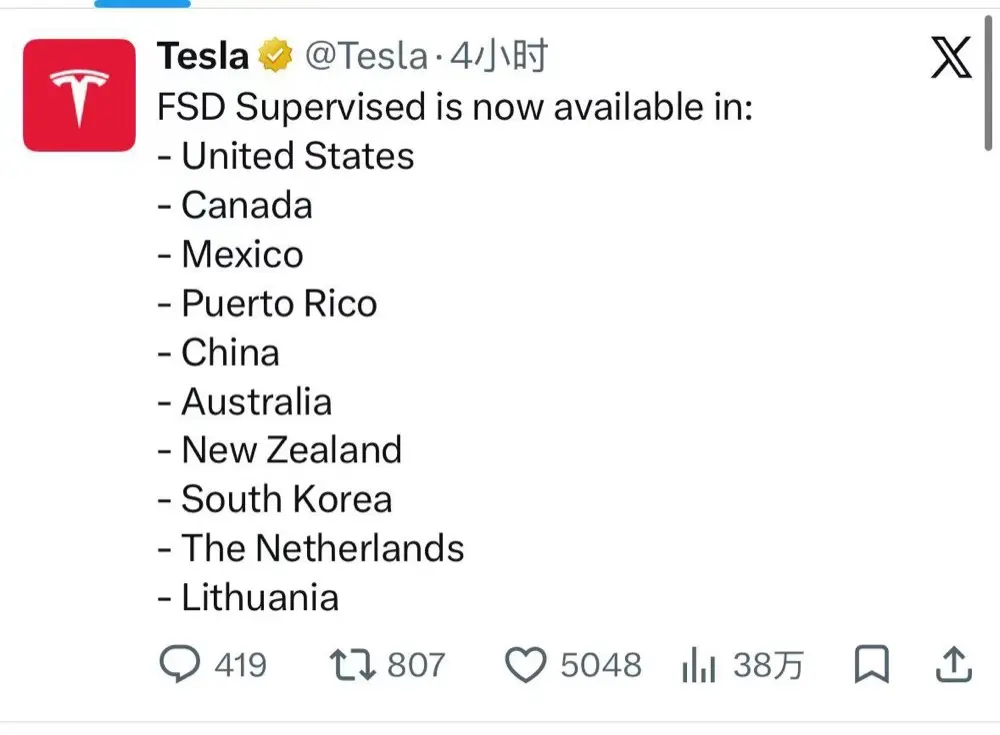
Is Tesla’s announcement of supervised FSD (Full Self-Driving) in China a significant step forward, or just a marketing ploy to boost sales? This question is at the heart of the recent developments and debates surrounding Tesla’s autonomous driving technology in the Chinese market.
The Announcement: What Does It Mean?
Elon Musk’s recent visit to China has sparked a lot of speculation. While the media buzzed with photos of Musk and Lei Jun, the real focus was on the long-awaited rollout of FSD in China. On May 21, 2026, Tesla officially announced that ‘supervised FSD’ would be available in China. But what does this mean for the Chinese market and Western investors?
Understanding Supervised FSD
Supervised FSD, as the name suggests, is not fully autonomous. According to industry experts, it is still classified as L2 (Level 2) driving assistance. This means that the driver must remain attentive and ready to take control at any moment. In the event of an accident, the driver, not the system, is legally responsible.
UN R-171 Regulations and SAE Levels
Under the UN R-171 regulations, supervised FSD falls under the L2 category. This classification aligns with the SAE (Society of Automotive Engineers) L0-L5 autonomous driving levels, where L2 systems can assist with acceleration, braking, and steering, but the driver remains the primary operator. For true autonomy, L3 and above are required, where the system can take over in specific scenarios, and the driver can temporarily disengage.
Market Implications and Investor Concerns
The announcement of supervised FSD in China raises several questions for Western investors. Is this a genuine step towards full autonomy, or is it a strategic move to maintain market interest and boost sales?
Expert Opinions
According to Zhang Xiang, Secretary-General of the International Intelligent Vehicle Technology Association, the supervised FSD is more of a marketing tool than a technological breakthrough. He stated, ‘It’s just a way for companies like Tesla to keep up with the competition by releasing new features. There’s no major innovation here; it’s just a new term to attract customers.‘
Timeline and Regulatory Challenges
The timeline of FSD’s rollout in China has been marked by delays and regulatory hurdles. In February 2025, Tesla began pushing the ‘City Street Autopilot’ feature to Chinese FSD owners, but it was quickly halted due to regulatory issues. By November 2025, Musk optimistically predicted that FSD would be approved by February or March 2026. However, the actual rollout of supervised FSD in May 2026 indicates that the process is still ongoing and fraught with challenges.
Conclusion
While the announcement of supervised FSD in China is a step forward, it is important to understand its limitations. The L2 classification means that it is not yet the fully autonomous solution many had hoped for. For Western investors, this highlights the need to carefully evaluate the strategic implications of such announcements and to stay informed about the regulatory and technological landscape in the Chinese EV market.
For more insights into the Chinese EV market and ADAS standards, see our analysis on Chinese ADAS standards.