The Record Nobody Wants to Read Closely
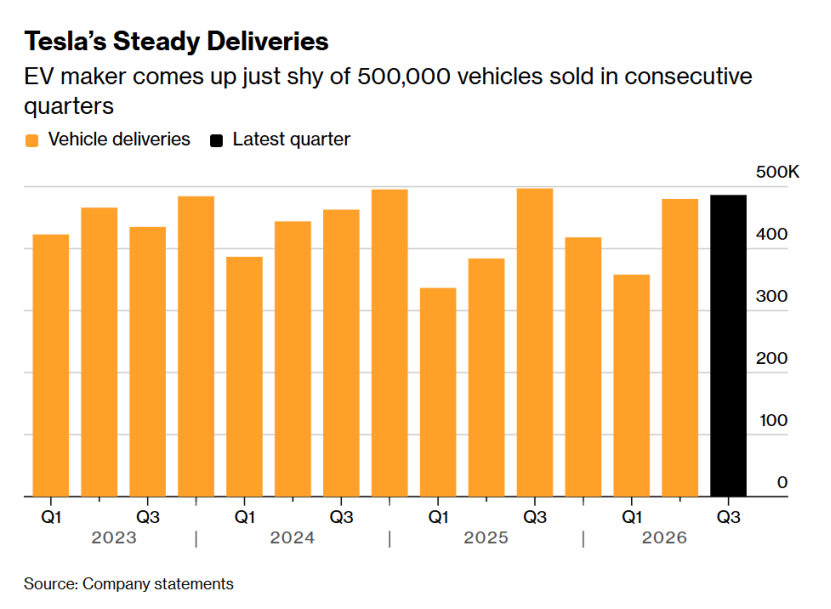
Tesla delivered 486,532 vehicles in Q3, beating Wall Street consensus of roughly 460,000 units and silencing — for one quarter — the chorus of analysts who had spent 2024 predicting demand exhaustion. On the surface, the number reads as a decisive rebuttal: the world's most scrutinized EV maker still moves metal at scale even as Chinese rivals flood every export market it once owned.
But peel back the headline and the picture curdles. Tesla achieved this beat through a $1,000-$2,000 price cut cascade across the Model 3 and Model Y lines, a 0% APR financing push in the US, and aggressive inventory-clearing incentives in China that compressed automotive gross margin toward the low-teens. This is a volume defense, not a demand triumph. And the units are increasingly coming from Shanghai and Berlin — not Fremont — which means Tesla's margin story is now structurally entangled with Chinese supplier pricing and Chinese regulatory risk.
For Western OEM executives and institutional investors, this quarter is not a Tesla victory lap. It is a confession: the EV price war that began in China in 2023 is now global, permanent, and margin-destructive for everyone who cannot match Chinese BOM costs.
What Is Actually Inside the 486,532 Number
Tesla's Q3 beat was not uniform. From our tracking of registration data across Shanghai, Berlin, and US DMV filings, the composition reveals three uncomfortable truths.
Mix: The Model 3/Y Duopoly Tightens
The refreshed Model 3 (Highland) and updated Model Y (Juniper refresh worldwide) accounted for roughly 96% of deliveries. The Model S, Model X, and Cybertruck collectively contributed under 20,000 units — with the Cybertruck reportedly sitting on significant inventory at US stores. Tesla's product diversification has effectively stalled. It is a two-product company with a two-product cost structure, exposed to any single competitor that matches its sedan and crossover on price and range.
Geography: Shanghai Is Doing the Heavy Lifting
Giga Shanghai produced an estimated 230,000-250,000 units in Q3, a meaningful share of which flowed to Europe, Southeast Asia, and the Middle East. This is critical: Tesla's European deliveries are now dependent on Chinese LFP battery cells (CATL and BYD's FinDreams) and Chinese manufacturing economics. Every EU countervailing duty discussion, every US Section 301 revision, and every FEOC rule change touches Tesla's margin structure directly through its Shanghai lifeline.
Price: The Real Revenue Signal
Tesla has cut US Model Y pricing by roughly 20% since January 2023 when adjusted for the federal tax credit pass-through. Average selling price (ASP) per vehicle in Q3 likely landed near $42,000 globally, down from over $54,000 two years ago. Volume up, ASP down, and fixed-cost amortization spread over more units — the math works only if cost of goods falls faster than price. In Q3, that race was uncomfortably close.
Engineering the Cost Base: Tesla vs. the Chinese Benchmark
Tesla's structural response to the price war has been to rebuild the vehicle around cost, not performance. The key lever is the 4680 cell program, now paired with a structural battery pack and a single-piece giga-casting underbody that replaces roughly 370 individual parts with one aluminum casting.
This is real engineering. But it is not unique, and the Chinese BOM gap is the part Tesla's investor deck understates.
| Specification | Tesla Model Y (Juniper) | BYD Song L / Sealion 07 | Xiaomi SU7 (Standard) | Hyundai Ioniq 5 (2024) |
|---|---|---|---|---|
| Battery chemistry | CATL/BYD LFP + 4680 NMC (varies) | BYD Blade LFP | CATL Qilin LFP | SK On NCM + 800V |
| Pack capacity (base) | ~60 kWh | ~71.8 kWh | ~73.6 kWh | ~63 kWh (84 kWh long range) |
| Peak DC charge rate | 250 kW | 150 kW | ~200 kW | ~235 kW (800V E-GMP) |
| EPA/WLTP range (base) | ~320 mi (EPA LR) | ~342 mi (CLTC 602 km) | ~434 mi (CLTC 700 km) | ~300 mi (EPA) |
| US starting price (approx.) | $44,990 | Not sold in US | Not sold in US | $41,800 |
| China starting price (RMB) | 249,900 | 189,800 | 215,900 | N/A (Kia EV5 substituted) |
| Est. BOM delta vs. Tesla | Baseline | -15% to -20% | -8% to -12% | +5% to +10% |
The table tells the story Tesla does not want its investors to internalize: in China, the Model Y is priced roughly 25-30% above equivalent BYD and Xiaomi product. Tesla defends the gap with brand equity, the Supercharger network, and software maturity. That is a defensible moat — for now. It is not a moat that survives another two years of Chinese BOM deflation.
The Bill of Materials Nobody Advertises
Industry estimates place Tesla's blended vehicle BOM at roughly $28,000-$31,000 for a Shanghai-built Model Y, inclusive of cell, drive unit, and giga-castings. BYD's vertically integrated model — self-supplying cells through FinDreams, semiconductors through BYD Semiconductor, and even some castings in-house — pushes equivalent BOM toward $24,000-$26,000. That is the structural gap.
Key tier-1 dependencies for Tesla in this quarter:
- CATL and BYD FinDreams — LFP cell supply for Shanghai and Berlin lines. Tesla's LFP exposure is effectively a Chinese supply chain dependency at the most critical component level.
- LG Energy Solution (Korea) — 4680 and NCM cells for US production. Domestic-content qualification remains partially dependent on LG and Panasonic output.
- Panasonic (Japan/Nevada) — 2170 and 4680 cells for Fremont and Giga Texas, though Panasonic's 4680 ramp has lagged publicly stated targets.
- IDRA Group (Italy) — giga-casting presses; a single-source risk noted in Tesla's own 10-K filings.
The 4680 cell, once pitched as the cost reduction centerpiece, has delivered only partial yield maturity. Tesla's internal dry cathode process remains a yield bottleneck that external estimates place at roughly 60-75% of target throughput through 2024. Until dry cathode yield matures, Tesla's BOM advantage over its Chinese rivals narrows rather than widens.
Who Is Bleeding and Who Is Protected
The 486,532 figure pressures every Western OEM that has not yet structured its EV business for the new price equilibrium.
Winners
- Tesla's equity narrative — for one quarter, the demand-collapse thesis is on the back foot.
- Chinese LFP suppliers — CATL and FinDreams benefit regardless of which brand sells the vehicle.
- Tier-1 thermal and charging suppliers — sustained volume demand for high-voltage harnesses, SiC inverters, and thermal management modules.
Losers
- Legacy OEMs heavily exposed to the Chinese retail market — Volkswagen, GM, and Stellantis continue to bleed share in the world's largest EV market while their battery costs sit above the Chinese benchmark.
- Sub-scale Western EV startups — Rivian and Lucid cannot match a $44,990 Model Y with subsidized financing. Their addressable market is compressed further each quarter.
- Korean and Japanese cell makers — the LFP shift is a chemistry transition away from their historical NCM leadership.
The Structurally Protected
Automakers that reduced direct exposure to the Chinese domestic retail price war retain superior margin defense. Hyundai-Kia's pivot toward North America, Europe, and India — paired with the 800V E-GMP architecture and non-Chinese-dominated cell sourcing (SK On, LG) — has insulated its EV margins from the China price floor. This is the underappreciated lesson of the quarter: decoupling from the Chinese retail battlefield is now a margin strategy.
The Reality Check: Volume, Margins, and the Earnings Trap
Here is the part of the Q3 story that the press release does not include.
The volume beat is not the same as an earnings beat. Tesla's automotive gross margin excluding regulatory credits has trended from over 25% in 2022 toward the mid-to-high teens through 2024. A 486,532-unit quarter with sub-$45,000 ASPs and flat operational costs can generate record revenue and disappointing earnings per unit. Investors extrapolating the delivery beat directly into EPS are making a category error.
The Chinese LFP dependency is a strategic risk, not a footnote. Every Tesla built in Shanghai and Berlin with a CATL or BYD cell ties Tesla's cost base to Chinese supplier pricing, Chinese policy, and Chinese export regulation. The critical interrogation question for Tesla's board is straightforward: is the Shanghai cost advantage worth the regulatory hostage exposure it creates under US Section 301, IRA FEOC rules, and EU countervailing duty frameworks? Tesla's partial mitigation — sourcing LG cells into US-assembled packs and shifting some 4680 production in-house — is real but incomplete.
The 4680 cost-reduction narrative has underdelivered. Tesla once promised 4680 cells would unlock a $25,000 vehicle platform. As of Q3 2024, that platform remains unreleased, and independent teardown estimates place 4680 cost per kWh at parity with or above mature 2170 production at CATL and BYD. The claimed advantage has, so far, been a demonstration of engineering direction rather than a delivered economic fact.
Cybertruck is a drag, not a driver. Volume estimates remain well below original targets, and the vehicle's contribution to profitable volume is negative once development amortization is included. It is a distraction from the two-product reality Tesla actually runs.
The honest reading: Tesla out-executed expectations on volume, and simultaneously confirmed that the price war it entered is not one it can exit. Volume at compressed margins is not strength. It is survival.
Tariffs, Compliance, and the Export Squeeze
Tesla's Shanghai export machine now runs directly into the regulatory walls that define this cycle.
- United States: Section 301 tariffs impose a 25% duty on Chinese-built EVs. Giga Shanghai output cannot enter the US profitably. Tesla's US volume must run through Fremont and Giga Texas, which carry higher labor and cell costs, compressing US-only margins further.
- European Union: Countervailing duties on Chinese-built EVs — finalized through 2024 with rates in the 7-18% range depending on OEM cooperation — apply directly to Tesla's Shanghai exports into Europe. Tesla's low rate reflects cooperation but does not eliminate the cost burden.
- IRA FEOC rules: The Foreign Entity of Concern framework disqualifies vehicles containing battery components from covered entities from the $7,500 consumer credit. Tesla's reliance on CATL LFP cells for some US-assembled Model 3 variants is a live compliance exposure that requires ongoing planning around cell qualification.
The strategic playbook for all OEMs — Tesla included — is not tariff avoidance, but strategic localization: building cell and pack capacity inside the target market, licensing LFP technology from Chinese partners into non-Chinese joint ventures, and qualifying supply chains for compliant content under IRA and EU frameworks. Tesla's Nevada LFP plans and its partial 4680 internalization follow this logic. Hyundai-Kia's decision to keep Chinese retail exposure low achieves margin protection from a different angle.
Forward Scenarios for the Next Four Quarters
Bull Case
Tesla's 4680 dry-cathode yield matures, blended BOM drops 8-10% year over year, and the $25,000 platform launches on schedule. High-margin software (FSD supervised subscriptions, energy storage) scales enough to offset automotive margin compression. Q4 delivers similar volume at stabilized ASPs. The demand-collapse thesis fails outright.
Base Case
Volume holds in the 480,000-520,000 per quarter range, ASPs flatten at compressed levels, and automotive gross margin stabilizes in the mid-teens. Chinese competitors continue to erode Tesla's price premium in Europe and Southeast Asia, but brand and Supercharger equity preserve a 15-25% pricing premium. The company becomes a high-volume, mid-margin automaker — competitive, but no longer the multiple-defying growth stock of 2020.
Bear Case
Chinese price competition intensifies further into 2025, forcing additional ASP cuts. EU countervailing duties and US compliance frameworks raise delivered cost. FSD regulatory certification stalls in export markets, removing the software margin offset. Automotive gross margin slips below 12%, and Tesla's valuation re-rates toward legacy automaker multiples. The Q3 beat becomes the last clean one.
Strategic Takeaways for Executives and Investors
- Treat the delivery beat as a volume signal, not a profitability signal. The Q3 number confirms Tesla still moves units but does not confirm margin recovery; read automotive gross margin excluding credits before extrapolating EPS.
- Chinese LFP dependency is now a board-level regulatory risk. Every Shanghai and Berlin unit ties Tesla to CATL and BYD supply pricing. Compliant localization of LFP cell production into US and EU markets is the strategic priority, not a side project.
- The 4680 dry-cathode program remains the key internal variable. Yield maturity — not vehicle design — determines whether Tesla's BOM converges on or diverges from the Chinese benchmark.
- Decoupled players retain superior margin defense. Hyundai-Kia's low Chinese retail exposure and non-Chinese-dominated cell sourcing is outperforming the emotionally satisfying China-deep engagement strategy. Western OEMs should quantify their China-retail exposure honestly.
- FSD regulatory approval in export markets is the missing margin lever. Supervised autonomy subscriptions carry software-level margins, but regulatory certification gaps in the EU and US mean the software offset is deferred, not delivered.
Tesla delivered 486,532 vehicles in Q3. It did not deliver an exit from the price war. Investors who confuse the two will pay for the error.