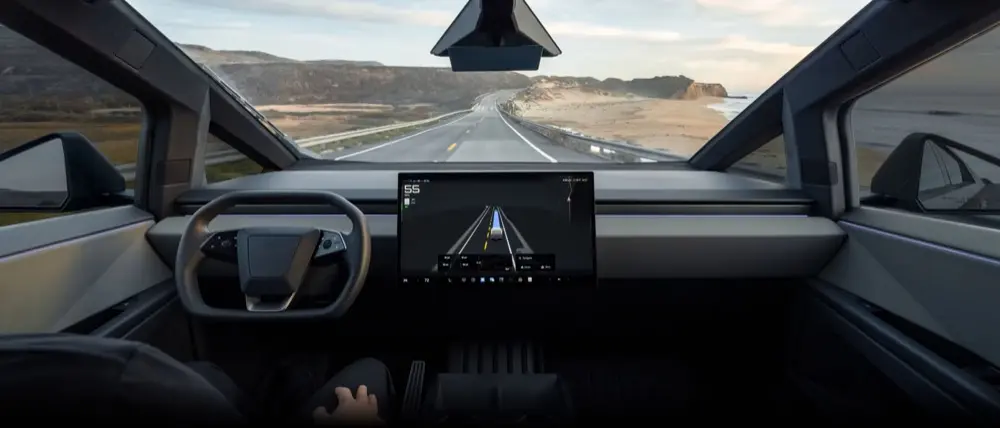
Did Tesla just leapfrog its own hardware limitations without changing a single chip? With the Tesla FSD v14.3 HW4 update rolling out globally, Elon Musk’s engineering team has delivered a startling 20% reduction in response latency—not through silicon upgrades, but by fundamentally rewriting the AI compiler from scratch. For Western investors tracking the autonomous vehicle race, this is not merely a software patch. It is a declaration that Tesla’s path to unsupervised Full Self-Driving may hinge more on computational efficiency than raw hardware power, at a moment when Chinese EV rivals like BYD and XPeng are aggressively deploying city-wide Navigate on Autopilot (NOA) features.
According to Reuters, software version 2026.2.9.6 represents one of the most significant architectural shifts in Tesla’s autonomy stack since the transition to HW3. The update leverages Multi-Level Intermediate Representation (MLIR) to rebuild the AI compiler and runtime environment from the ground up—a move that directly addresses computational bottlenecks plaguing real-time decision-making in complex urban environments.
The Hardware Divide: Why HW4 Owners Get Exclusive Access
Tesla’s decision to limit FSD v14.3 to HW4-equipped vehicles (Model S, Model 3, Model X, Model Y, and Cybertruck manufactured with the latest hardware) has created a two-tier ecosystem that should concern HW3 owners. While Bloomberg analysts note that HW3 remains capable of supervised autonomy, the MLIR compiler rewrite appears optimized for HW4’s increased camera bandwidth and processing headroom.
This exclusivity signals a strategic pivot: Tesla is no longer promising feature parity across hardware generations. For Western investors, this suggests accelerated depreciation of HW3 vehicle values and potential liability concerns as the company shifts development resources exclusively toward its latest platform.
The MLIR Revolution: Understanding the 20% Breakthrough
The headline figure of 20% faster response speeds masks a deeper technical achievement. MLIR, originally developed by Google as part of the LLVM project, allows Tesla’s neural networks to optimize code generation across heterogeneous hardware architectures. By rewriting the compiler to utilize MLIR’s multi-level abstraction, Tesla has effectively taught its HW4 computers to ‘think’ faster without increasing clock speeds or power consumption.
This optimization is critical for Western regulatory approval. Agencies like the NHTSA and European equivalents scrutinize reaction times in safety-critical scenarios. A 20% reduction in latency could mean the difference between a collision and a near-miss when identifying emergency vehicles or unexpected road debris.
Under the Hood: FSD v14.3 Feature Analysis
Beyond the compiler rewrite, version 14.3 introduces substantive improvements targeting specific competitive vulnerabilities:
Reinforcement Learning at Fleet Scale
Tesla has upgraded the RL training phase for its end-to-end neural networks, focusing specifically on ‘hard cases’ drawn from its global fleet. This includes complex left-hand turns across oncoming traffic, handling compound traffic signals on curved intersections, and responding to yellow-light scenarios. The system now learns from millions of edge cases where human drivers previously intervened.
Vision Geometry and Low-Visibility Performance
The upgraded visual encoder enhances 3D geometric understanding—a traditional weakness in camera-only systems compared to lidar-dependent competitors like Waymo. Improvements in low-visibility scenarios directly challenge the narrative that Tesla’s camera-only approach falters in adverse weather.
Parking Intelligence and Mapping Integration
New parking spot markers now appear as ‘P’ icons on the navigation map, while the system exhibits ‘more decisive’ behavior when selecting and maneuvering into spaces. This addresses user complaints about hesitation in parking lots—a friction point that has benefited Chinese competitors offering more aggressive automated parking.
Safety-Critical Object Detection
The update specifically targets rare and unusual objects: extended truck loads, suspended items, and—uniquely—small animals. By increasing RL rewards for ‘proactive safety consciousness,’ Tesla aims to reduce the false confidence that has led to high-profile accidents involving emergency vehicles and school buses.
The China Factor: Why Latency Matters in the Global Race
While Tesla optimizes its Western fleet, Chinese EV manufacturers are not standing still. Bloomberg reports that BYD has partnered with Huawei to deploy ADS 3.0 (Advanced Driving System) across its premium lineup, offering unsupervised highway autonomy and city NOA in over 300 Chinese municipalities. XPeng’s XNGP system similarly operates across complex urban environments with minimal human intervention.
For Western investors, the Tesla FSD v14.3 HW4 update represents a necessary defensive maneuver. Tesla cannot achieve global robotaxi scale without solving China—and it cannot solve China without matching the reaction speeds and smoothness of local players. The MLIR optimization provides headroom for FSD to run on China’s diverse road infrastructure, where mixed traffic of scooters, pedestrians, and vehicles demands millisecond-level decision-making.
See our analysis on how BYD’s intelligent driving system compares to Tesla’s FSD architecture.
Investment Implications: The Path to Unsupervised FSD
The 20% latency improvement is not merely a quality-of-life upgrade. It is a prerequisite for Tesla’s unsupervised FSD roadmap. Regulatory bodies globally have expressed concern about ‘phantom braking’ and delayed responses in Tesla’s current supervised system. By demonstrating that HW4 can achieve superior reaction times through software optimization alone, Tesla strengthens its case that existing hardware is sufficient for Level 4 autonomy.
However, Tesla’s ‘Upcoming Improvements’ list reveals three critical gaps: extended reasoning capabilities beyond destination handling, pothole avoidance, and enhanced driver monitoring. The latter is particularly relevant given recent regulatory scrutiny over driver attention warnings. Investors should view v14.3 as foundation-laying that enables, but does not yet deliver, unsupervised autonomy.
Recommended Reading
For readers seeking to understand the strategic implications of compiler optimization in autonomous vehicles, we recommend Autonomy: The Quest to Build the Driverless Car—And How It Will Reshape Our World by Lawrence D. Burns. The book provides essential context on why software architecture often trumps hardware specifications in the race for self-driving supremacy.
Conclusion
Tesla’s FSD v14.3 update for HW4 vehicles signals a maturation of the company’s software-first strategy. By extracting 20% more performance from existing silicon through MLIR compiler optimization, Tesla has bought itself time—and credibility—in the global autonomy race. For Western investors and car buyers, the message is clear: the gap between Tesla and its Chinese competitors is narrowing not through megapixels or lidar arrays, but through superior code. Whether that proves sufficient for regulatory approval in Beijing and Brussels remains the multi-billion dollar question.