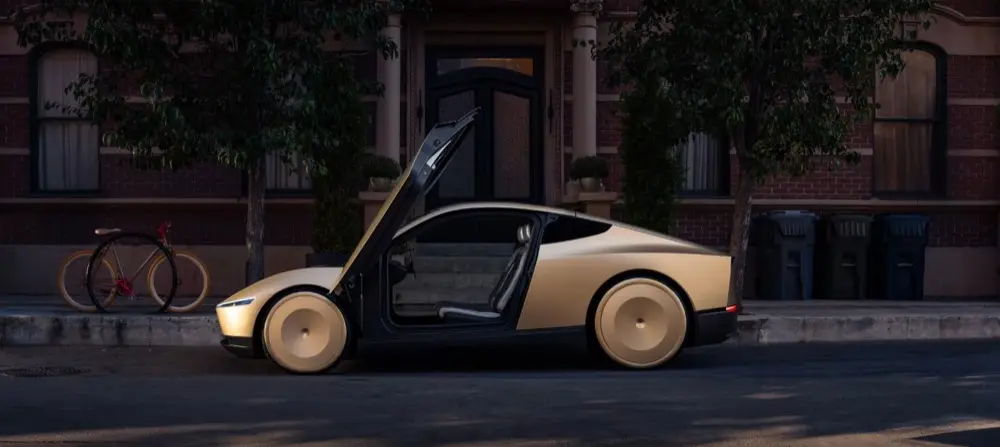
What happens when the world’s most valuable automaker promises a steering-wheel-free future, but delivers the opposite? This week, drone footage from Gigafactory Texas revealed approximately 60 Tesla Cybercab units lined up for pre-production—a sight that should excite investors, except for one glaring detail: every single vehicle sported a traditional steering wheel and pedals.
This shocking reversal, captured by factory observer Joe Tegtmeyer and reported by Teslarati, directly contradicts Elon Musk’s February proclamation that the Cybercab would enter production in April without steering wheels or pedals. For Western investors betting on Tesla’s high-margin mobility-as-a-service pivot, this is not merely a design change—it is a signal that regulatory and technical realities are forcing compromises on the company’s most critical growth narrative.
The Sighting: 60 Units and a Regulatory Compromise
The fleet spotted outside Tesla’s Austin facility represents the largest concentration of Cybercabs observed to date. While Musk has warned that initial production would be painfully slow following the classic S-curve ramp, the presence of control interfaces suggests something more troubling than scaling challenges.
- Volume Milestone: 60 units represent a significant jump from the 25 observed in March, confirming production intent
- Design Reversal: All units feature clearly visible steering wheels and pedal assemblies
- Timeline Pressure: Musk’s April production target appears met, but not as originally specified
According to Reuters analysis, this pivot likely stems from the National Highway Traffic Safety Administration’s Federal Motor Vehicle Safety Standards, which mandate traditional controls for vehicles sold to the public.
The Regulatory Trap: Why Tesla Cannot Go Wheel-Less Yet
Tesla faces a trilemma threatening its $30,000 Cybercab business model: regulatory compliance, technical readiness, and shareholder expectations. While Musk has marketed a fully autonomous future, current federal regulations create a formidable barrier.
NHTSA’s 2,500-Unit Exemption Cap
Under current FMVSS provisions, NHTSA may grant exemptions allowing up to 2,500 vehicles annually per manufacturer to operate without traditional controls. However, Tesla’s spotted fleet alone represents roughly 2.4% of this annual allowance, suggesting the company preserves exemption capacity while producing compliant vehicles for broader sales.
As Bloomberg reported, this bottleneck forces Tesla to choose between limited pilot programs with exemption-approved wheel-less units, or mass production of steerable versions for consumer sales.
Austin Pilot Data: The Technical Reality Check
Compounding regulatory constraints are troubling performance metrics from Tesla’s Austin Robotaxi pilot. Data indicates accident rates approximately four times higher than human drivers, with operational availability at just 19%.
These figures suggest Full Self-Driving software has not achieved the reliability threshold necessary for true unsupervised operation—a gap making the steering wheel’s return as much a safety necessity as a legal one.
Investment Implications: Valuing a Compromised Vision
For Western investors, the steering wheel’s reappearance challenges the valuation premium assigned to Tesla’s autonomous taxi ambitions. The narrative depends on transforming from hardware manufacturer to high-margin service provider, with robotaxi margins projected at 70% compared to automotive’s 18%.
See our analysis on Tesla’s Full Self-Driving safety record versus Chinese EV rivals to understand how these delays impact competitive positioning against BYD and XPeng.
Immediate consequences include:
- Delayed Service Launch: With steering wheels required, Tesla cannot activate the pure robotaxi network promised for 2024
- Margin Compression: Manufacturing complexity increases with dual-mode capability
- Competitive Risk: Chinese manufacturers like Baidu’s Apollo advance purpose-built autonomous vehicles without legacy controls
Until Tesla secures broader regulatory exemptions or achieves verifiable Level 4 autonomy, the Cybercab remains essentially a very expensive, two-seat electric vehicle with advanced driver assistance—not the transportation revolution promised to shareholders.
Recommended Reading
For deeper insight into the autonomous vehicle industry’s path to commercialization, we recommend Autonomy: The Quest to Build the Driverless Car—And How It Will Reshape Our World by Lawrence D. Burns and Christopher Shulgan. This comprehensive history explores why the industry’s most confident predictions have repeatedly collided with technical and regulatory realities—offering essential context for Tesla’s current predicament.