Introduction
In the rapidly evolving world of autonomous driving, the ability to simulate realistic sensor data is crucial for safe and efficient development. A recent breakthrough from the Singapore University of Technology and Design (SUTD) promises to accelerate this process by generating highly realistic 4D LiDAR scenes using a novel AI framework. This innovation could significantly reduce the reliance on expensive real-world data collection and accelerate the deployment of L3+ autonomous vehicles.
As a market analyst with a focus on the Chinese EV ecosystem, I see this development as a critical enabler for the entire autonomous driving industry. The ability to simulate edge cases and dynamic scenarios in a virtual environment is a cornerstone for achieving the safety and reliability required for mass adoption. This breakthrough not only benefits global OEMs but also provides a powerful tool for Chinese automakers like NIO, XPeng, and Li Auto, who are aggressively pushing the boundaries of autonomous driving technology.
Understanding the 4D LiDAR Simulation Breakthrough
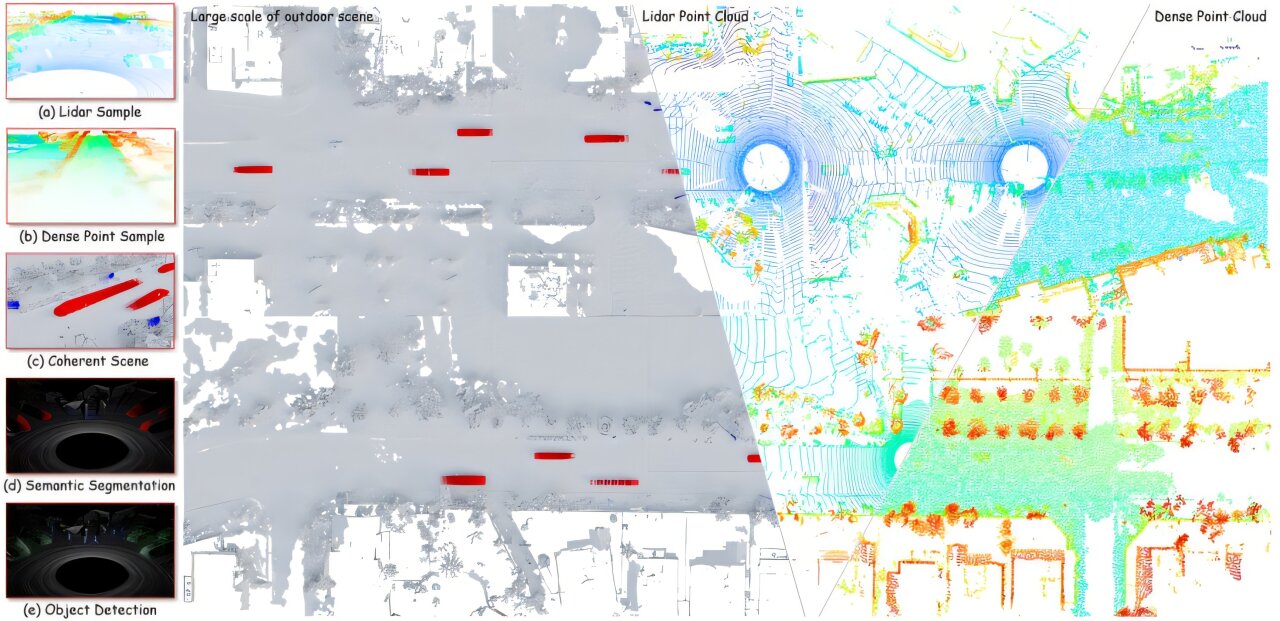
LiDAR (Light Detection and Ranging) is a key sensor for autonomous vehicles, providing precise 3D mapping of the environment. However, traditional simulation methods often fall short in realism, particularly in capturing the dynamic nature of real-world scenes over time. The SUTD framework addresses this by incorporating the fourth dimension—time—to generate 4D LiDAR data that accurately reflects moving objects and changing environments.
How the SUTD AI Framework Works
The framework leverages advanced AI models to synthesize LiDAR point clouds from a combination of sensor data and scene descriptions. It can generate realistic 4D scenes that include moving vehicles, pedestrians, and other dynamic elements, which are essential for training and testing autonomous driving algorithms. According to the researchers, this approach outperforms existing methods in terms of realism and diversity, potentially setting a new standard for simulation-based validation.
Implications for the Autonomous Driving Industry
The ability to generate high-fidelity 4D LiDAR simulations has profound implications for the autonomous driving industry. It allows developers to test their systems against a wide range of scenarios, including rare and dangerous edge cases, without the need for extensive and costly real-world driving. This can significantly shorten development cycles and improve safety.
Accelerating L3+ Autonomous Driving Development
L3+ autonomous driving requires robust perception and decision-making capabilities. Simulation is a critical tool for validating these systems. With more realistic simulations, developers can more accurately assess the performance of their algorithms and identify potential failures before they occur on the road. This is particularly important for Chinese automakers, who are aiming to launch L3+ vehicles in the near future.
Impact on the Chinese EV Market
Chinese EV brands such as NIO, XPeng, and Li Auto are at the forefront of autonomous driving innovation. They are investing heavily in R&D and are rapidly deploying advanced driver-assistance systems (ADAS) and autonomous driving features. The SUTD framework could provide these companies with a powerful tool to accelerate their development and validation processes.
Moreover, the Chinese government has been supportive of autonomous driving testing and commercialization. The ability to simulate realistic scenarios aligns with the regulatory push for safer and more reliable autonomous systems. As a result, we can expect Chinese automakers to quickly adopt and integrate such simulation technologies into their development pipelines.
Broader Implications for Global OEMs and Suppliers
Western OEMs and Tier 1 suppliers also stand to benefit from this breakthrough. The global race to autonomous driving is intensifying, and companies that can bring safe and reliable systems to market faster will gain a competitive edge. The SUTD framework offers a way to enhance simulation capabilities, potentially reducing the time and cost required for validation.
Furthermore, this technology could foster greater collaboration between academia and industry, driving further innovation in the field. As the industry moves towards standardized simulation formats and benchmarks, frameworks like this could become integral to the development ecosystem.
Challenges and Future Directions
While the SUTD framework represents a significant step forward, challenges remain. The computational resources required to generate high-fidelity 4D simulations can be substantial, and the accuracy of the simulations depends on the quality of the input data. Additionally, there is a need for standardized evaluation metrics to compare different simulation approaches.
Looking ahead, we can expect further advancements in AI-driven simulation, including the integration of more sensor modalities and the ability to simulate complex interactions between multiple agents. These developments will be crucial for achieving the levels of safety and reliability required for fully autonomous driving.
Market Analysis and Strategic Implications
From a market perspective, the SUTD breakthrough underscores the growing importance of simulation in the autonomous driving value chain. Companies that provide simulation tools and services are likely to see increased demand. This also presents opportunities for Chinese tech giants like Baidu and Huawei, who are developing their own autonomous driving platforms and could benefit from advanced simulation capabilities.
For investors, this development reinforces the long-term potential of the autonomous driving market. As simulation technology matures, it will enable faster iteration and deployment of autonomous systems, potentially accelerating the adoption curve. This could have significant implications for companies across the automotive and technology sectors.
Conclusion
The SUTD AI framework for 4D LiDAR simulation is a noteworthy advancement that could accelerate the development and validation of autonomous driving systems. By providing more realistic and dynamic simulations, it addresses a critical need in the industry. For Chinese EV brands and global OEMs alike, this technology offers a path to safer and more efficient autonomous driving development. As the industry continues to evolve, simulation will play an increasingly central role, and breakthroughs like this are paving the way for the future of mobility.