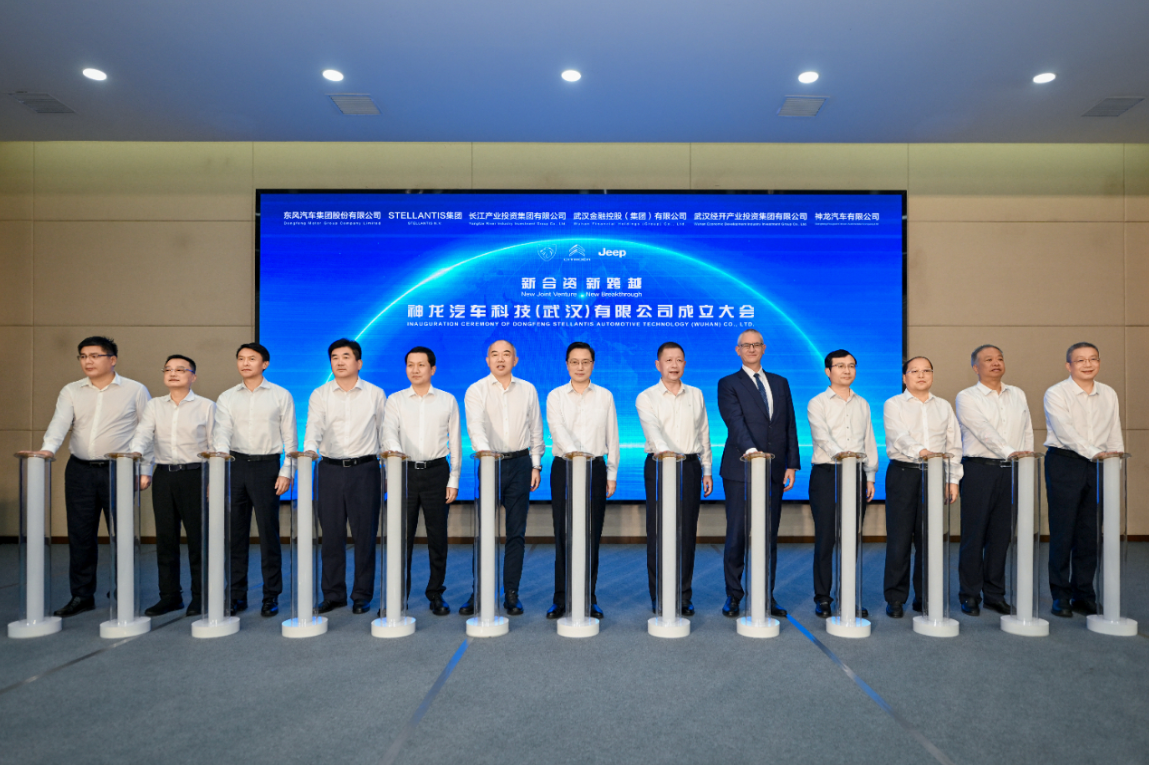
In a major consolidation move that redefines legacy automotive partnerships in China, Dongfeng Motor and Stellantis Group have officially unveiled their latest joint venture vehicle, Shenlong Automotive Technology (Wuhan) Co., Ltd. Backed by an injection of over 8 billion RMB ($1.1 billion USD) from six distinct investing parties, this new entity marks a decisive step in the ongoing Stellantis Dongfeng joint venture restructuring, shifting focus away from overcapacity in a hyper-competitive domestic market toward a highly optimized global export and technology hub.
The 8 Billion RMB Capitalization of Shenlong Technology
On August 20, Shenlong Automotive Technology was formally inaugurated in the Wuhan Economic and Technological Development Zone. This newly capitalized entity represents a deep alignment of interests between French-American conglomerate Stellantis, state-owned Dongfeng Motor, and local municipal investment platforms. By pooling resources, the six participating stakeholders aim to breathe new life into existing manufacturing infrastructure through modernization, digitization, and localized supply chain integration.
Rather than letting valuable assembly lines sit idle amid the fierce price war in China's domestic electric vehicle (EV) market, the partners are pivoting DPCA (Dongfeng Peugeot-Citroën Automobile) assets into an export-oriented base. Below is a breakdown of the strategic objectives behind this high-stakes restructuring:
| Metric / Strategic Pillar | Restructuring Details |
|---|---|
| Total Investment | Exceeding 8 Billion RMB (~$1.1 Billion USD) |
| Key Participants | Dongfeng Motor, Stellantis Group, Wuhan Gov. investment entities |
| Core Focus Areas | NEV development, software-defined vehicle integration, and international component exports |
| Geographic Hub | Wuhan Economic and Technological Development Zone |
Analyzing the Pivot: Strategic Sourcing and Trade Adaptability
As an industry analyst observing Sino-Western automotive dynamics, this restructuring illustrates how global legacy OEMs are reframing their operations. Facing rising trade barriers in Europe and North America, multinational automotive groups can no longer rely on simple import-export frameworks. Instead, cross-border collaboration and localized regional footprints have become the standard for maintaining trade adaptability.
By transforming the Wuhan facility into a modernized manufacturing hub, Stellantis is positioning itself to leverage China’s mature battery, powertrain, and ADAS supply chains. This setup allows the joint venture to manufacture highly competitive, cost-effective models designed for global markets—particularly in regions across Southeast Asia, Latin America, and the Middle East—while maintaining strict supply chain compliance across varied geopolitical jurisdictions.
The Strategic Play for Western Investors
For institutional investors tracking the automotive sector, the Stellantis Dongfeng joint venture restructuring offers several critical takeaways:
- Asset Optimization: By consolidating legacy assets into a lean, export-focused technology hub, Stellantis mitigates the risk of multi-billion dollar write-downs on Chinese factory capacity.
- Access to Localized Innovation: Wuhan remains a hotbed for automotive R&D. Establishing Shenlong Technology ensures that Stellantis maintains a direct window into Chinese battery developments (such as advanced LFP architectures) and autonomous driving frameworks.
- Pragmatic Collaboration over Exit: Rather than executing a costly exit from the Chinese market, Stellantis is executing a strategic sourcing alliance, combining its global distribution network with Dongfeng’s localized production efficiencies.
Ultimately, this restructuring signals a broader trend in the automotive industry: Western OEMs are transitioning from treating China solely as a consumer market to treating it as a primary technological and manufacturing springboard for global expansion.