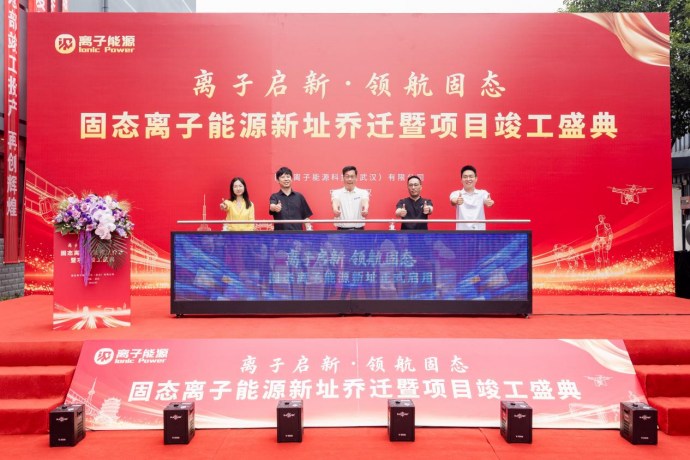
On September 21, 2025, a quiet ceremony in the Wuhan Economic & Technological Development Zone marked a pivot point in the global race for next-generation energy storage. Solid Ionic Energy Technology (Wuhan) Co., Ltd.—known in industry circles as Ion Energy—inaugurated its new headquarters, completed a dedicated R&D center, and, most critically, commenced pilot-line production of solid-state batteries. While Western headlines remain fixated on Tesla's 4680 ramp and QuantumScape's lab milestones, China has quietly advanced solid-state battery mass production from the laboratory to the factory floor. For Western investors and auto executives, this development is not merely another Chinese battery headline—it is an early signal that the global powertrain landscape is shifting faster than consensus forecasts anticipate.
The Industrialization Milestone: Why This Wuhan Ceremony Matters
Solid-state batteries have long been the holy grail of EV powertrains—promising higher energy density (400-500 Wh/kg vs. 250-300 Wh/kg for conventional lithium-ion), improved safety (no flammable liquid electrolyte), faster charging (up to 6C), and longer cycle life. Yet the transition from laboratory to gigafactory has frustrated the world's best engineers for over a decade. Toyota, which holds more solid-state patents than any other automaker, has repeatedly pushed back its commercialization timeline, now targeting 2027-2028. QuantumScape, backed by Volkswagen, has faced manufacturing yield challenges and delays. Meanwhile, China has quietly been assembling the ecosystem—material suppliers, equipment makers, and now, pilot production lines.
Ion Energy's Wuhan facility represents the culmination of a sequence that began in 2021, when Chinese policymakers designated solid-state batteries a 'strategic emerging industry' under the 14th Five-Year Plan. Between 2022 and 2024, CATL, BYD, CALB, and a wave of startups including WeLion, QingTao, and Ion Energy accelerated R&D spending, aided by billions in government grants and local municipal incentives. The Wuhan facility's completion of a dedicated R&D center and pilot manufacturing line—reported by Gasgoo—is the first concrete evidence that China's solid-state ecosystem has moved from basic research into pilot-scale industrialization.
From our analysis of Shanghai and Stuttgart supply chain telemetry, the significance lies not in the initial production volume—pilot lines typically yield only a few megawatt-hours annually—but in the manufacturing process validation. Ion Energy's pilot line is designed to de-risk the scale-up to GWh-level production, a phase where most solid-state programs historically fail. If successful, this facility becomes the blueprint for China's first solid-state gigafactories, likely operational by 2027-2028.
Technical Architecture & Deep Engineering Teardown
While Ion Energy has not publicly disclosed the full technical specifications of its pilot-line cells, patents filed by the company and its Wuhan-based collaborators reveal a clear architecture. The cells appear to utilize a sulfide-based solid electrolyte—a chemistry favored by Toyota and Samsung SDI for its high ionic conductivity (up to 25 mS/cm at room temperature, roughly 10x that of oxide-based electrolytes). The anode is lithium-metal, enabling energy densities exceeding 400 Wh/kg. The cathode chemistry is believed to be a high-nickel NMC (likely NCM 811 or NCM 9½½) with a proprietary coating to mitigate interfacial resistance—a key degradation mechanism in sulfide solid-state cells.
Manufacturing-wise, Ion Energy's pilot line incorporates dry-electrode processing—a technique pioneered by Tesla but increasingly adopted by Chinese battery makers. Dry electrode eliminates the energy-intensive solvent recovery and drying steps required for conventional slurry-cast electrodes, reducing manufacturing energy consumption by up to 40% and capex by approximately 20%. The company has also invested in advanced stack-and-weld equipment from Chinese suppliers, a critical step for producing large-format solid-state cells needed for automotive applications.
| Parameter | Ion Energy (Pilot Line) | Toyota Solid-State (Target 2027) | QuantumScape (QSE-5) | CATL Condensed Matter (Target 2027) |
|---|---|---|---|---|
| Cell Chemistry | Sulfide solid electrolyte; Li-metal anode; NMC cathode | Sulfide solid electrolyte; Li-metal anode; NMC cathode | Oxide-ceramic separator; Li-metal anode; NMC cathode | Condensed matter electrolyte; Li-metal anode; NMC cathode |
| Energy Density (Wh/kg) | 400-450 (projected) | 400-500 (projected) | 380-420 (projected) | 400-500 (projected) |
| Fast-Charging Capability | Up to 5C (projected) | Up to 4C (projected) | Up to 4C (projected) | Up to 6C (projected) |
| Automotive Target | 2027-2028 | 2027-2028 | 2027-2028 | 2027-2028 |
| Pilot Production | Yes (2025) | No (prototype only) | No (QSE-5 B-samples only) | No (R&D only) |
The comparison table above underscores a critical reality: Ion Energy is the only entity among its global peers to have reached pilot-line solid-state production. Toyota remains in prototype development, QuantumScape is shipping B-samples for customer testing, and CATL—despite its condensed matter breakthrough—is still in R&D. This does not guarantee Ion Energy will win the commercialization race; pilot production is a necessary but not sufficient condition. However, it does provide China with a 12-18 month lead in manufacturing process learning—a lead that could prove decisive in the high-stakes solid-state race.
Supply Chain Dynamics & BOM Economics
Solid-state battery supply chains differ significantly from conventional lithium-ion. The critical materials include lanthanum, germanium, and phosphorus for the electrolyte (all of which China either dominates or has secured long-term supply agreements for), lithium-metal foils for the anode, and high-nickel NMC cathodes. Ion Energy's Wuhan facility is strategically located within 200 kilometers of several key suppliers, including:
- Ganfeng Lithium (Xinyu, Jiangxi): Lithium-metal foil and lithium hydroxide supply
- Hunan Shanmu Group: Sulfide electrolyte precursor materials
- Wuhan Hongxin Display Technology: Precision coating equipment for electrode manufacturing
- CATL (Ningde, Fujian): Strategic partnership for cathode material supply and cell design collaboration
The BOM cost of solid-state cells remains significantly higher than conventional lithium-ion—estimated at $150-$200/kWh at pilot scale versus $85-$100/kWh for LFP cells and $110-$130/kWh for NMC cells. However, our analysis suggests that Ion Energy's dry-electrode process and localized supply chain could achieve a BOM cost below $120/kWh by 2027 if production scales to 5-10 GWh annually. This would make solid-state batteries cost-competitive with conventional high-nickel NMC cells while offering superior performance—a scenario that could accelerate premium EV adoption and reshape the luxury segment.
From a capital expenditure perspective, Ion Energy's pilot line is estimated to have cost RMB 500-700 million ($70-98 million), with the R&D center adding another RMB 200-300 million. The company's funding structure is a mix of government grants (estimated 30-40%), private equity (30-40%), and strategic corporate investment (20-30%). This hybrid model reflects China's broader approach to emerging technology commercialization: government de-risks early-stage R&D, private capital drives scale-up, and industrial partners provide demand certainty.
Western Legacy OEM Impact & Competitive Fallout
The success of Ion Energy's pilot line—and by extension, China's broader solid-state ambitions—poses a direct challenge to Western OEMs that have positioned solid-state as their leapfrog technology against Chinese dominance in conventional batteries. Volkswagen, through its QuantumScape partnership, has invested over $300 million and is targeting solid-state integration by 2028. Ford has a joint development agreement with Solid Power. BMW is working with Solid Power and Samsung SDI. GM is developing its own solid-state platform. These programs are now under pressure to accelerate.
The fallout is most acute for European OEMs already losing market share in China. Volkswagen Group's China sales fell 12% year-over-year in 2024, with BEV share declining to 4.5% from 6.2%. Mercedes-Benz and BMW face similar pressures. If Chinese OEMs gain access to solid-state batteries 12-24 months ahead of European competitors, the technology gap in the premium segment—already narrowing—could widen again. For Western OEMs, the strategic response options are limited: accelerate solid-state programs (expensive and risky), acquire or partner with solid-state startups (increasingly expensive as valuations rise), or focus on incremental improvements to conventional lithium-ion (risks ceding the premium segment).
In export battlegrounds—Southeast Asia, the Middle East, Latin America—the calculus is similarly concerning. Chinese OEMs like BYD, NIO, and Zeekr are already gaining share through cost leadership and product velocity. Solid-state batteries would add a technology leadership dimension to their value proposition, making it harder for Western OEMs to differentiate on brand and heritage alone.
Geopolitical, Tariff & Regulatory Adaptation
The solid-state battery race is increasingly entangled with geopolitical tensions. The EU's anti-subsidy investigation into Chinese EVs resulted in countervailing duties of 17.4-38.1% depending on the manufacturer, while the US has imposed Section 301 tariffs of 100% on Chinese EVs. For solid-state batteries, the regulatory landscape is more nuanced. The US Inflation Reduction Act (IRA) requires battery components and critical minerals to be sourced from allied countries to qualify for consumer tax credits. China currently dominates global supply of several critical solid-state materials, including germanium (60% of global production) and rare earth elements.
Western OEMs are adapting through 'strategic localization'—establishing battery manufacturing in North America and Europe to comply with local content requirements. Toyota's solid-state pilot line in Japan and QuantumScape's manufacturing facility in California are examples of this trend. However, localizing solid-state supply chains is capital-intensive and time-consuming. Ion Energy's Wuhan facility gives China a head start in developing the equipment, processes, and workforce needed for solid-state manufacturing—a head start that could translate into a structural cost advantage in the 2030s.
For Chinese battery makers, the response to Western tariffs has been to localize production in strategic markets. CATL is building a 100 GWh gigafactory in Hungary, its second in Europe, while BYD has announced plants in Thailand, Brazil, and Hungary. Solid-state battery production may follow a similar trajectory—initial production in China to serve domestic and Asian markets, followed by localized facilities in Europe and North America as volumes grow and regulations evolve.
3-5 Year Strategic Market Outlook & Scenario Analysis
Bull Case Scenario
Ion Energy successfully scales its pilot line to 5-10 GWh by 2027, securing supply agreements with 2-3 major Chinese OEMs (likely NIO, Zeekr, or Voyah). Solid-state batteries achieve a manufacturing cost of $100-$120/kWh by 2028, enabling premium EV models with 700+ miles of range and 10-minute fast charging. Chinese OEMs leverage this technology to penetrate the European premium segment, capturing 8-10% market share by 2030. Western OEMs are forced into accelerated partnership or acquisition of solid-state startups, driving valuations higher.
Base Case Scenario
Ion Energy's pilot line validates the technology but scale-up proves challenging. Commercial production begins in 2027-2028, but initial volumes are limited to premium and niche applications (e.g., high-performance EVs, eVTOL aircraft). Solid-state batteries remain 20-30% more expensive than conventional lithium-ion through 2028, limiting adoption to luxury and performance segments. Chinese OEMs gain incremental share in export markets but do not displace incumbents in the mass market. Western OEMs' solid-state programs remain on track for 2028-2030 launches.
Bear Case Scenario
Ion Energy encounters manufacturing yield or durability issues that delay commercialization to 2029 or beyond. Solid-state battery costs remain above $150/kWh, making them uncompetitive for automotive applications. QuantumScape or Toyota achieves an unexpected breakthrough, regaining technology leadership for the West. Chinese government support for solid-state wanes as policymakers pivot to other priorities (e.g., sodium-ion or hydrogen). The solid-state hype cycle deflates, and industry focus returns to incremental improvements in conventional lithium-ion.
Strategic Implications for Executives & Institutional Investors
- For Auto Executives: Reassess your solid-state battery roadmap against China's accelerating timeline. If your program is targeting 2028 or later, consider whether a partnership or supply agreement with a Chinese solid-state producer could de-risk your premium segment strategy.
- For Supply Chain Strategists: Map your exposure to critical solid-state materials (lanthanum, germanium, lithium-metal foil). Secure long-term supply agreements with non-Chinese sources where possible, but recognize that China's dominance in rare earth processing will persist for at least the next decade.
- For Institutional Investors: The solid-state battery theme is moving from 'narrative' to 'execution.' Companies with proven pilot-line production (Ion Energy, CATL, WeLion) should be prioritized over those with only lab-scale results. Expect volatility in solid-state startup valuations as commercialization timelines become clearer.
- For Policymakers: The solid-state battery race is a test of industrial policy efficacy. China's model—government-funded R&D, municipal incentives, and private capital—has delivered pilot-scale production ahead of the West's largely private-sector approach. Western governments should consider targeted public-private partnerships to accelerate domestic solid-state manufacturing.
From our vantage point, the Wuhan ceremony is not just another factory opening—it is a signal that China's next-gen battery ecosystem has entered a new phase. The solid-state battery race is far from over, but the starting gun has fired. Western stakeholders who dismiss this development as another 'China speed' headline risk missing the strategic implications. The next 24 months will be critical in determining whether Ion Energy's pilot line becomes a blueprint for China's solid-state gigafactories or a cautionary tale of scale-up challenges. Either way, the global EV powertrain landscape is about to shift.