As the global automotive industry seeks to diversify away from highly volatile lithium supply chains, sodium-ion batteries (SIBs) have emerged as a frontrunner for entry-level electric vehicles and stationary energy storage. However, the commercial viability of SIBs has long been hindered by a critical engineering bottleneck: rapid cathode degradation. Because sodium ions are physically larger than lithium ions, their continuous insertion and extraction cause severe structural strain, limiting overall sodium-ion battery durability.
The Structural Challenge of Sodium-Ion Chemistry
From a strategic sourcing perspective, sodium-ion chemistry is highly attractive. Sodium is thousands of times more abundant than lithium and can be harvested globally, offering a resilient hedge against raw material supply disruptions. Yet, the physical chemistry presents a daunting hurdle.
During charge and discharge cycles, sodium ions migrate between the anode and the cathode. Because of their large ionic radius, this migration causes the host material's crystal lattice to expand and contract violently. Over hundreds of cycles, this volumetric fluctuation leads to micro-cracking, active material loss, and ultimately, rapid capacity decay. To compete with lithium iron phosphate (LFP) chemistries, sodium-ion systems must prove they can deliver sustained cyclic longevity.
How Scandium Doping Restructures SIB Longevity
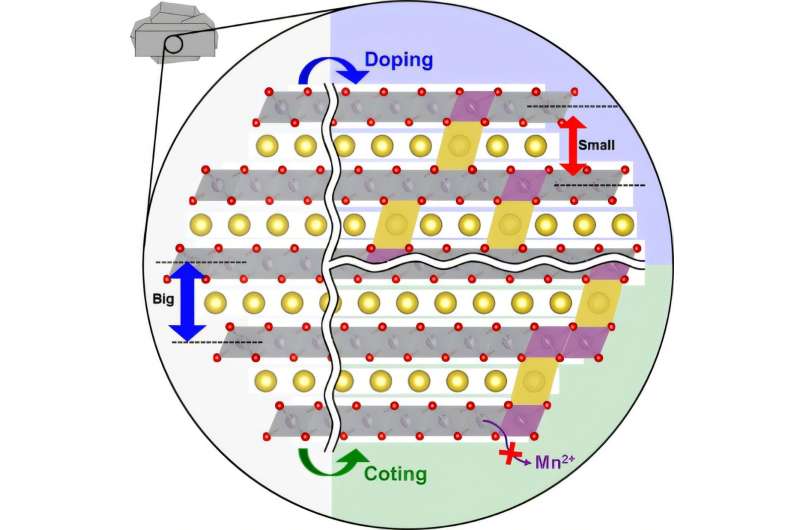
The recent research pioneered by the Tokyo University of Science addresses this degradation pathway at the atomic level. By substituting a fraction of the transition metals in layered metal oxide cathodes with scandium (Sc), the research team successfully mitigated structural distortion.
Scandium acts as a structural anchor. When integrated into the transition metal layers, it suppresses the phase transitions that typically trigger severe volume changes. The result is a highly robust host framework that tolerates the repeated ingress and egress of large sodium ions without fracturing. This atomic stabilization directly translates to prolonged electrochemical performance, preserving capacity over extended cycle testing.
Comparing Cathode Performance and Durability
For strategic analysts and battery procurement teams, the trade-offs of doping materials must be carefully evaluated against performance benefits:
| Cathode Formulation | Structural Retention | Energy Density Potential | Target Application Segment |
|---|---|---|---|
| Standard Layered Transition Metal Oxides | Moderate-Low (Prone to phase decay) | Baseline (140-160 Wh/kg) | Low-speed urban mobility, basic grid storage |
| Scandium-Doped Layered Oxides | High (Suppressed phase transitions) | Optimized (Highly stable at high voltages) | A-segment passenger EVs, long-duration storage |
| Polyanion Compounds (e.g., NFPP) | High (Intrinsically stable framework) | Low (110-130 Wh/kg) | Heavy-duty stationary backup power |
Strategic Implications for Global OEMs and Supply Chain Compliance
As Western OEMs navigate complex geopolitical landscapes and seek localized regional footprints, battery chemistry diversification is becoming a cornerstone of risk management. Incorporating advanced SIBs into product portfolios allows manufacturers to construct vehicles that are entirely decoupled from highly concentrated lithium-processing hubs.
While scandium is a relatively niche element, its high-efficiency utilization as a dopant—rather than a primary structural component—means the cost-to-benefit ratio remains highly favorable. This technological milestone signals to global investors that the performance gap between low-cost sodium-ion technology and traditional mid-range lithium-ion chemistries is closing faster than anticipated. Through strategic cross-border technology integration, global automotive supply chains stand to benefit from a more balanced, dual-chemistry ecosystem.