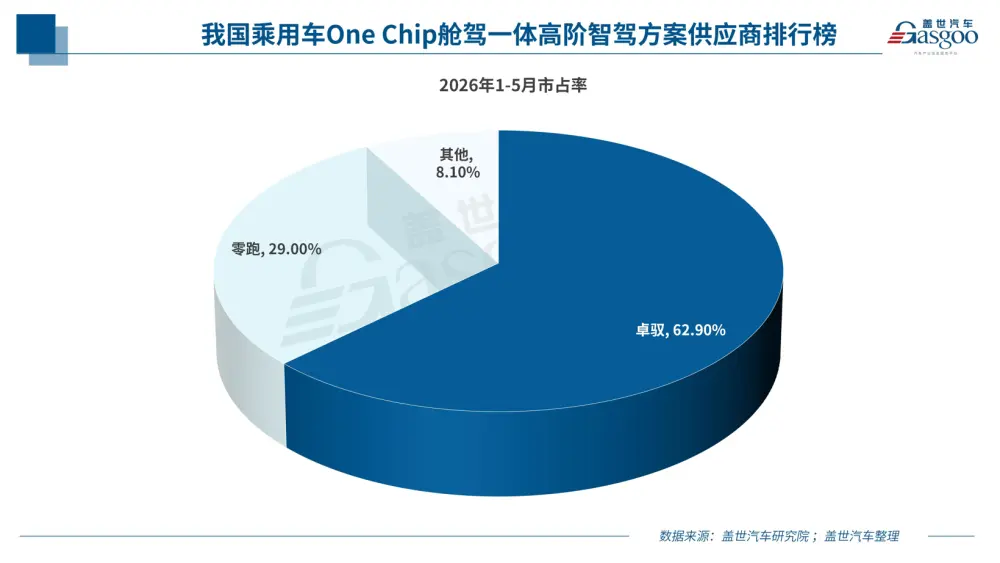
As global automakers struggle to transition to software-defined vehicles (SDVs), China's fast-moving EV supply chain has quietly passed a monumental milestone. DJI's autonomous driving and smart-cabin arm, JoyRide (卓驭 - Zhuoyu), has successfully achieved the commercial scale-up of its single-chip cockpit-driving integration system. This technical breakthrough marks the end of a seven-year conceptual wait, transitioning unified central computing from a luxury architecture down to highly competitive, mass-market electric vehicles.
The Evolution toward Single-Chip Cockpit-Driving Integration
Since the concept of a 'Central Computing Platform' was first proposed in 2019, the automotive industry has struggled to merge disparate computational domains. Historically, a modern electric car required separate, specialized brains: a smart cockpit chip (like the Qualcomm Snapdragon 8155) to run high-resolution infotainment screens, and an autonomous driving processor (like the NVIDIA DRIVE Orin or Horizon Journey series) to compute ADAS safety algorithms.
This separation—known as domain isolation—comes with significant costs. It requires multiple physical printed circuit boards (PCBs), complex wiring harnesses, redundant power management components, and high-latency communication protocols to let the cabin talk to the driving systems. True single-chip cockpit-driving integration bypasses this friction by running both critical operating systems on a single silicon wafer, divided securely by hardware-level hypervisors.
How DJI's JoyRide Cracked the Mass-Production Code
While Western chip giants and tier-1 suppliers have written extensively about 'central computing' in their future roadmaps, JoyRide has actually delivered it at scale. By leveraging deep software optimization and utilizing a visual-inertial visual model (without the need for expensive LiDAR sensors), JoyRide has managed to partition a single, cost-effective SoC to handle intensive compute workloads simultaneously.
This engineering feat ensures that critical ADAS features (like highway navigation, automated parking, and collision avoidance) remain functionally isolated and secure from any non-critical infotainment glitches (such as music streaming or maps crashing on the center console).
Architectural Breakdown: Domain vs. Single-Chip Consolidation
To understand why this is a structural shift for automotive margins, consider the direct architectural advantages:
| Metric | Traditional Domain Setup | JoyRide Single-Chip Integration |
|---|---|---|
| Silicon Overhead | 2+ Dedicated SoCs (e.g., Qualcomm + Horizon) | 1 Unified SoC |
| System BOM Cost | High (multiple PCBs, wiring, cooling loops) | Reduced by 30% to 40% |
| Inter-Domain Latency | Milliseconds (Ethernet / CAN-FD bus delay) | Microseconds (Shared on-chip memory) |
| Target Vehicle Price | Premium luxury models (> $35,000 USD) | Mass market and budget (< $20,000 USD) |
The Strategic Threat to Legacy Western OEMs
For Western automotive executives and institutional investors, the successful scale-up of JoyRide’s single-chip architecture is a clear warning sign. Legacy OEMs (Volkswagen, Ford, Stellantis) are currently battling legacy software systems, often relying on outsourced, fragmented code across dozens of legacy electronic control units (ECUs).
While Western legacy brands delay their clean-sheet software-defined platforms, Chinese competitors are utilizing platforms like JoyRide to democratize premium autonomous driving features. Integrating L2+ highway navigate-on-pilot (NoP) and 3D smart-cabin environments into cars costing less than $20,000 creates a massive cost-to-value gap that imports from Europe and the US simply cannot match.
Ultimately, this isn't just about reducing silicon count. It represents a fundamental shift in the economics of smart EV manufacturing. Companies that control the software layer of unified hardware will lead the next generation of global automotive sales.