As global EV supply chains seek to diversify away from natural graphite dependencies, a groundbreaking research project from Pennsylvania State University offers a highly sustainable solution: a high-performance recycled plastic battery anode.
As a battery materials analyst, I see this not just as an environmental win, but as a critical technical milestone. Currently, over 70% of the world's synthetic and natural graphite is processed in China. By utilizing local municipal waste streams to produce a high-capacity recycled plastic battery anode, Western OEMs and tier-1 suppliers can build domestic supply chain compliance while hitting ambitious ESG (environmental, social, and governance) targets.
The Science: Turning Trash into Battery-Grade Anodes
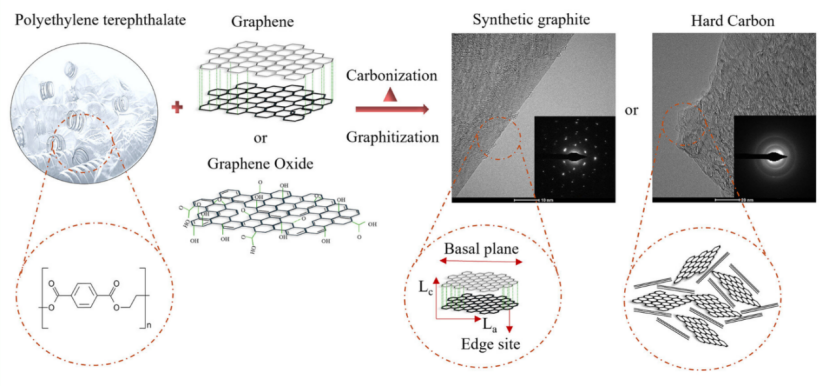
Historically, converting waste plastics into high-crystallinity graphite has been hindered by low yields and poor electrochemical performance. However, the Penn State research team bypassed these obstacles through a novel low-temperature catalytic graphitization process.
By using waste PET bottles as a carbon precursor and introducing a metal-based catalyst during pyrolysis, the researchers successfully aligned the carbon atoms into a highly ordered hexagonal lattice. This structures the material perfectly for lithium-ion intercalation, matching the structural integrity of premium commercial synthetic graphite.
Performance Metrics Comparison
To understand the strategic viability of this technology, we must look at how this recycled plastic battery anode stacks up against traditional EV-grade materials:
| Performance Metric | Traditional Synthetic Graphite | Recycled PET-Derived Graphite Anode |
|---|---|---|
| Specific Capacity | ~360-372 mAh/g | ~355 mAh/g (optimized) |
| Carbon Footprint | High (coal/petroleum coke precursor) | Ultra-low (circular economy credit) |
| Supply Chain Risk | High (concentrated refining) | Low (localized regional footprint) |
| Raw Material Cost | Volatile market pricing | Low (utilizes waste feedstock) |
Strategic Advantages for Western OEMs and Suppliers
Why should automotive strategists and investors pay attention to this development? It directly addresses three distinct pain points currently keeping auto executives up at night:
- Supply Chain Compliance: Trade frameworks like the US Inflation Reduction Act (IRA) and the EU Critical Raw Materials Act heavily incentivize localized sourcing. Finding alternative domestic graphite precursors is paramount.
- Decarbonization Goals: Standard synthetic graphite production relies on fossil-fuel-derived needle coke processed at temperatures exceeding 3,000°C. Shifting to catalytic conversion of waste plastic drastically lowers Scope 3 carbon emissions.
- Strategic Sourcing Alliances: This research opens the door for joint ventures between global waste management firms and battery manufacturers, creating an entirely closed-loop domestic ecosystem.
The Road to Commercialization and Scaling Challenges
While the laboratory results are highly encouraging, scaling up this technology from milligram-level lab samples to kiloton-level industrial output presents key hurdles. Purification is the first obstacle; municipal plastic waste often contains contaminants like labels, dyes, and other polymers that must be strictly filtered to prevent battery degradation.
Secondly, the economic viability depends heavily on the cost of the catalyst recovery process. If the catalyst metals can be recycled efficiently within the manufacturing loop, this process could easily compete with, if not beat, the cost of imported natural graphite.