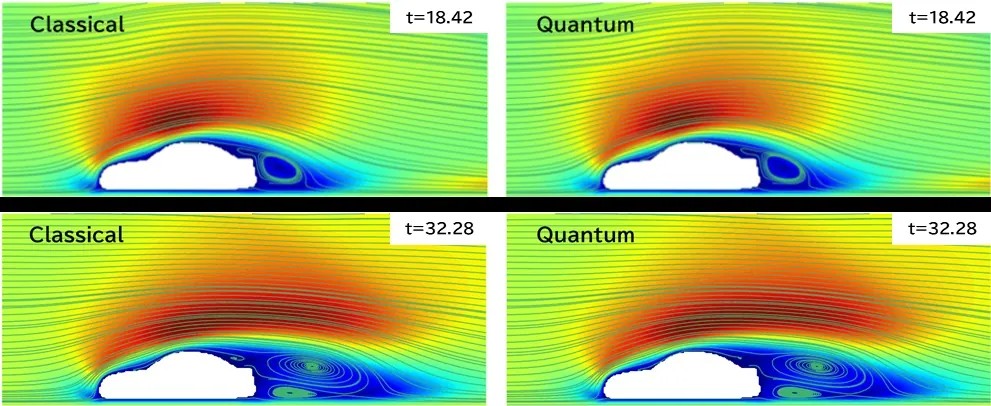
In the hyper-competitive electric vehicle (EV) landscape, aerodynamic efficiency is the holy grail of range extension. Traditionally, optimizing a car's drag coefficient (Cd) has required massive supercomputers running grueling fluid dynamics simulations for days. However, Nissan Motor Co. and quantum software pioneer Quemix Inc. have shattered this bottleneck, successfully demonstrating the world's first application of quantum computing automotive aerodynamics simulation.
The Quantum Leap: Resolving the 24-Hour CFD Bottleneck
For decades, automotive manufacturers have relied on Computational Fluid Dynamics (CFD) to predict how air flows around a vehicle's chassis. While indispensable, classical CFD runs are notoriously resource-intensive. A single high-fidelity simulation of complex turbulent airflow can easily take 24 hours or more on a high-performance computing (HPC) cluster. This delay creates a massive drag on the rapid prototyping cycles required for modern EV development.
By leveraging quantum algorithms, the Nissan-Quemix partnership aims to bypass the physical scaling limitations of classical silicon hardware. Their successful proof-of-concept demonstrates that quantum-enhanced simulations can process complex fluid dynamics equations at exponential speeds, effectively compressing a full day's worth of processing into minutes.
How Nissan and Quemix Deployed Hybrid Quantum-Classical Algorithms
Pure quantum hardware is still in its Noisy Intermediate-Scale Quantum (NISQ) era, meaning quantum processors (QPUs) alone cannot yet handle the massive scale of an entire automotive 3D simulation. To overcome this, Nissan and Quemix co-developed a sophisticated hybrid architecture:
- The Classical Processor: Handles the overall structural layout and preprocessing of the vehicle grid mesh.
- The Quantum Core: Dedicated to executing complex fluid dynamics algorithms (specifically targeting localized non-linear flow structures and boundary layers) where quantum superposition and entanglement offer mathematical acceleration.
By delegating the most computationally taxing mathematical tasks to quantum algorithms, the hybrid system achieves unprecedented processing speeds without requiring a fault-tolerant quantum computer.
Strategic Implications: Can Legacy OEMs Leapfrog 'China-Speed' R&D?
As an industry analyst tracking the global EV ecosystem, I find the timing of this breakthrough highly strategic. Chinese OEMs like BYD, Xiaomi, and Geely have achieved unprecedented time-to-market cycles (often 18 to 24 months for a new EV compared to the traditional 4-5 years of Western legacy OEMs) largely through sheer brute-force parallel computing, agile design loops, and massive engineering workforces.
For legacy OEMs like Nissan, competing on raw physical iteration speed is incredibly difficult. Quantum computing represents a potential technological leapfrog. If Nissan can scale this quantum CFD simulation tool, their engineering teams can test hundreds of aerodynamic variations in a single day—a process that would take Chinese competitors using classical HPCs months to execute.
Comparing Classical vs. Quantum CFD in Automotive R&D
| Metric / Feature | Traditional Classical CFD | Nissan-Quemix Quantum-Classical CFD |
|---|---|---|
| Average Compute Time | ~24 Hours (per complex run) | A few minutes (estimated at scale) |
| Hardware Dependency | Massive HPC Clusters / Server Farms | Hybrid QPU + Classical GPU/CPU |
| Design Iteration Speed | Slow; limited by daily queue times | Real-time; allowing dynamic adjustments |
| Primary Target Value | Standard structural validation | Ultra-precise EV drag reduction & range extension |
The Road Ahead: Scaling Quantum for Production
While this milestone is historic, some skepticism is warranted. Transitioning from a validated algorithm in a lab environment to full-scale production vehicle design remains a challenge. Current quantum hardware suffers from noise and limited qubit counts, meaning it will likely be several years before Nissan completely replaces classical CFD with quantum alternatives.
However, as global competition intensifies and EV range efficiency becomes the primary battleground, those who master quantum-accelerated design today will likely hold a massive structural advantage tomorrow. Investors and strategy directors should keep a close eye on partnerships like Nissan-Quemix, as they represent the true vanguard of next-generation automotive engineering.