As the global automotive industry intensifies its search for cost-effective lithium-ion alternatives, sodium-ion chemistry has emerged as a frontrunner. However, commercializing these cells has been plagued by performance degradation during manufacturing. For years, the industry attributed this to moisture. Now, a groundbreaking study from South Korea's Pohang University of Science and Technology (POSTECH) reveals a different culprit: Prussian Blue sodium-ion battery degradation is primarily driven by surface oxidation, not water contamination.
Challenging the Moisture Myth in Sodium-Ion Chemistry
Prussian Blue Analogs (PBAs) are highly attractive cathode materials for sodium-ion batteries due to their open framework structure, rapid sodium-ion transport, and reliance on abundant, low-cost elements like iron and manganese. They offer a viable path to de-risk supply chains from volatile lithium and cobalt markets.
During the slurry preparation and electrode-drying phases, PBAs historically suffered unexplained capacity loss. Battery engineers assumed that trace water trapped within the crystal lattice was the destructive force, leading to highly expensive, energy-intensive vacuum drying protocols. The POSTECH study, led by Professor Kyu-Young Park, fundamentally reframes this challenge.
The Science: How Surface Oxidation Causes Prussian Blue Sodium-Ion Battery Degradation
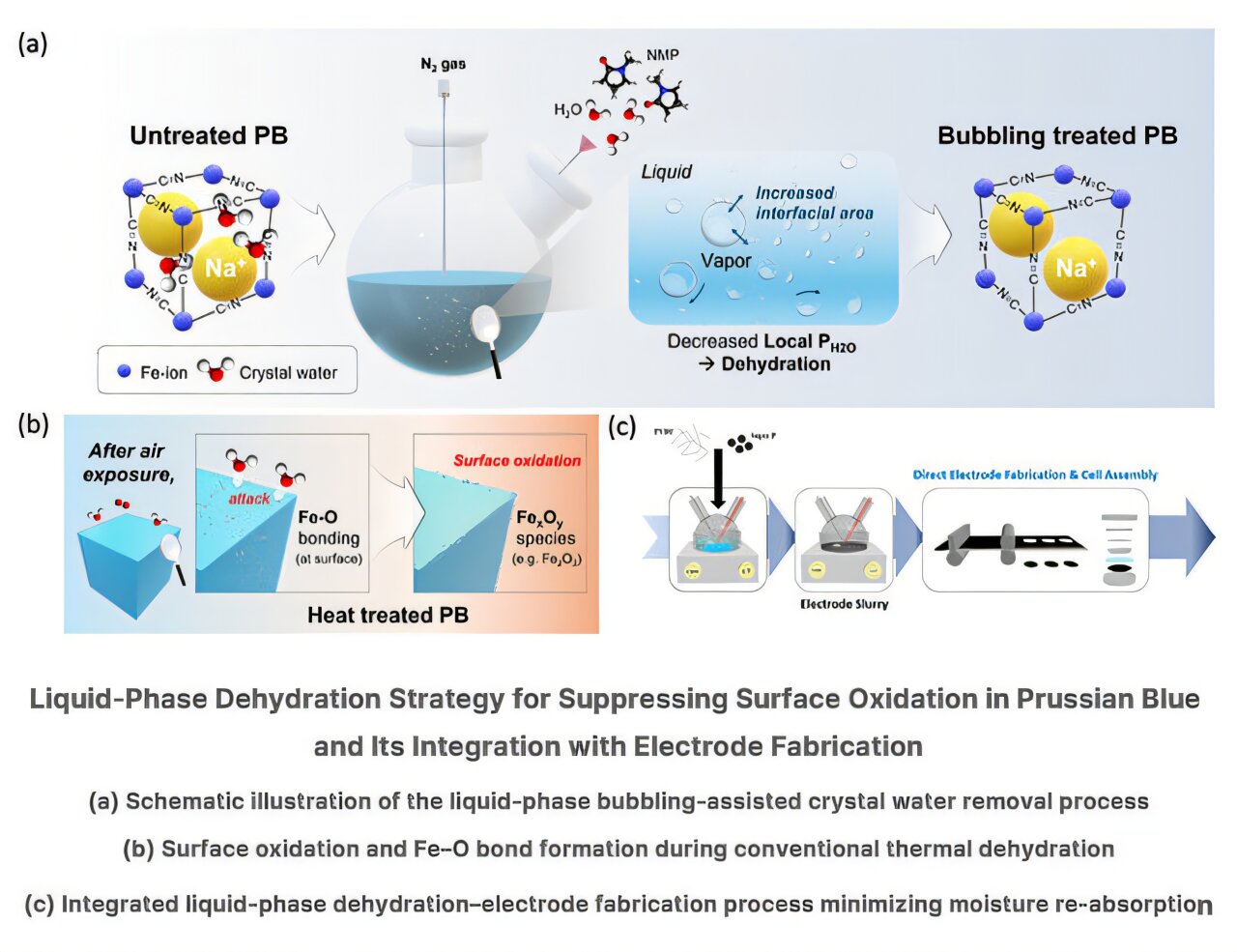
Using advanced synchrotron-based X-ray absorption spectroscopy, the POSTECH team analyzed PBA cathodes during the high-temperature vacuum drying process. They observed that the material undergoes a chemical shift even in the absence of moisture:
- Spin-State Transition: Under thermal stress, surface iron atoms (Fe2+) undergo oxidation, changing to Fe3+.
- Structural Collapse: This valence change alters the spin state of the iron, causing the crystal lattice to contract and distort.
- Sodium-Ion Blockage: The physical distortion blocks the diffusion pathways for sodium ions, permanently lowering the cathode's electrochemical capacity and cycle life.
Crucially, this oxidation occurs because of trace oxygen present during thermal processing, meaning traditional dry-room environments alone cannot prevent degradation if oxygen exposure is not strictly managed.
Industrial Implications: Reshaping Gigafactory Processing
For battery manufacturers and Western OEMs targeting localized supply chains, this discovery is a major operational win. It suggests that instead of chasing impossible-to-reach moisture-free thresholds, focus should shift toward atmospheric control during thermal processing.
| Parameter | Traditional Assumption | POSTECH Finding & New Strategy |
|---|---|---|
| Primary Degradation Trigger | Residual interstitial water molecules | Surface iron oxidation (Fe2+ to Fe3+) |
| Manufacturing Focus | Ultra-high vacuum, extreme dry rooms | Inert gas purging (nitrogen/argon), reducing atmospheres |
| Capital Expenditure (CapEx) | Very High (expensive dehumidification) | Moderate (standard gas-control systems) |
By using inert or slightly reducing atmospheres (like nitrogen or argon blankets) during the drying phase, gigafactories can mitigate Prussian Blue sodium-ion battery degradation without investing millions in ultra-low dew point dry rooms. This significantly lowers the barrier to entry for domestic sodium-ion manufacturing in the US and Europe, enabling rapid scaling of grid storage and entry-level electric vehicle batteries.