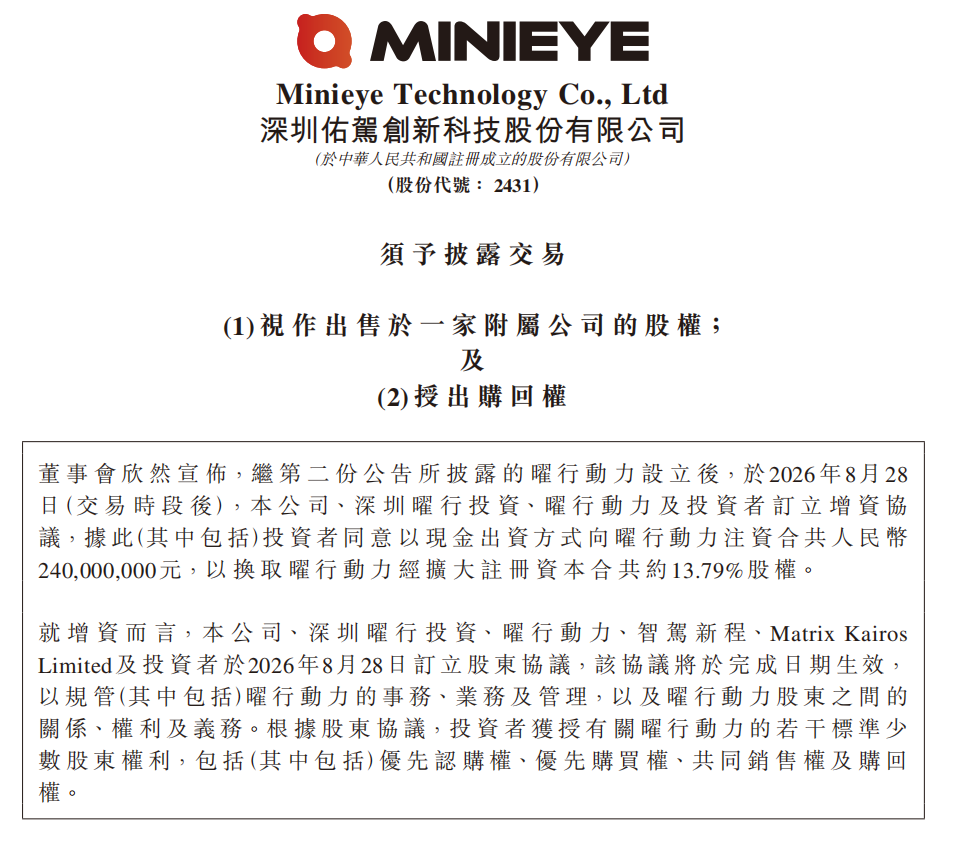
The autonomous driving landscape is undergoing a monumental paradigm shift, moving beyond traditional software algorithms toward embodied intelligence. At the forefront of this evolution is the integration of physical AI in autonomous driving—systems that do not just process data, but actively understand and interact with the physical laws of the real world. A prime indicator of this capital shift occurred on August 28, 2026, when Youjia Innovation (HKG: 2431) announced that its physical AI subsidiary, Yao Xing Dong Li, successfully closed a massive 240 million RMB (approximately $33 million USD) Angel funding round, backed by a powerful syndicate including Dongfeng Asset Management and a CICC-Porsche joint fund.
The Paradigm Shift: What is Physical AI in Autonomous Driving?
For years, autonomous vehicle development focused primarily on cognitive AI—perception, localization, and path planning. However, the next frontier requires physical AI (often referred to as embodied AI), which bridges the gap between digital reasoning and physical execution. As a market analyst tracking global mobility trends, I view this funding round as a clear signal that leading automotive groups are preparing for a future where vehicles act as intelligent physical agents.
Yao Xing Dong Li specializes in creating full-scenario physical AI systems. Unlike standard ADAS (Advanced Driver Assistance Systems) that rely on pre-programmed heuristic rules, physical AI leverages foundation models trained on physical dynamics. This allows the system to predict how objects move, react to complex environmental physics, and operate seamlessly across both passenger vehicles and industrial robotic applications.
The Strategic Play: Decoding Porsche and Dongfeng's Involvement
The participation of the CICC-Porsche joint fund and Dongfeng Asset Management highlights a sophisticated cross-border technology integration strategy. Rather than viewing this as a regional venture, global legacy OEMs are actively seeking strategic alliances to secure early-stage positioning in high-potential AI technologies.
1. Global Technology Sourcing and Collaborative Innovation
For international luxury brands like Porsche, participating in Chinese technology ecosystems via joint investment funds allows for deep-dive technical scouting. This strategy fosters global supplier expertise and provides early access to cutting-edge physical AI architectures that can enhance global software platforms.
2. State-Backed Validation and Localization
Dongfeng's involvement provides solid industrial validation. As a major Chinese state-owned automaker, Dongfeng offers immediate commercialization pathways, allowing Yao Xing Dong Li to test and deploy its physical AI models across diverse commercial and passenger vehicle fleets.
| Metric / Detail | Details of the Transaction |
|---|---|
| Target Company | Yao Xing Dong Li (曜行动力) - Subsidiary of Youjia Innovation |
| Funding Amount | 240 Million RMB (~$33M USD) |
| Key Investors | Dongfeng Asset Management, CICC Porsche Joint Fund |
| Core Technology | Embodied physical AI models for autonomous mobility |
Implications for the Global EV & AV Value Chain
This transaction highlights several critical shifts in how global automotive giants are navigating the rapid pace of technological disruption:
- Transition from Software-Only to Embodied Systems: Future vehicle platforms will increasingly treat the vehicle chassis, steering, and AI system as a unified physical actor, optimizing ride comfort and safety through real-time physical modeling.
- Supply Chain Diversity and Resilience: Global OEMs are establishing localized regional footprints. Collaborating with leading-edge Chinese AI firms allows Western brands to maintain high-tech competitiveness while complying with regional trade requirements.
- Focus on Capital Efficiency: Investing in established incubators of public companies (like Youjia Innovation, HKG: 2431) minimizes the risk profile for early-stage VC investments, ensuring that the capital is deployed directly into functional R&D.
As the industry moves toward end-to-end AI models, the synergy between physical AI and traditional automotive engineering will define the next generation of software-defined vehicles. This 240M RMB injection is not just an investment in a startup; it is a strategic bet on the foundational framework of future autonomous systems.