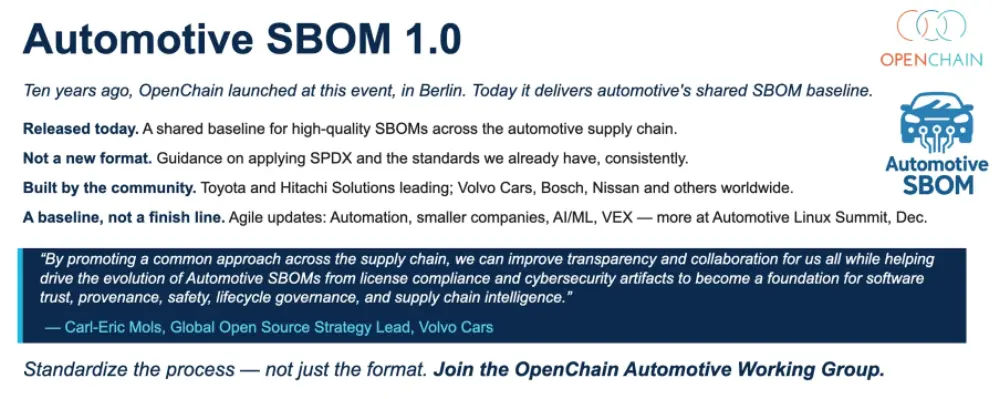
On May 5, 2026, the Linux Foundation announced the release of the OpenChain Automotive SBOM Framework 1.0 — a specification designed to standardize Software Bill of Materials (SBOM) generation, exchange, and management across the automotive supply chain. While this announcement lacks the visceral punch of a 1,000-horsepower EV debut, its strategic implications for global automakers are arguably more consequential. This framework arrives at a critical juncture: the software-defined vehicle (SDV) era has transformed cars into rolling software platforms, with modern premium vehicles containing over 100 million lines of code — more than a fighter jet — yet the industry still lacks a unified mechanism to trace the provenance of that code. The OpenChain Automotive SBOM Framework 1.0 seeks to change that.
The timing is not coincidental. Over the past 18 months, regulators in the European Union (via UNECE R155/R156), the United States (via the NHTSA cybersecurity directive), and China (via MIIT's intelligent connected vehicle regulations) have moved to mandate software traceability mechanisms. The automotive industry, long accustomed to hardware-centric supply chains with clear tiered structures, now faces a software supply chain that is fragmented, opaque, and increasingly vulnerable to open-source licensing disputes and cybersecurity exploits. The OpenChain Automotive SBOM Framework 1.0 is the Linux Foundation's attempt to bring order to this chaos before regulators impose their own fragmented solutions.
Why Software Supply Chain Integrity Became the Auto Industry's Sleeping Crisis
The automotive software supply chain has evolved rapidly from embedded firmware to complex, layered software stacks that include open-source components, third-party middleware, and proprietary application code. A single electric vehicle today may incorporate software from hundreds of suppliers, ranging from Tier-1 giants like Bosch and Continental to small open-source projects maintained by individual developers. This complexity creates systemic risks: a vulnerability in a widely used open-source library (e.g., Log4j in 2021) can expose millions of vehicles; an unresolved open-source license dispute can halt production; and the inability to trace software provenance can delay regulatory approval for safety-critical functions like autonomous driving.
The OpenChain Automotive SBOM Framework 1.0 builds upon the Linux Foundation's existing OpenChain Project, which since 2016 has developed ISO/IEC 5230:2020 — the international standard for open-source license compliance. The automotive-specific framework adds layers tailored to vehicle software: functional safety (ISO 26262) alignment, cybersecurity (ISO/SAE 21434) integration, and supply chain data exchange protocols. It defines a common SBOM format (based on SPDX 3.0) and provides implementation guidance for automakers, suppliers, and tool vendors. Crucially, it is vendor-neutral and open — a stark contrast to proprietary solutions that lock participants into a single ecosystem.
Under the Hood: Technical Architecture and Supply Chain Data Exchange
The framework's technical foundation rests on three pillars: standardized component identification, automated SBOM generation, and secure data exchange across supply chain tiers. The SBOM format accommodates component names, versions, suppliers, license types, known vulnerabilities (via CVE references), and dependency relationships. It supports both source code and binary artifacts, and it is designed to be machine-readable and human-auditable.
From a practical standpoint, the framework introduces a 'trust but verify' model. Tier-1 suppliers generate SBOMs for their software packages and share them with OEMs through a standardized API. OEMs aggregate these SBOMs into a vehicle-level bill of materials, which can be queried for vulnerability impact analysis or license compliance checks. The Linux Foundation provides open-source tooling (OpenChain Reference Tooling) to facilitate adoption, reducing the barrier for smaller suppliers.
However, the framework's success hinges on adoption depth. Unlike hardware specifications where a single design win can scale across millions of units, software SBOM compliance requires continuous, per-release effort. Every software update — including over-the-air (OTA) patches — demands an updated SBOM. This operational burden may cause some suppliers to comply minimally or delay reporting. Moreover, enforcement mechanisms are weak: the framework is voluntary, and there is no central authority to audit compliance.
| Feature | OpenChain Automotive SBOM 1.0 | SPDX 2.2 (General) | CycloneDX (General) | Proprietary Automotive Solutions |
|---|---|---|---|---|
| Automotive-specific extensions | Yes — ISO 26262, ISO/SAE 21434 mapping | No | No | Varies; often closed |
| Supply chain data exchange API | Standardized, open | Limited | Limited | Proprietary |
| License compliance (OpenChain) | Integrated | Basic | Basic | Often separate module |
| Regulatory alignment | UNECE R155/R156, NHTSA, MIIT ready | None | None | Custom |
| Open-source tooling | Yes (OpenChain Reference Tooling) | Yes | Yes | No |
The table above illustrates the framework's differentiation: it is the only specification that explicitly bridges general SBOM standards with automotive safety and cybersecurity requirements. However, its reliance on voluntary adoption and the absence of penalty mechanisms means that compliance may be uneven. For Western OEMs subject to EU and US regulations, this framework provides a ready-made compliance pathway — but it does not eliminate the need for internal auditing and supplier enforcement.
Who Actually Builds This? Tier-1 Suppliers and the Cost of Compliance
The OpenChain Automotive SBOM Framework 1.0 was developed with contributions from major automotive stakeholders, including Bosch, Continental, ZF, and several Chinese Tier-1 suppliers. Notably, the Linux Foundation has not disclosed the full list of participating companies, but industry sources indicate that Chinese EV players such as NIO and XPeng have been actively involved in early adoption pilots. This aligns with China's broader push to establish domestic standards for intelligent connected vehicles while also positioning its exporters for global regulatory compliance.
For Tier-1 suppliers, the cost of implementing SBOM frameworks is non-trivial. Based on industry estimates from supply chain consultants, a mid-sized Tier-1 supplier (revenue $1–5 billion) can expect to invest $500,000 to $2 million in tooling, training, and process changes in the first year of adoption. Ongoing annual costs for SBOM generation and management may range from $100,000 to $500,000, depending on software complexity and update frequency. These costs are not trivial for margin-compressed suppliers, especially in the current EV price war environment where OEMs are squeezing supplier margins.
Automakers themselves also face significant integration costs. A legacy OEM with multiple vehicle platforms and a complex supplier network may need to build a centralized SBOM aggregation platform, estimated at $5–15 million for development and integration, plus ongoing operational costs. These investments are justified by regulatory risk mitigation: failure to comply with UNECE R155 can result in vehicle type approval denial in the EU, effectively blocking sales.
From a Bill of Materials (BOM) perspective, the software content of a modern vehicle already represents 20–30% of total vehicle cost, and this share is rising. SBOM management adds a layer of overhead that, while small in absolute terms (0.5–1.5% of software cost), requires dedicated engineering resources. For Chinese OEMs aiming to export to Europe and North America, this overhead is a necessary cost of doing business. For Chinese OEMs focused on domestic and Global South markets, the urgency is lower, though global supply chain integration will eventually force compliance.
Competitive Impact: Who Wins, Who Loses, and Who Avoids the Fight
The OpenChain Automotive SBOM Framework 1.0 creates a bifurcated competitive landscape. Winners include: (1) Linux Foundation and its ecosystem partners, who gain influence over automotive software standards; (2) Tool vendors that provide SBOM compliance solutions, which will see growing demand; (3) OEMs that adopt early, as they gain a compliance moat and can streamline regulatory approvals; and (4) Chinese EV exporters targeting Europe, who can leverage the framework to demonstrate regulatory readiness.
Losers include: (1) Suppliers that resist transparency and view SBOM as a cost burden; (2) Proprietary SBOM solution providers that face displacement by an open standard; and (3) OEMs that delay adoption, risking regulatory delays and cybersecurity vulnerabilities.
Among Western OEMs, Volkswagen and Stellantis are particularly exposed due to their complex, multi-platform software architectures and heavy reliance on outsourced software development. Both companies have announced SBOM initiatives, but their progress is uneven. Tesla, with its vertically integrated software stack, is less dependent on external SBOM frameworks, though it still must comply with regulatory requirements. Hyundai-Kia, which has pursued a more decoupled strategy from Chinese software suppliers, may find SBOM adoption easier because its software supply chain is more concentrated.
Chinese competitors such as BYD and Geely are accelerating SBOM adoption to support export ambitions. BYD's in-house software development (including its DiPilot ADAS and DiLink OS) gives it greater control over SBOM generation, but its sheer scale — over 3 million NEVs sold annually — means even minor software components require tracking. Geely, through its subsidiaries like Zeekr and Volvo, faces a dual challenge: aligning its Chinese and European software supply chains under a single SBOM framework.
The Compliance Chasm: From Framework Theory to Factory Floor Execution
While OpenChain promises a unified language, mapping SBOMs to functional safety (ISO 26262) remains an engineering black box. A static framework cannot account for dynamic OTA updates or the probabilistic nature of open-source vulnerabilities. For this to be viable at scale, suppliers must implement automated dependency scanning that integrates with CI/CD pipelines without introducing latency risks in safety-critical control loops.
The economic reality is stark; a $1M investment for Tier-1 compliance may erode margins during the EV price war. Unlike hardware BOMs which are fixed, software SBOMs require continuous auditing of every patch. If this framework represents a genuine paradigm shift, it must prove that automated traceability reduces long-term recall liability more than it increases upfront engineering overhead.
Western OEMs like VW face legacy integration debt, while Chinese players like BYD leverage vertical integration to control SBOM data but risk regulatory friction in the West. The framework's voluntary nature means adoption will be dictated by regulators rather than market pull, creating a bifurcated landscape where compliance becomes a license-to-operate rather than an engineering choice.
Regulatory and Geopolitical Crosscurrents: SBOM as a Compliance Passport
The regulatory landscape for automotive software is tightening rapidly. In the European Union, UNECE R155 (cybersecurity) and R156 (software updates) require manufacturers to demonstrate a cybersecurity management system (CSMS) and software update management system (SUMS). SBOMs are a critical input to both. The EU's Cyber Resilience Act, expected to enter force in 2027, will impose additional requirements on software transparency for products with digital elements, including vehicles. In the United States, the NHTSA has issued voluntary cybersecurity guidance that strongly recommends SBOM practices, and the FTC has taken action against companies that fail to secure software supply chains. China's MIIT has issued its own intelligent connected vehicle regulations, which mandate software security assessments and data provenance tracking.
For Chinese EV exporters, SBOM compliance is not optional if they wish to sell in these regulated markets. The OpenChain Automotive SBOM Framework 1.0 provides a common language that can satisfy multiple regulators, reducing the need for region-specific solutions. However, it does not eliminate the need for localization: Chinese OEMs must still navigate data sovereignty requirements (e.g., EU data localization) and may need to establish local SBOM repositories in each jurisdiction.
Geopolitically, SBOM frameworks are becoming a tool of industrial policy. The US has restricted the export of certain software and hardware technologies to China, and SBOMs could be used to enforce those restrictions by revealing the presence of controlled components. Conversely, China has promoted its own standards (e.g., the China Automotive Software Standardization Committee's SBOM guidelines) and may require domestic SBOM formats for vehicles sold in China. The OpenChain framework's global aspirations may be tempered by these national interests.
Strategic Outlook: Three Scenarios for SBOM Adoption and Automotive Software Competition
Bull Case: Rapid Standardization and Harmonized Global Compliance
In this scenario, the OpenChain Automotive SBOM Framework 1.0 gains rapid adoption across major OEMs and Tier-1 suppliers. Regulatory bodies recognize it as a compliant pathway, and Chinese and Western automakers converge on a single SBOM standard. This reduces compliance costs, accelerates L3 autonomous driving approvals, and enhances cybersecurity resilience. Chinese EV exporters benefit from streamlined market access, while Western OEMs gain visibility into their software supply chains. The framework becomes a model for other industries.
Base Case: Incremental Adoption Amidst Fragmentation
Adoption proceeds unevenly. Large OEMs and Tier-1 suppliers comply, but smaller players lag. Regulatory bodies accept multiple SBOM formats, leading to a patchwork of requirements. Chinese OEMs adopt the framework for export models but maintain separate domestic SBOM systems. Compliance costs remain a burden for suppliers, and cybersecurity incidents continue to occur due to incomplete SBOMs. The framework is a useful tool but not a panacea.
Bear Case: Geopolitical Fracture and Compliance Divergence
Geopolitical tensions lead to the splintering of SBOM standards. The US and EU promote Western-led frameworks, while China mandates its own SBOM specifications. Chinese OEMs and Western OEMs operate with incompatible SBOM systems, increasing costs and complicating cross-border collaborations. SBOM data becomes a weapon in trade disputes, with accusations of hidden software backdoors. The OpenChain framework loses relevance as national interests dominate.
Key Strategic Takeaways for Executives and Investors
- Regulatory compliance is non-negotiable. SBOM frameworks are becoming a prerequisite for vehicle type approval in the EU and are strongly recommended in the US. Automakers and suppliers that delay adoption risk market access and legal liability.
- SBOM adoption costs are manageable but require planning. Large suppliers should budget $1–2 million in year one and $100–500K annually for SBOM compliance. These costs are small relative to the potential regulatory penalties and recall risks.
- Chinese EV exporters gain a competitive advantage by early alignment. Companies like BYD and NIO that adopt OpenChain SBOM early can demonstrate regulatory readiness and build trust with Western regulators and partners.
- The framework's voluntary nature is its greatest weakness. Without enforcement, inconsistent adoption is likely. Investors should monitor whether OEMs impose SBOM requirements on their suppliers through contracts — this will be the true driver of compliance.
- Watch for convergence with autonomous driving certification. As L3 systems require demonstrable software safety, SBOM frameworks that integrate ASIL tagging will become indispensable. The current OpenChain framework is a starting point, but further development is needed.
In conclusion, the OpenChain Automotive SBOM Framework 1.0 is a significant but incomplete step toward software supply chain integrity in the auto industry. It provides a much-needed common language for SBOM exchange, but its voluntary nature, cost implications, and geopolitical vulnerabilities mean that its impact will be shaped by corporate strategy and regulatory enforcement. For Western auto executives and investors, the message is clear: software traceability is no longer a back-office concern — it is a boardroom imperative.