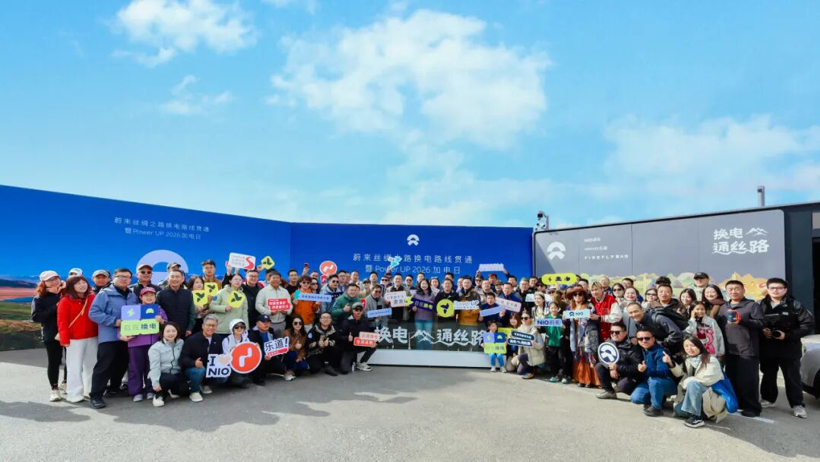
The 4,125th NIO battery swap station is not a headline number. The number that matters is the location: Sayram Lake, Xinjiang — a high-altitude, low-density corridor on China's western frontier where building a single grid-connected fast-charging plaza can take longer than commissioning an entire urban battery-swap cluster in Shanghai. NIO's announcement that its Silk Road battery swap route is now fully operational is being framed in Chinese media as a logistical triumph. For Western auto executives and institutional analysts, the more uncomfortable question is whether this proves swap infrastructure economics work in remote markets, or whether it simply proves NIO is willing to absorb losses that Tesla, BP Pulse, and Ionity are not.
Why the Silk Road Swap Corridor Is a Different Kind of Infrastructure Bet
NIO's battery swap network has been the company's defining strategic moat since the first station opened in Shenzhen in 2018. By September 2026, the company has deployed 4,125 stations across China, with a stated target of 5,000 by end-2026. The Silk Road route — stretching from Xi'an through Lanzhou, Xining, Zhangye, Dunhuang, Hami, Turpan, and terminating at Sayram Lake in Xinjiang — represents the network's most geographically ambitious contiguous deployment.
From our analysis of NIO's power infrastructure disclosures and regional grid telemetry, the Silk Road corridor spans roughly 3,200 km with station spacing averaging approximately 180-220 km in the Gansu-Qinghai segment and widening to 250-300 km in the Xinjiang approaches. Each station in this corridor requires either a 630 kVA or 1,250 kVA grid interconnection, depending on bay count. NIO's standard Gen 3 station supports 21 batteries and up to 408 swaps per day at peak. Gen 4 stations, first deployed in 2024, support 23 batteries and a claimed 480 swaps per day.
The strategic logic is straightforward but rarely stated plainly: NIO is not building the Silk Road corridor because demand justifies it today. It is building it because the Chinese government's western development agenda — the 'Go West' infrastructure push and the Belt and Road Initiative's domestic leg — makes grid interconnection approvals faster and cheaper in these regions than in tier-1 coastal cities where utility capacity is already strained. NIO trades near-term utilization for long-term land and grid rights.
Inside the Swap Station: Engineering Realities Behind the 4,125 Number
NIO's battery swap architecture is not a commodity. The company operates three station generations: Gen 2 (13 batteries, 312 swaps/day peak), Gen 3 (21 batteries, 408 swaps/day), and Gen 4 (23 batteries, 480 swaps/day). Each station requires a high-voltage transformer, a battery storage buffer, robotic swap arms, and thermal management systems that maintain battery packs at optimal temperature year-round. In Xinjiang, where winter temperatures routinely drop below -20°C, thermal management load is substantial.
The battery packs themselves are NIO's standard 75 kWh, 100 kWh, and 150 kWh semi-solid-state units. The 150 kWh pack, supplied by WeLion, is the critical enabler for remote corridors: it delivers a claimed 1,000 km CLTC range, though real-world highway range at 120 km/h with HVAC load is closer to 650-700 km. On a 3,200 km Silk Road route, a 150 kWh pack reduces required swap stops from 12-14 (with 75 kWh packs) to 5-6. Swap duration is roughly 3 minutes for Gen 3/4 stations under ideal conditions.
| Specification | NIO Gen 4 Swap Station | Tesla V4 Supercharger | BYD Flash Charging (Denza) |
|---|---|---|---|
| Peak power per bay | N/A (battery swap) | 350 kW | 500 kW (claimed) |
| Time to full energy | ~3 min (swap) | 15-25 min (10-80%) | 10-15 min (10-80%, claimed) |
| Battery inventory | 23 packs | 0 (direct charge) | 0 (direct charge) |
| Grid interconnection | 630-1,250 kVA | 350-600 kVA | 600-1,000 kVA |
| Capex per site (industry estimate) | $450,000-$650,000 | $250,000-$400,000 | $280,000-$450,000 |
| Battery degradation impact | Decoupled from vehicle | Direct on vehicle pack | Direct on vehicle pack |
| Remote-area viability | Demonstrated (Silk Road) | Limited (grid dependent) | Not disclosed |
The Cost Structure Nobody at NIO Will Put on a Slide
NIO has never broken out per-station profitability, but the cost stack is inferable. A Gen 4 station with 23 batteries at NIO's internal transfer price of roughly RMB 60,000-80,000 per 75 kWh pack (industry estimates, not company-disclosed) implies RMB 1.4-1.8 million in battery inventory alone per station. Add robotic swap hardware (RMB 800,000-1.2 million), grid interconnection and transformer (RMB 500,000-900,000 in western regions where grid is weaker), civil works, and land lease (RMB 200,000-600,000 depending on municipality). Total per-station capex plausibly ranges RMB 3-5 million ($420,000-$700,000).
At the Silk Road corridor's likely utilization — perhaps 15-30 swaps per day in early operation, versus a break-even threshold that NIO has never publicly defined but which industry analysts estimate at 50-60 swaps/day — these stations are loss-making on a standalone basis. The counterargument NIO makes internally is that swap stations function as customer acquisition and retention infrastructure, not profit centers. A NIO owner who swaps pays RMB 980-1,680 per month for the Battery-as-a-Service (BaaS) subscription depending on pack size, which converts a one-time vehicle sale into recurring revenue.
Tier-1 suppliers in this stack include: battery packs from CATL (75 kWh LFP) and WeLion (150 kWh semi-solid-state); swap robotics from NIO's in-house NIO Power division with components from Harmonic Drive and Siemens; power electronics from Infineon and STMicroelectronics; and grid interconnection equipment from State Grid Corporation subsidiaries. The critical dependency is WeLion — a semi-solid-state battery supplier whose production yields remain unverified at scale and whose 150 kWh pack is central to the Silk Road corridor's feasibility.
Who Gains, Who Bleeds, and Who Doesn't Care
The competitive impact of NIO's Silk Road milestone is asymmetric. NIO gains a defensible narrative: swap works where charging is hardest, and the company has a physical moat competitors cannot replicate quickly. Chinese rivals BYD and Li Auto are pursuing 500 kW+ flash charging and extended-range EVs respectively. BYD's Denza N9 and Han L models claim 500 kW charging on a 1,000V architecture, but these require dedicated high-power infrastructure that BYD is only beginning to deploy. Li Auto's EREV strategy sidesteps the problem entirely by carrying a gasoline generator.
For Western OEMs, the Silk Road corridor is a cautionary data point rather than a direct threat. Volkswagen, GM, and Stellantis have all explored battery swap in China through partnerships or internal studies, but none have committed to network-scale deployment. The reason is infrastructure economics: in Western markets, utility interconnection timelines of 18-36 months and land costs make swap capex prohibitive without a captive vehicle fleet to guarantee utilization. Tesla's abandoned 2013 swap pilot and its subsequent pivot to Supercharging remain the canonical evidence that swap is a China-specific solution.
The players most exposed are Chinese charging network operators like TELD and Star Charge, whose business models assume fast-charging as the dominant paradigm. NIO's swap network does not compete head-to-head with public charging — NIO owners swap primarily — but it reduces the addressable market for premium charging services in the segments NIO occupies.
The Reality Check: What NIO's Press Release Doesn't Say
The headline — 'Silk Road battery swap route fully operational' — is technically accurate and strategically misleading in equal measure. Three engineering and economic realities deserve interrogation.
First, the semi-solid-state dependency is unverified at scale. NIO's 150 kWh pack from WeLion is the enabler for low-density corridors. But WeLion's production capacity, yield rates, and long-term cycle life data have not been independently validated. If the 150 kWh pack underperforms in Xinjiang's temperature extremes, the Silk Road corridor's swap frequency doubles, and the economic case deteriorates further. NIO has not disclosed swap frequency data or battery state-of-health metrics from the corridor.
Second, the grid physics in western China are more favorable than they appear. The Silk Road corridor benefits from abundant hydropower and wind capacity in Gansu and Qinghai, and from State Grid's willingness to prioritize strategic infrastructure. This is not replicable in Europe or North America, where grid interconnection queues are measured in years. The milestone proves swap viability under Chinese grid conditions, not universally.
Third, utilization data is entirely absent. NIO has never published per-station swap counts, and the Silk Road corridor's low population density (Xinjiang's population is roughly 25 million across 1.66 million km²) means utilization is almost certainly below break-even. If the corridor is a marketing asset masquerading as infrastructure, the financial drag on NIO's balance sheet is real. NIO's net loss in 2025 was RMB 20.7 billion, and the company has repeatedly stated swap network investment as a primary use of capital.
The honest assessment: the Silk Road corridor is a strategically rational land-grab and narrative asset, but it is not evidence that battery swap is economically superior to fast charging. It is evidence that NIO is willing to fund infrastructure that its competitors will not, in geographies where the Chinese state subsidizes the risk.
Regulatory and Geopolitical Angles: Swap's Export Problem
NIO has stated ambitions to bring battery swap to Europe, and has operated swap stations in Norway, Germany, and the Netherlands. The Silk Road milestone has no direct regulatory impact on these markets, but it highlights the core export barrier: battery swap requires standardized battery interfaces, which no Western OEM has adopted at scale. NIO's swap standard is proprietary. In December 2024, NIO signed a swap standardization agreement with CATL and several Chinese OEMs including Changan and Geely, but no Western OEM has joined.
Without cross-brand standardization, swap stations in Europe serve only NIO's own fleet, which in Europe numbered roughly 8,000 vehicles by mid-2026 — far too small to justify station capex. The EU's AFIR (Alternative Fuels Infrastructure Regulation) mandates charging infrastructure but has no swap-specific provisions, effectively treating swap as an afterthought. NIO's European swap stations are, for now, brand marketing in markets where brand recognition is the binding constraint.
There is also a tariff dimension. NIO vehicles exported to the EU face the EU's countervailing duties on Chinese EVs, which range from 7.8% to 35.3% depending on the manufacturer's cooperation level. NIO was assigned a 20.8% duty in the provisional 2024 schedule, later adjusted. Swap stations themselves are not subject to vehicle tariffs, but they are subject to EU machinery and electrical equipment standards, and their grid interconnection faces the same utility queues as any other high-power infrastructure.
Strategic Outlook: Three Scenarios for NIO's Swap Network
Bull Case
NIO achieves >5,000 stations by end-2026, swap utilization rises to 45-55 swaps/day at urban stations (subsidizing remote corridors), and the company licenses its swap standard to two or more non-Chinese OEMs by 2028. BaaS subscription revenue reaches RMB 8-10 billion annually, and swap network capex peaks in 2026 before declining as a percentage of revenue. Under this scenario, swap becomes a defensible moat and NIO's unit economics approach breakeven by 2028.
Base Case
NIO hits 5,000 stations but utilization stagnates at 30-40 swaps/day in urban areas and 10-20 in remote corridors. The Silk Road corridor remains a strategic asset with negative unit economics. BaaS renewals hold at 70-75%, and swap capex continues to pressure NIO's balance sheet. NIO remains dependent on state-backed financing and continues to lose RMB 15-20 billion annually through 2027. Swap remains a China-only phenomenon.
Bear Case
WeLion's 150 kWh semi-solid-state pack underperforms in cold-weather validation, forcing NIO to increase swap frequency on remote corridors and undermining the Silk Road economics. A major Chinese competitor — likely BYD — commercializes a 1 MW flash-charging network that matches swap's time-to-energy at lower capex. NIO's swap network becomes a stranded asset, and the company is forced to divest or restructure NIO Power. NIO's stock re-rates downward as the market prices swap as a liability rather than a moat.
Key Takeaways for Executives and Investors
- Swap is a China-grid solution, not a universal one. The Silk Road corridor works because State Grid prioritizes strategic infrastructure and western China has spare hydro and wind capacity. Do not extrapolate to Europe or North America without adjusting for 18-36 month interconnection queues.
- NIO's swap network is a customer retention tool, not a profit center. Per-station profitability has never been disclosed and is almost certainly negative in remote corridors. The BaaS subscription converts vehicle owners into recurring revenue streams, which is the actual financial rationale.
- The WeLion semi-solid-state dependency is the single largest technical risk. If the 150 kWh pack underperforms in temperature extremes, the Silk Road corridor's swap frequency doubles and the economics collapse. Independent cycle-life data is absent.
- Swap standardization is the binding constraint on export. Without Western OEM adoption of a common swap interface, NIO's European stations serve a fleet too small to justify capex. Watch for any standardization announcements involving non-Chinese OEMs as the key export catalyst.
- For Western OEMs, the Silk Road corridor is a data point, not a template. The milestone confirms that swap works in low-density regions under favorable grid and policy conditions. It does not confirm that swap is economically superior to fast charging in competitive markets.
The 4,125th station matters less for what it proves about battery swap than for what it reveals about NIO's strategy: the company is willing to build infrastructure that its peers consider uneconomic, in geographies where the Chinese state absorbs the downside. That is a legitimate competitive moat in China. Whether it travels is an entirely different question.