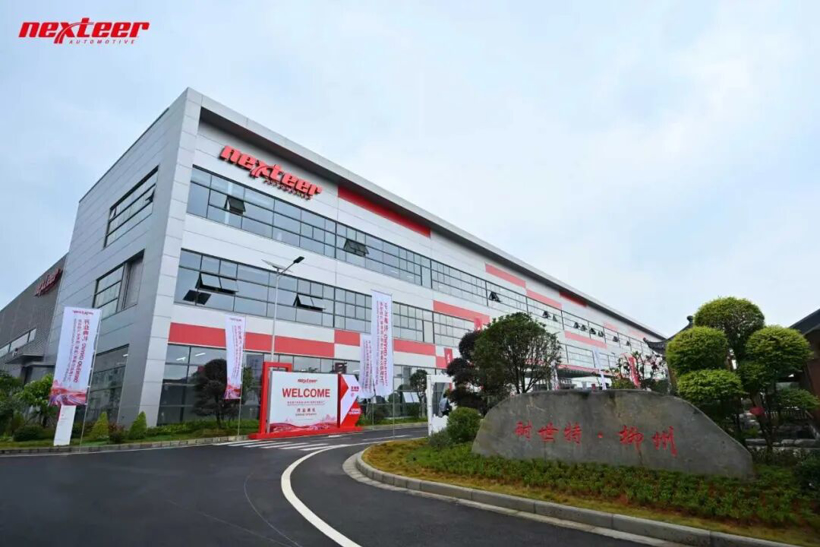
On the morning of May 6, 2026, Nexteer Automotive hosted the grand opening of its new manufacturing facility in Liuzhou, Guangxi — a quiet but telling moment in the global automotive supply chain. While Western headlines obsess over EU countervailing duties, US IRA exclusions, and the so-called 'de-risking' of Chinese supply chains, a Tier 1 steering giant just poured concrete and installed assembly lines deep inside China's EV heartland.
The move raises an immediate, uncomfortable question for every Western automotive executive: if the geopolitical narrative is one of decoupling, why is a Michigan-headquartered, Chinese-controlled supplier expanding capacity in a city best known as the home of SAIC-GM-Wuling? The answer lies in the brutal arithmetic of EV production — and the uncomfortable reality that China still assembles roughly 60% of the world's electric vehicles.
Why Liuzhou Matters More Than the Press Release Suggests
Nexteer Automotive (柳州) Co., Ltd. — the entity behind the new factory — is not a newcomer to Liuzhou. The company has operated in the city since 2015, supplying electric power steering (EPS) systems to SAIC-GM-Wuling (SGMW), the joint venture that produces the wildly popular Wuling Hongguang Mini EV and a growing family of affordable electric crossovers. The new plant, according to Gasgoo, represents a 'further deepening' of Nexteer's Liuzhou layout, but the company has not publicly disclosed the exact investment amount, production capacity in units per year, or the specific product lines that will be manufactured.
What we do know from Nexteer's global footprint and industry benchmarks is that this is likely an EPS assembly operation. Nexteer is the world's second-largest steering supplier by revenue, behind Bosch and roughly on par with JTEKT. Its core products are column-assist EPS (CEPS), rack-assist EPS (REPS), and steering columns. For a city like Liuzhou, where SGMW produces over 1.5 million vehicles annually (including roughly 400,000 to 500,000 electrified models), a local EPS plant reduces logistics costs and insulates the OEM from cross-provincial supply shocks.
The historical context is critical. Between 2020 and 2024, China's EV production exploded from 1.4 million units to over 9 million units. Steering systems — particularly EPS, which is mandatory for any modern EV — became a bottleneck. Nexteer's existing Liuzhou capacity was stretched. The new plant is a response to that demand, not a speculative bet. But the timing, coming amid EU tariff investigations and US political pressure, makes it a geopolitical statement as much as an industrial one.
Inside the EPS Supply Chain: What Nexteer Builds and Who It Serves
Electric power steering is deceptively complex. Unlike hydraulic systems, EPS relies on an electric motor, torque sensor, and electronic control unit (ECU) to provide steering assist. For EVs, EPS is non-negotiable because hydraulic pumps drain battery range. The global EPS market is expected to grow from $25 billion in 2024 to $38 billion by 2030, with China accounting for over 40% of that demand.
Nexteer's competitive advantage lies in its modular EPS architectures. The company supplies both CEPS (used in smaller vehicles like the Wuling Mini EV) and REPS (used in heavier EVs like the BYD Han or NIO ET5). While Nexteer does not publicly break down its per-vehicle content, industry teardowns suggest an EPS system costs between $150 and $400 depending on steering column complexity, motor power, and redundancy requirements for ADAS integration.
In Liuzhou, the primary customer is almost certainly SGMW. The joint venture's 'GSEV' (Global Small Electric Vehicle) platform, which underpins the Mini EV and the newer Wuling Bingo, uses a compact CEPS system. Nexteer also supplies other Chinese OEMs with operations in Guangxi, including Dongfeng Liuzhou Motor. The new plant likely consolidates production of CEPS units for these customers, freeing up Nexteer's other Chinese plants (in Suzhou, Wuhan, and Shajing) for higher-value REPS and steer-by-wire systems destined for premium EVs and export markets.
| Specification | Nexteer (Liuzhou, estimated) | Bosch (China operations) | JTEKT (China operations) | Local Chinese rival (e.g., Elsais) |
|---|---|---|---|---|
| Primary EPS type | CEPS / REPS | CEPS / REPS / SbW | CEPS / REPS | CEPS |
| Annual capacity (units, est.) | 1.5 – 2.5 million | 3 – 4 million | 2 – 3 million | 0.5 – 1 million |
| Key customers in China | SGMW, Dongfeng, BYD | VW, GM, BMW | Toyota, Honda, Nissan | Geely, Changan, local startups |
| Steer-by-wire readiness | In development (unverified timeline) | Production-ready (2024) | In development | Early prototype stage |
| Price per unit (CEPS, est.) | $150 – $220 | $180 – $250 | $170 – $240 | $100 – $160 |
Note: Capacity and pricing figures are industry estimates based on public supplier disclosures, teardown analyses, and Chinese automotive press reports. Nexteer has not confirmed specific Liuzhou plant metrics.
Cost Structure: Where the Yuan Goes and Why Liuzhou Makes Sense
Nexteer does not disclose its bill of materials, but we can reverse-engineer a reasonable estimate. An EPS system consists of five major sub-assemblies: the steering column (stamped steel and aluminum), the electric motor (rare-earth magnets, copper windings), the ECU (semiconductors, PCBA), the torque sensor (magnetostrictive or strain-gauge), and the mechanical rack-and-pinion gearset. For a CEPS unit, the motor and ECU together account for roughly 45-55% of total cost. The housing and column add 20-25%, and assembly labor plus overhead make up the rest.
Liuzhou offers two cost advantages over coastal Chinese cities like Shanghai or Suzhou: lower labor costs (roughly 20-30% below the national average for manufacturing technicians in Guangxi) and proximity to SGMW's assembly lines. By locating final assembly next to the customer, Nexteer eliminates long-haul freight — a meaningful saving when you are shipping millions of steering columns per year. However, Liuzhou is inland, which means imported components (semiconductors, rare-earth magnets) must travel from ports in Guangdong or Shanghai, adding inbound logistics cost. This is why Nexteer likely sources its ECUs from a nearby Tier 2 supplier or its own Suzhou plant.
The bigger cost pressure is pricing. Chinese OEMs, particularly SGMW, are ruthless negotiators. The Wuling Mini EV sells for under $5,000 in China, which means every component — including the EPS — must be aggressively cost-engineered. Industry sources suggest that Chinese EPS suppliers like Elsais and Hibo have quoted CEPS units as low as $100 for high-volume contracts. Nexteer cannot match that price with its global cost structure, so its Liuzhou plant must compete on quality, reliability, and engineering support rather than pure price.
Competitive Impact: Who Wins, Who Loses, and Who Shrugs
The immediate beneficiaries of the Liuzhou expansion are Chinese OEMs in southern and southwestern China. SGMW gains a more resilient local supply of EPS systems, reducing its exposure to cross-provincial logistics disruptions (a lesson learned during the 2022 COVID lockdowns). Dongfeng Liuzhou Motor, which produces commercial EVs and passenger models, also benefits. For these customers, Nexteer's presence means faster design iterations and lower inventory costs.
The losers are local Chinese steering suppliers that had been gaining share. Companies like Elsais, based in Hubei, and Hibo, based in Zhejiang, have been winning contracts from cost-sensitive OEMs by undercutting Nexteer and Bosch on price. The new Liuzhou plant signals that Nexteer is willing to defend its turf with localized production, potentially squeezing these rivals on delivery speed and engineering support. However, Nexteer is unlikely to win a pure price war — its global overhead and compliance costs (including potential ESG reporting requirements) make it structurally more expensive than domestic competitors.
Western OEMs are largely unaffected in the short term. Nexteer's Liuzhou output is destined for Chinese domestic vehicles, not export markets. However, the strategic implication is that Nexteer is deepening its integration with the Chinese EV ecosystem, which could complicate its position if US or EU regulations restrict content from Chinese factories. For now, steering systems are not subject to the same tariff scrutiny as batteries or semiconductors, but that could change.
The Reality Check: Localization Is Not a Panacea
The press release describes the Liuzhou plant as a 'further deepening' of Nexteer's commitment to China. That is corporate language for 'we need to be closer to our biggest customers.' But the move does not address three uncomfortable realities.
First, the margin trap. Chinese OEMs are locked in a price war that shows no sign of abating. SGMW's Mini EV, the primary consumer of Nexteer's CEPS units in Liuzhou, has seen its average selling price fall by over 20% since 2022. Suppliers are being asked to absorb cost reductions year after year. Nexteer's Liuzhou plant may improve logistics efficiency, but it will not escape the deflationary pricing environment. If anything, localizing production reduces the company's argument that import costs justify higher prices.
Second, the technology ceiling. Nexteer's global R&D is focused on steer-by-wire (SbW), which eliminates the mechanical connection between the steering wheel and the road wheels. SbW is critical for Level 4 autonomous vehicles and for vehicles with foldable steering columns. Chinese competitors like Huawei and Bosch are already deploying SbW in pilot programs. Nexteer has demonstrated SbW prototypes, but it has not publicly announced a production contract with a Chinese OEM. If Nexteer's Liuzhou plant is primarily assembling older CEPS technology, it risks becoming a cost center rather than a strategic asset.
Third, the geopolitical overhang. The European Commission's countervailing duty investigation into Chinese EVs has already resulted in provisional tariffs of up to 38% on some brands. While steering systems are not directly targeted, the broader political climate could lead to 'content restrictions' — rules that require a certain percentage of a vehicle's value to originate outside China to qualify for incentives. If that happens, Nexteer's Chinese production could become a liability for Western OEM customers. The company has not disclosed any contingency plans for shifting Liuzhou output to export markets, which suggests it views the plant as purely domestic-facing.
In short: the Liuzhou expansion is a rational response to customer demand, but it is not a growth story. It is a defensive move to protect existing revenue in a market that is growing in volume but shrinking in profitability. The press release says 'commitment,' but the engineering and economic reality suggests 'containment.'
Regulatory and Geopolitical Crosscurrents: Steering Through Tariff Fog
Nexteer operates at the intersection of two regulatory regimes: China's push for supply chain self-sufficiency and the West's push for supply chain diversification. The Liuzhou plant is a clear bet on the former. Beijing's 'dual circulation' strategy encourages local sourcing, and Chinese OEMs are under informal pressure to prioritize domestic suppliers. By expanding in Liuzhou, Nexteer strengthens its credentials as a 'local' supplier, even though it is ultimately controlled by Aviation Industry Corporation of China (AVIC), a state-owned enterprise.
For Western readers, the key regulatory question is whether steering systems will be added to the list of 'critical components' subject to content requirements. The US Inflation Reduction Act already imposes battery content rules. The EU's proposed 'Net-Zero Industry Act' includes local content ambitions for clean technologies. If steering systems are classified as strategic, Nexteer's Liuzhou plant could become a compliance headache for any Western OEM that sources from it. Nexteer has not commented on this risk, but it is a material uncertainty that investors should monitor.
Strategic Outlook: Three Scenarios for Nexteer's China Bet
Bull Case
Chinese EV production continues to grow at 15-20% annually through 2028, driven by affordable models like the Wuling Bingo and BYD Seagull. Nexteer's Liuzhou plant ramps to full capacity, achieving 90% utilization and capturing incremental share from local competitors. Nexteer successfully localizes ECU sourcing and reduces its cost base by 12%, preserving operating margins above 8%. The company wins a steer-by-wire contract with a major Chinese OEM, positioning it for the autonomous driving era.
Base Case
Chinese EV growth slows to 5-10% as the domestic market matures and price wars compress supplier margins. Nexteer's Liuzhou plant operates at 70-80% utilization, delivering modest revenue growth but flat profitability. Local competitors continue to gain share in the entry-level CEPS segment, forcing Nexteer to focus on higher-value REPS and SbW systems for premium EVs. The plant remains a defensive asset, not a growth engine.
Bear Case
Western regulatory restrictions tighten, and Chinese OEMs accelerate localization mandates. Nexteer's Liuzhou plant faces pricing pressure that erodes margins to low single digits. A major customer (e.g., SGMW) shifts volume to a domestic supplier, leaving Nexteer with excess capacity. The company is forced to write down the Liuzhou investment or repurpose the plant for export markets that are increasingly closed to Chinese-made components. Nexteer's global margins decline by 200-300 basis points.
Strategic Takeaways for Executives and Investors:
- Localization is necessary but not sufficient: Nexteer's Liuzhou plant protects existing business but does not create a moat against low-cost Chinese rivals. The company's future depends on successfully transitioning to steer-by-wire and software-defined steering.
- Margin defense is the real challenge: China's EV price war is a structural deflationary force. Any supplier that cannot reduce costs faster than OEM price cuts will see profitability erode, regardless of how many plants it builds.
- Regulatory risk is underappreciated: Steering systems are not currently a tariff target, but the political environment is volatile. Nexteer should develop contingency plans for shifting production or sourcing non-Chinese components for export-bound vehicles.
- Watch the tech roadmap: Nexteer's Liuzhou investment is a bet on current EPS demand, not future SbW demand. If the company does not announce a Chinese SbW production contract within 18 months, investors should question its long-term competitiveness in the world's largest EV market.
- Western OEMs should hedge: Continued reliance on Chinese steering supply is a strategic vulnerability. While Nexteer is a reliable partner, geopolitical shocks could disrupt supply. Dual-sourcing from Bosch or JTEKT outside China is a prudent risk management step.
Nexteer's Liuzhou opening is not a headline-grabbing event. There was no flashy product launch, no CEO keynote, no viral social media moment. It was a quiet ribbon-cutting that underscores a hard truth: for all the talk of decoupling, the global auto industry is still deeply intertwined with China's EV supply chain. Nexteer is placing its chips accordingly. Whether that bet pays off depends less on the plant itself and more on the company's ability to innovate beyond the steering column.