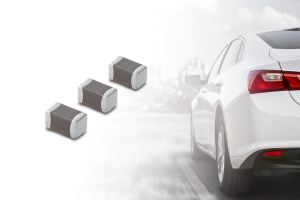
As the automotive world races toward high-voltage architectures and autonomous driving systems, the underlying hardware components are facing unprecedented physical and electrical strains. In a major move to address these design bottlenecks, Murata Manufacturing Co., Ltd. has introduced the GCJ21BD72A225KE02, a cutting-edge automotive soft-termination MLCC designed specifically for automotive powertrains and safety systems. This passive component breakthrough offers a vital solution to the industry's dual challenges: high power demands and severe PCB space constraints.
The Critical Role of Soft-Termination in Modern EV Hardware
Modern electric vehicles (EVs) are highly vibration-prone environments subjected to extreme thermal cycles. In standard Multilayer Ceramic Capacitors (MLCCs), mechanical stress caused by PCB bending or thermal expansion can easily lead to microscopic cracks in the ceramic body. This often results in catastrophic electrical short circuits and potential vehicle-level system failures.
An automotive soft-termination MLCC addresses this vulnerability by incorporating a conductive resin layer within the external copper/nickel/tin electrodes. This elastic resin layer acts as a mechanical shock absorber. When the PCB flexes during high-stress assembly or structural vehicle movement, the resin absorbs the stress, preventing the internal ceramic element from fracturing. This level of reliability is non-negotiable for safety-critical components like Autonomous Driving (AD) controllers and Advanced Driver Assistance Systems (ADAS) sensor suites.
Breaking Down the Technical Specifications
Engineers historically had to compromise on size or voltage rating when selecting soft-termination capacitors. Murata’s new GCJ21BD72A225KE02 shatters this trade-off by combining a highly compact 0805 footprint with high-voltage durability.
| Specification Parameter | Murata GCJ21BD72A225KE02 | Strategic Value to EV Design |
|---|---|---|
| Footprint Size | 0805 inch (2.0 × 1.25 mm) | Minimizes board footprint, leaving more space for processing units and high-speed memory. |
| Capacitance | 2.2 μF | Industry-leading density for passive noise filtering and decoupling. |
| Rated Voltage | 100 Vdc | Provides a robust safety margin for 48V mild hybrid and pure EV power rails. |
| Electrode Type | Resin External Electrode (Soft-Termination) | Guarantees structural survival against high-vibration chassis mounting and thermal cycles. |
Strategic Implications for Western Tier 1s and OEMs
From an automotive systems engineering perspective, this component development is more than just an incremental hardware update. It directly impacts the current architectural shifts happening within major Western OEMs like Tesla, Ford, and BMW, as well as Tier 1 suppliers like Bosch and Continental.
First, the industry is accelerating its transition to 48V low-voltage architectures. 48V systems require passive components with a 100V rating to withstand voltage spikes and noise from regenerative braking. Up until now, finding a high-capacitance (2.2μF) soft-termination option meant sizing up to bulkier 1206 or 1210 packages. Murata's ability to pack this capacity into an 0805 package represents a massive footprint savings on the PCB.
Second, as autonomous driving units employ more powerful SoC processors, multi-phase power supply architectures become highly complex. These systems demand dozens of decoupling MLCCs adjacent to the processors. High-density capacitors allow engineers to cluster components closer to the processor, reducing parasitic inductance and ensuring cleaner power delivery to the silicon.
The Verdict
By solving the density-reliability trade-off, Murata is providing the precise hardware building blocks necessary for the next wave of ADAS and power distribution innovations. For Western automotive developers trying to match the rapid development speed of Chinese EV disruptors, utilizing these ultra-compact, failure-resistant components will be essential for streamlining physical board layouts and speeding up time-to-market.