The global automotive landscape is undergoing a profound structural shift, and at the center of this transformation is the rapidly developing Morocco EV supply chain. As Western automotive original equipment manufacturers (OEMs) seek to build resilient, cost-effective, and fully compliant supply chains, North Africa has emerged as a primary destination for strategic localization. By establishing a localized regional footprint in Morocco, global battery and material suppliers are integrating deeply with European production networks, ensuring high-speed delivery and strict compliance with evolving international trade standards.
The Rise of Morocco as a Mediterranean Automotive Hub
Morocco is no stranger to the automotive industry. For over a decade, the kingdom has served as a critical production site for European legacy automakers like Renault and Stellantis. Today, the nation is successfully leveraging its established infrastructure, competitive operating costs, and strategic Mediterranean logistics to pivot toward the electric vehicle ecosystem.
From an investment and strategy perspective, Morocco offers an unparalleled combination of geographical proximity and institutional stability. Positioned just miles from the southern tip of Europe, the port of Tanger Med allows components to reach assembly lines in Spain, France, and Germany within a matter of days. Furthermore, Morocco’s comprehensive Free Trade Agreements (FTAs) with both the European Union and the United States offer a reliable framework for global suppliers looking to maintain regulatory alignment and trade adaptability.
Mapping Key Investments in the Moroccan EV Ecosystem
The influx of capital into Morocco’s battery materials sector highlights the country’s growing importance in global supply chains. Rather than focusing solely on vehicle assembly, global suppliers are investing heavily in the upstream chemical and material processing stages—areas where technical expertise and cost-efficiency are paramount.
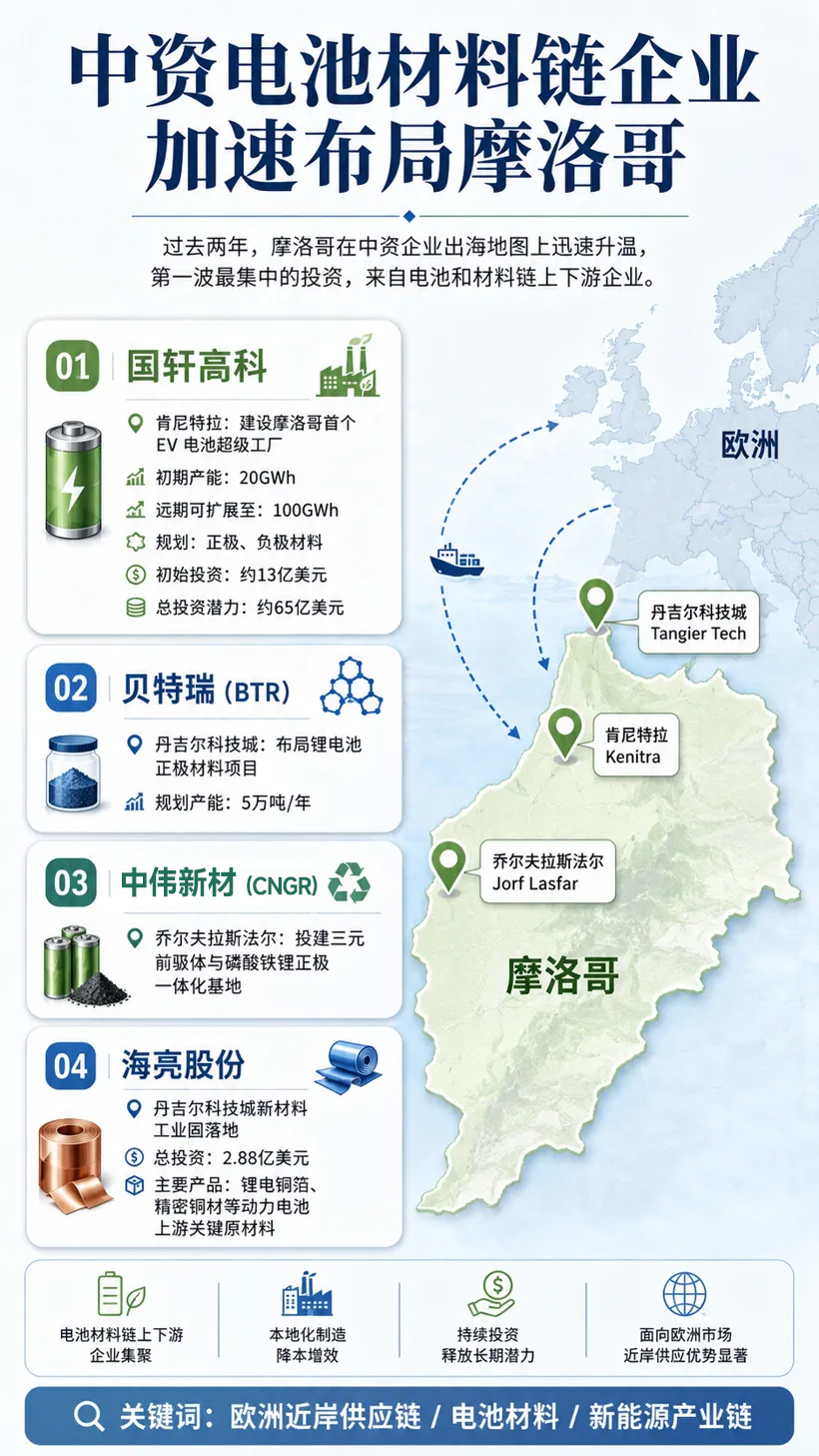
Below is an overview of major ongoing projects shaping the Morocco EV supply chain:
| Company | Project Type | Estimated Investment | Strategic Focus |
|---|---|---|---|
| Gotion High-Tech | EV Battery Gigafactory | $1.3 Billion (Initial) | Localized cell and pack manufacturing for European OEMs. |
| BTR New Material Group | Anode Material Factory | $500 Million | High-capacity anode production targeting European battery assembly lines. |
| CNGR Advanced Material | Cathode Precursor Plant | Joint Venture (Al Mada) | Upstream lithium-ion precursor refinement with a focus on ESG compliance. |
Strategic Localization: Navigating Trade and Regulatory Shifts
The strategic migration of battery material manufacturing to Morocco is a prime example of cross-border collaboration and trade adaptability. As both the European Union and the United States introduce stricter rules-of-origin requirements and environmental standards, relying on centralized, distant manufacturing centers presents significant operational risks.
By establishing localized facilities in Morocco, international suppliers can offer European OEMs a steady supply of crucial battery inputs—such as lithium-iron-phosphate (LFP) precursors and synthetic graphite anodes—that meet stringent local sourcing criteria. This regional footprint enhances supply chain compliance while insulating automakers from geopolitical volatility and shipping disruptions in key maritime corridors.
Leveraging Global Supplier Expertise
Rather than viewing these developments through a purely competitive lens, Western market analysts emphasize that these collaborations represent standard industry shifts for cost-efficiency. Western OEMs benefit immensely from leveraging global supplier expertise in battery chemistry, allowing them to accelerate their own electrification timelines. This integration helps bridge the gap between high-level technological innovation and competitive retail pricing for consumers in Europe and North America.
The Strategic Impact on Western Investors and OEMs
For institutional investors and strategic planners, the integration of Morocco into the European automotive nearshoring framework reveals several critical trends:
- De-Risking Logistics: Shifting processing and manufacturing from East Asia to North Africa dramatically reduces lead times and transit emissions, aligning with corporate ESG and decarbonization initiatives.
- Industrial Clustering: Morocco is quickly establishing a comprehensive industrial cluster, meaning suppliers can access localized raw materials, specialized chemical processing facilities, and a trained labor force in close proximity.
- Policy Safeguards: Operating within a country with deep EU trade integration offers a highly stable framework for capital expenditure, mitigating risks associated with shifting trade policies.
Conclusion
As the electric vehicle sector matures, success will be defined by supply chain resilience and regulatory compliance. The development of the Morocco EV supply chain stands as a testament to how global suppliers and European automotive brands are proactively adapting to these requirements. By combining localized manufacturing with advanced battery technology, Morocco is securing its position as an indispensable partner in Europe’s green transition.