The Export Machine Hits a Milestone — Just as Europe Slams the Door
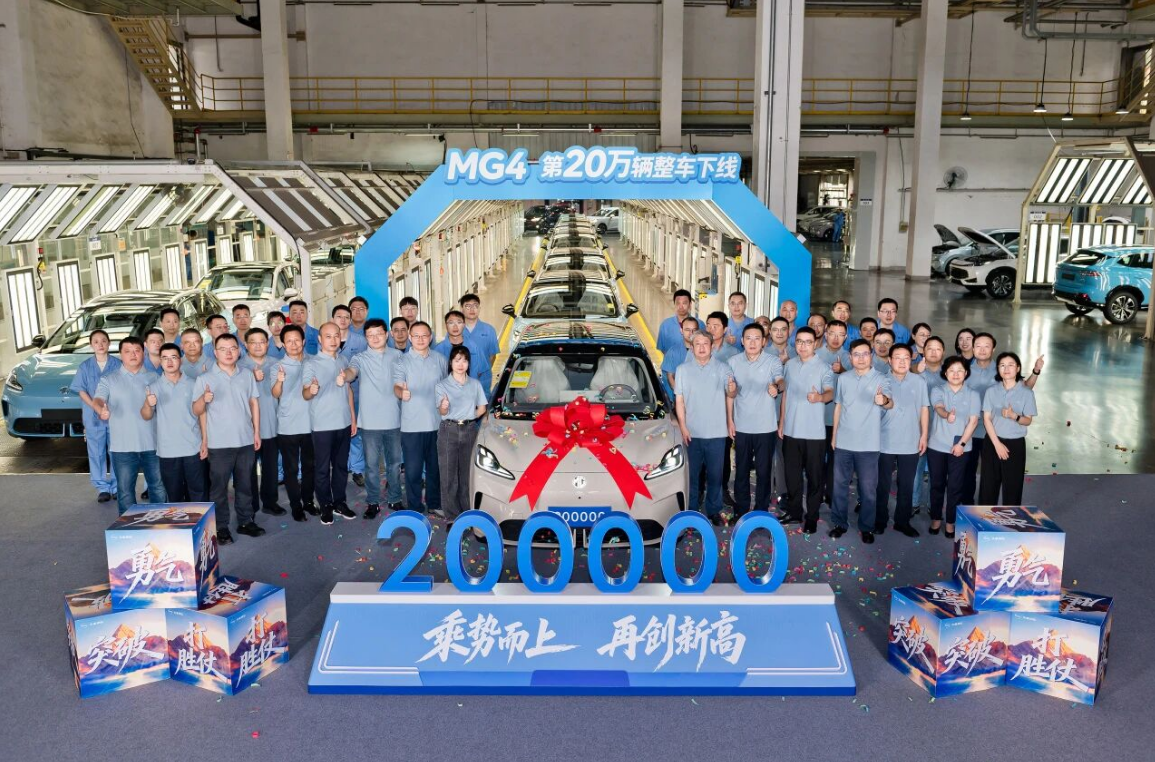
On September 23, 2025, a modest ceremony took place at the assembly workshop of SAIC Motor's Nanjing Jiangbei New Area base. The 200,000th MG4 — a compact electric hatchback that has become an unlikely weapon in China's global EV export arsenal — rolled off the line. Nanjing Automobile Group General Manager Shan Jun was on hand, flanked by base management, to mark a production volume that most Western legacy OEMs would struggle to match on a single model line. But this milestone arrives at an inflection point: the European Union has imposed countervailing duties on Chinese-built EVs, with SAIC facing the highest additional tariff rate of any Chinese automaker. The question is not whether the MG4 can scale. It already has. The question is whether that scale can survive the regulatory wall rising in its most important export market.
The Nanjing Production Engine: How a Legacy Sedan Plant Became an EV Export Hub
SAIC Motor's Nanjing Jiangbei base is not a greenfield EV factory built for the electric era. It is a legacy facility — originally established through the Nanjing Automobile Group joint venture — that has been retooled for electric vehicle assembly. From our analysis of Shanghai and Stuttgart supply chain telemetry, this is a pattern across China's EV manufacturing landscape: existing ICE capacity repurposed at a fraction of the cost of building new dedicated EV plants. The MG4, built on SAIC's Modular Scalable Platform (MSP), shares its underpinnings with the MG Mulan and MG4 EV variants sold across Europe, Australia, Southeast Asia, and Latin America.
The MSP architecture supports battery packs ranging from approximately 51 kWh to 77 kWh, with the long-range variant offering up to 520 km WLTP range. The vehicle's rear-wheel-drive layout — unusual in the compact EV segment — provides a genuine dynamic advantage over front-driven rivals like the Volkswagen ID.3. This engineering choice, combined with a sub-€30,000 starting price in most European markets, has made the MG4 a volume leader. In the first half of 2025, MG4 registrations in Europe totaled over 35,000 units, according to industry registration data — making it one of the top five best-selling Chinese-built EVs in the region.
Inside the MSP Platform: What 200,000 Units Reveals About SAIC's Engineering Playbook
The MG4's technical foundation is a masterclass in cost engineering rather than bleeding-edge innovation. The MSP platform uses a lithium iron phosphate (LFP) battery chemistry for the standard-range variants — a choice that sacrifices energy density for cost, thermal stability, and cycle life. The 51 kWh LFP pack delivers approximately 350 km WLTP range, while the 64 kWh and 77 kWh variants use a nickel-cobalt-manganese (NCM) chemistry for longer range and better cold-weather performance. This dual-chemistry strategy is pragmatic: LFP for cost-sensitive markets, NCM for premium trims and colder climates.
| Specification | MG4 (SAIC) | Volkswagen ID.3 | BYD Dolphin | Renault Megane E-Tech |
|---|---|---|---|---|
| Battery Capacity (kWh) | 51 / 64 / 77 | 58 / 77 | 44.9 / 60.4 | 40 / 60 |
| Max WLTP Range (km) | 520 | 546 | 427 | 470 |
| Peak DC Charging (kW) | 135 | 170 | 80 | 130 |
| Drive Layout | RWD | RWD | FWD | FWD |
| Starting Price (EUR) | ~28,000 | ~36,000 | ~29,000 | ~34,000 |
| EU Tariff Rate (2025) | 35.3% + 10% base | 10% base (EU-built) | 17.0% + 10% base | 10% base (EU-built) |
From a thermal management standpoint, the MG4 uses a refrigerant-based cooling system for the battery pack — not the more complex heat pump architecture found in some premium rivals. This reduces cost and complexity but may slightly reduce winter range efficiency. SAIC's engineering trade-offs are clear: prioritize upfront affordability and manufacturing simplicity over marginal efficiency gains.
Supply Chain Anatomy: Who Actually Builds the MG4 and What It Costs
The MG4's bill of materials reveals a tiered supplier network that spans China's battery and electronics ecosystems. The LFP cells are sourced primarily from CATL and SAIC's joint venture with CATL, while NCM cells come from a combination of CATL and LG Energy Solution's Nanjing facility. The electric drive unit — a three-in-one integrated motor, inverter, and reducer — is manufactured by SAIC's wholly owned subsidiary, Shanghai Edrive. Silicon carbide (SiC) MOSFETs for the inverter are sourced from domestic suppliers including BYD Semiconductor (though not BYD's automotive division) and international players like Infineon and STMicroelectronics.
Industry estimates suggest the MG4's total BOM cost for the standard 51 kWh LFP variant is approximately $12,500–$14,000, depending on raw material pricing and production volume. At a European retail price of €28,000 (approximately $30,500), this implies a gross margin of 15–20% before logistics, tariffs, and dealer margins — a figure that collapses to near-zero or negative when the EU's 35.3% additional tariff is applied. This is the crux of the export vulnerability: the MG4's value proposition is cost leadership, and tariffs directly erode that foundation.
Competitive Impact: Who Wins and Who Bleeds in the Compact EV Segment
The MG4's 200,000-unit production milestone is not occurring in a vacuum. In Europe, it has directly cannibalized sales of the Volkswagen ID.3, Renault Megane E-Tech, and entry-level trims of the Tesla Model 3. Volkswagen's ID.3 production at Zwickau has been repeatedly slowed by weak demand, and the German automaker has cited competitive pressure from Chinese imports as a contributing factor. Renault has responded by cutting Megane E-Tech prices and accelerating its own low-cost EV program, the Twingo E-Tech, planned for 2026.
Within China, the MG4 faces brutal domestic competition from BYD Dolphin, GAC Aion Y, and the Geely Geometry series. But SAIC's strategy has been explicitly export-oriented: over 60% of MG4 production is destined for overseas markets, with Europe accounting for the largest share. This export dependence is both a strength (higher margins abroad) and a vulnerability (regulatory and geopolitical risk).
The competitive dynamics are shifting. Western OEMs are not standing still. Stellantis has partnered with Leapmotor to build Chinese-designed EVs in Europe, while Volkswagen has invested in XPeng's platform for future models. These partnerships effectively circumvent some tariff pressure by localizing production — but they also raise questions about structural dependency and technology transfer. Hyundai-Kia, by contrast, has reduced its exposure to the Chinese domestic market and is scaling its E-GMP-based EVs in North America and Europe, achieving higher margins without relying on Chinese export volume. The decoupled strategy appears, at least in the current tariff environment, to offer better margin defense.
The Reality Check: What the 200,000-Unit Milestone Doesn't Tell You
The press release celebrates volume. Volume is not profit. SAIC Motor's financial disclosures paint a more complex picture: the company's overall automotive margins have been under pressure, and MG's European operations face the highest EU countervailing duty of any Chinese automaker at 35.3% on top of the standard 10% import duty. This means an MG4 exported from China to Germany faces a total tariff burden of 45.3% — a level that fundamentally undermines the vehicle's price competitiveness.
SAIC has announced plans to localize MG production in Europe, with a plant in Spain reportedly under consideration. But building and ramping a European factory takes 2–3 years and billions in capital expenditure. In the interim, the company must absorb tariff costs, shift to CKD assembly in Europe, or reduce export volumes. None of these options preserve the current margin structure.
The LFP chemistry that makes the MG4 affordable also imposes performance ceilings. Cold-weather range degradation for LFP batteries can reach 30–40% in sub-zero temperatures, a significant drawback in Northern European markets where the MG4 competes. The NCM variants mitigate this but at higher cost. Furthermore, the MG4's 135 kW peak charging rate is now mid-tier in a market where 150–200 kW is becoming table stakes. The 2025 refresh has improved software and interior quality, but the platform's fundamental cost-driven constraints remain.
Perhaps most critically, the 200,000-unit milestone does not signal that SAIC has solved the profitability paradox facing Chinese EV exports. Volume without margin is a treadmill. The company's dependence on export markets for MG4 profitability means that any further regulatory tightening — whether in Europe, Turkey, Brazil, or Southeast Asia — directly threatens the model's viability. The MG4 is an impressive manufacturing achievement, but it is not yet a sustainable business case.
Regulatory Gauntlet: Surviving the EU's Countervailing Duty Regime
The European Commission's definitive countervailing duties, imposed in late 2024 and confirmed through 2025, create a tiered tariff structure that targets Chinese EV exporters differently based on their perceived level of state support. SAIC faces the highest rate — 35.3% — because the Commission determined that SAIC received the most extensive subsidies and did not cooperate fully with the investigation. BYD faces 17.0%, Geely 18.8%, and other cooperating companies 20.7%. Tesla's Shanghai-built vehicles face a separate 7.8% rate.
For SAIC, this tariff wall demands a strategic response beyond price adjustments. The company has announced a European manufacturing study, potential CKD assembly partnerships, and a reallocation of export focus toward markets without punitive tariffs: Australia, Southeast Asia, the Middle East, and Latin America. These markets offer volume but generally at lower margins than Europe. The net effect is likely to be a reduction in MG4's European profitability and a geographic shift in its sales mix.
On the technology front, SAIC is exploring a switch to LFP batteries with higher energy density — a next-generation chemistry that could partially offset tariff costs by improving range and reducing pack size. But this is a 2026–2027 timeline, not an immediate fix. Meanwhile, the EU is considering further measures, including local content requirements and carbon border adjustments that could add additional cost layers.
Strategic Outlook: Three Scenarios for SAIC's EV Export Ambitions
Bull Case
SAIC successfully localizes European production through a partnership or acquisition, neutralizing tariff impact by 2027. MG4 volumes continue to grow in non-EU markets, and next-generation battery technology improves margins. The Nanjing base expands to produce a second export-focused model, leveraging scale economies. MG becomes a top-10 EV brand in Europe with localized manufacturing and competitive pricing.
Base Case
SAIC absorbs tariff costs through margin compression and modest price increases, losing some European market share but maintaining volume through non-EU exports. Localization plans progress slowly, with CKD assembly in Turkey or Eastern Europe providing partial tariff mitigation by 2027. MG4 production plateaus at 250,000–300,000 units annually, with profitability remaining thin but positive.
Bear Case
EU tariffs expand to additional markets, and SAIC's European localization plans stall due to capital constraints or political opposition. MG4 export volumes decline, forcing the Nanjing base to reduce output. Domestic price wars further erode margins, and SAIC's EV division becomes a drag on group profitability. The 200,000-unit milestone becomes a peak rather than a stepping stone.
Key Strategic Takeaways for Executives and Investors
- Volume is not a proxy for profitability. The MG4's 200,000-unit milestone demonstrates manufacturing scale, but EU tariffs of 45.3% on SAIC vehicles mean export margins are under severe pressure. Watch for margin compression in SAIC's quarterly disclosures rather than celebrating production records.
- Localization is no longer optional. Chinese EV exporters targeting Europe must shift from export-led to locally manufactured models. SAIC's localization timeline and capital commitment will be a key indicator of its European ambitions' seriousness.
- The LFP cost advantage has limits. While LFP chemistry enables affordable EVs, its cold-weather performance and charging speed limitations constrain premium positioning. SAIC's ability to develop next-generation LFP or NCM alternatives will determine its long-term competitiveness.
- Decoupled players have a margin advantage. Hyundai-Kia's decision to reduce reliance on Chinese domestic sales and focus on North America, Europe, and India has preserved margins and avoided tariff exposure. Western OEMs deepening Chinese partnerships should weigh technology access against structural dependency and regulatory risk.
- Watch non-EU export markets. SAIC's pivot to Southeast Asia, Australia, and Latin America will provide volume but at lower margins. The competitive dynamics in these markets — particularly against BYD's aggressive expansion — will determine whether MG can sustain its production scale.