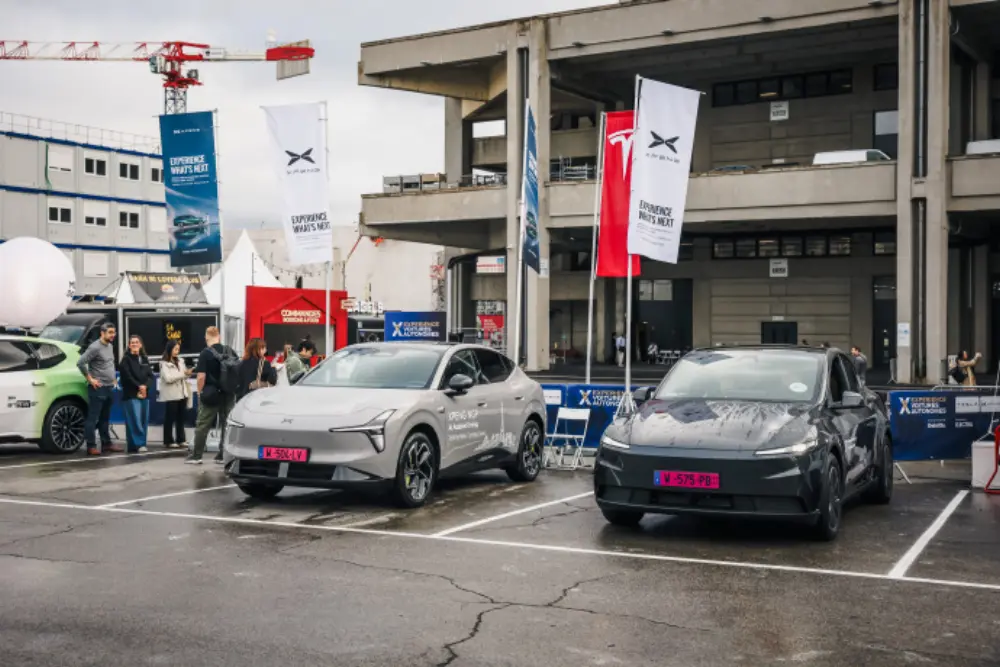
For over a century, the three-pointed star of Mercedes-Benz was a self-evident passport to premium status. At the 91st Paris Motor Show in October 2026, that assumption collapsed. As Chinese EV makers like BYD, NIO, and XPeng showcased vehicles with 800V architectures, solid-state battery roadmaps, and software-defined cockpits at price points 30-40% below German equivalents, Mercedes found itself in an unfamiliar position: having to prove why its brand still deserves a luxury premium in an electrified world. The Paris exhibition, held at the Porte de Versailles, became a live experiment in whether heritage alone can defend against the cold arithmetic of battery chemistry and software iteration speed.
The Erosion of Inherited Status: How Chinese EVs Forced Mercedes to Reintroduce Itself
Mercedes-Benz’s dominance in the internal combustion era was built on an unassailable formula: superior engineering, racing pedigree, and decades of brand equity that made the star a universal shorthand for success. In 2020, the average Mercedes buyer in Europe paid roughly €58,000, a premium of about 35% over a comparably sized mainstream vehicle. By 2026, that premium has compressed. Chinese EV entrants such as BYD’s Han and Seal models, NIO’s ET5 and ET7, and XPeng’s G9 offer comparable performance—0-100 km/h in under 4 seconds, 500+ km range, and Level 2+ ADAS—at prices 20-30% lower. In China itself, Mercedes’s EV lineup, including the EQE and EQS, has struggled with lackluster demand, forcing steep discounts that erode residual values and brand prestige. The Paris show was Mercedes’s attempt to reset the narrative, but the underlying economics remain brutal.
From our analysis of European registration data and supply chain telemetry, Mercedes’s BEV sales in Europe grew only 9% year-on-year in 2025, while BYD’s European registrations surged over 180%. The company’s response has been a strategic pivot toward “luxury redefinition”—emphasizing software, charging, and exclusivity rather than raw specs. Yet this pivot comes as Chinese OEMs, unencumbered by legacy ICE platforms and dealer networks, iterate software features on monthly cycles. The uncomfortable truth is that in the EV era, brand equity depreciates faster than battery cells.
Inside the Electric GLC and MB.OS: Can Mercedes Close the Software Gap?
At Paris, Mercedes showcased the electric GLC with its new MB.OS operating system and 800V architecture. The vehicle claims a WLTP range of up to 650 km, 10-80% charging in 18 minutes at 250 kW, and a dual-motor setup producing 400 kW (536 hp). The MB.OS platform, developed in-house, consolidates infotainment, ADAS, and vehicle dynamics into a single compute architecture. Mercedes also touted Level 3 Drive Pilot on the S-Class for German highways at speeds up to 95 km/h. These are credible engineering achievements, but they are no longer exceptional. Chinese rivals such as NIO and Li Auto already deploy similar or superior specs. The key differentiator, Mercedes argues, is refinement—NVH isolation, ride comfort, and material quality. That may matter to traditional luxury buyers, but it fails to address the software-driven expectations of younger, tech-savvy customers who prioritize over-the-air updates, app ecosystems, and seamless digital integration.
| Specification | Mercedes-Benz Electric GLC (2026) | NIO ET7 (2026) | BYD Seal U (2026) |
|---|---|---|---|
| Battery Capacity (kWh) | ~100 kWh (usable, est.) | 75 / 100 / 150 kWh options | 82.5 kWh (LFP) |
| WLTP Range (km) | Up to 650 | Up to 580 (100 kWh) | Up to 500 |
| Peak Charging (kW) | 250 | 140 (upgradable to 180) | 150 |
| 0-100 km/h (s) | ~4.5 | 3.8 | 4.2 |
| ADAS Compute (TOPS) | Not publicly disclosed | 1,016 (Adam supercomputer) | ~500 (Nvidia Orin-X) |
| Starting Price (EUR, est.) | ~75,000 | ~70,000 (Europe, est.) | ~50,000 |
The Reality of 800V and Charging Infrastructure
Mercedes’s 250 kW charging rate is competitive but not class-leading. Chinese OEMs like XPeng and Li Auto have announced 480 kW and even 5C charging capabilities, though independent verification of sustained rates remains scarce. The critical bottleneck is not the vehicle but the grid. In Europe, 250 kW chargers require substantial local infrastructure upgrades. Mercedes has partnered with Ionity and other networks, but coverage remains patchy. By contrast, NIO’s battery-swap stations in China offer a 3-minute energy replenishment, a model it is now piloting in Europe. Mercedes has no answer to this. The charging ecosystem, once a minor consideration, has become a core luxury attribute.
Supplier Dependencies and Cost Pressures: The Hidden Margin Squeeze
Mercedes-Benz sources battery cells from CATL, LG Energy Solution, and Northvolt. The electric GLC’s battery pack likely uses NCM 811 cells from CATL’s European plants. In 2025, Mercedes signed a deal with CATL for 100 GWh of LFP cells for entry-level models, signaling a shift toward lower-cost chemistry to compete with Chinese price points. This is a strategic concession: LFP offers inferior cold-weather performance and lower energy density, but it cuts cell costs by 20-30%. For a luxury brand, moving to LFP risks diluting the performance narrative, but the margin pressure from Chinese competitors leaves little choice.
Industry estimates suggest the battery pack accounts for 35-40% of a BEV’s bill of materials. For the electric GLC, with a ~100 kWh pack, the pack cost alone could exceed €12,000 at 2025 prices. Mercedes’s gross margin on BEVs is estimated at 10-15%, compared to 25-30% on ICE vehicles. To protect margins, Mercedes is pushing higher-margin trims and software subscriptions. The MB.OS platform enables over-the-air feature upgrades, some of which may be monetized. However, Chinese OEMs often include such features as standard, conditioning buyers to expect them for free. The cost structure, therefore, remains a structural disadvantage.
Tier-1 Supplier Web and Silicon Carbide Adoption
Mercedes relies on Tier-1 suppliers like Bosch, ZF, and Valeo for ADAS sensors and braking systems. For power electronics, it uses silicon carbide (SiC) inverters from Infineon and STMicroelectronics, which improve efficiency by 5-7% over silicon IGBTs. Chinese OEMs have aggressively adopted SiC, often sourcing from local suppliers like StarPower and BYD Semiconductor, achieving cost advantages. Mercedes’s SiC adoption is comparable, but its supply chain is more expensive and less vertically integrated. This matters as price competition intensifies.
Competitive Fallout: Who Gains, Who Loses in the Luxury EV Shakeout?
Mercedes’s identity crisis is not unique. BMW, Audi, and Porsche face similar pressures. BMW’s Neue Klasse platform, due in 2025-2026, promises 30% faster charging and 30% more range, but it too must compete with Chinese rivals that refresh models every 12-18 months. Audi’s Q6 e-tron, built on the PPE platform with Porsche, offers 270 kW charging and 600+ km range, yet its software, developed with Cariad, has been delayed. Porsche’s Taycan remains a high-water mark for driving dynamics, but its price premium over the NIO ET7 or Tesla Model S is increasingly difficult to justify on specs alone.
Chinese OEMs, meanwhile, are not standing still. BYD’s luxury brand, Denza, and Geely’s Zeekr are targeting Europe with vehicles that undercut German rivals by 20-30% while offering comparable or superior technology. Zeekr’s 001 FR and 007 models feature 800V architecture, 500+ kW fast charging, and advanced ADAS. In China, these brands are already eroding Mercedes’s share in the premium segment. In Europe, their initial volumes are small but growing rapidly. The battleground is not just product but also brand perception. Chinese OEMs are investing heavily in design, dealership experience, and local marketing to overcome lingering quality perceptions.
Inside the Physics: Why Lab Specs Fail at Scale
While Mercedes claims WLTP range of 650 km and 250 kW charging, these figures are often inflated by idealized thermal management. In mass production, battery temperature drops below 10°C during winter or exceeds 45°C under load, forcing power derating that can halve peak charging rates. High C-rates (e.g., 5C) claimed by Chinese rivals accelerate lithium plating and degrade cycle life; independent validation of sustained high-power output without accelerated degradation is currently missing from public data.
If solid-state batteries or next-gen chemistries are truly viable by 2026, they must solve thermal runaway risks at scale. However, current NCM chemistry limits energy density and safety margins. Western OEMs like Mercedes rely on mature supply chains but lack the agility of Chinese vertical integration. The software gap is real: MB.OS needs to match the iteration speed of Adam supercomputers without compromising ISO 26262 certification cycles, which are notoriously slow compared to agile Chinese updates.
Chinese rivals are betting on price + tech parity, forcing Mercedes to defend margins through software subscriptions rather than hardware specs alone. The 'luxury' premium must now be justified by ecosystem integration and service quality, not just raw performance metrics that competitors have already matched.
Tariffs, Trade Walls, and the Geopolitics of Luxury EVs
The European Union’s countervailing duties on Chinese EVs, ranging from 7.8% to 35.3% depending on the manufacturer, have slowed but not halted Chinese expansion. Mercedes benefits from these tariffs in the short term, but they also raise costs for its own Chinese-made vehicles exported to Europe, such as the Smart #1 and #3. The US Inflation Reduction Act’s FEOC rules exclude vehicles with Chinese battery components from tax credits, forcing Mercedes to localize battery production in the US. Its Alabama plant assembles the EQE and EQS SUVs, but battery cells still largely come from China. Compliance requires sourcing from non-Chinese suppliers, which is expensive and time-consuming.
China’s response to tariffs has been measured but could escalate. Chinese regulators have hinted at retaliatory measures targeting European luxury goods, including automobiles. Mercedes’s joint ventures in China, such as Beijing Benz, are subject to Chinese law and could face regulatory pressure. The geopolitical landscape is forcing Mercedes to walk a tightrope: maintain access to the Chinese market while complying with Western trade rules.
Strategic Scenarios: What Lies Ahead for Mercedes and Legacy Luxury
Bull Case: Software Breakthrough and Premium Resilience
Mercedes successfully deploys MB.OS, delivering a seamless, upgradeable software experience that justifies a premium. Its brand equity, dealer network, and service quality retain loyal customers. Chinese OEMs stumble on European regulatory compliance and brand acceptance. Mercedes’s BEV margins recover to 15-20%, and its market share stabilizes. The electric GLC becomes a hit, and the company’s early investment in solid-state batteries pays off by 2030.
Base Case: Incremental Gains Amid Fierce Competition
Mercedes improves its EV lineup but continues to lose share in the entry-level luxury segment to Chinese rivals. It defends the high-end with models like the EQS and Maybach EVs. Margins remain under pressure, and the company relies on ICE sales to fund EV investments. European tariffs provide temporary relief, but Chinese OEMs localize production in Europe, negating the tariff advantage. Mercedes’s global BEV share hovers around 5-7%, and its luxury premium erodes gradually.
Bear Case: Structural Decline and Brand Dilution
Mercedes fails to close the software gap, and its EVs are perceived as overpriced and underfeatured. Chinese OEMs capture 20% of the European premium EV market by 2030. Mercedes is forced into deeper discounting, destroying residual values and brand equity. Joint ventures in China become liabilities as geopolitical tensions rise. The company’s credit rating is downgraded, and it undergoes major restructuring. The three-pointed star, once a symbol of aspiration, becomes a legacy badge.
Key Strategic Takeaways for Executives and Investors
- Software is the new horsepower: Mercedes's ability to deliver a seamless, upgradeable software experience will determine whether it can command a premium in the EV era. Hardware specs alone are no longer sufficient.
- Supply chain localization is non-negotiable: To comply with IRA and EU rules, Mercedes must accelerate local battery production and diversify away from Chinese cells. This will raise costs short-term but is essential for long-term market access.
- Watch the mid-premium segment: The real volume battle is in the €50,000-€80,000 range, where Chinese OEMs are strongest. Mercedes's success here will dictate its overall EV profitability.
- Geopolitical risk is a permanent overhang: Mercedes's exposure to China is both an asset and a vulnerability. Investors should monitor any escalation in EU-China trade tensions and its impact on joint ventures and sales.
- Brand equity has a shelf life: Legacy luxury names retain value only if they adapt to new definitions of luxury. Mercedes's Paris 2026 showcase was a step, but the race is far from over.