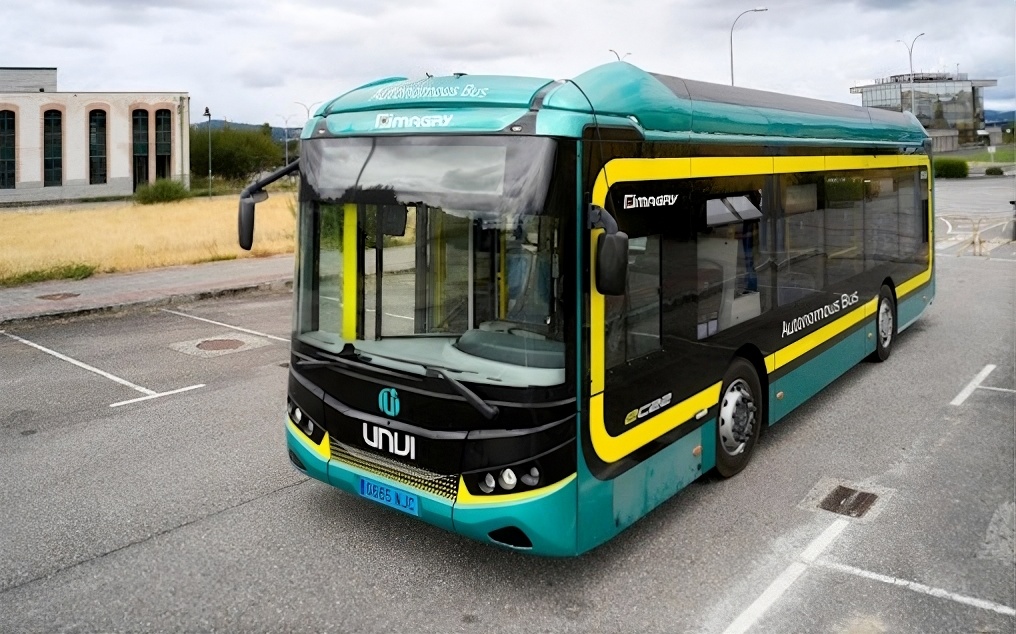
The race for commercial autonomous mobility is rapidly shifting from highway pilot programs to complex urban public transit networks. In a landmark development for European smart transit, US-based software pioneer Imagry has partnered with Spanish bus manufacturer UNVI to deploy an all-new passenger shuttle powered by advanced mapless autonomous driving technology in Germany. This milestone highlights a broader, undeniable industry-wide shift away from restrictive, high-definition (HD) mapping toward real-time, vision-based artificial intelligence.
The Shift to Mapless Autonomous Driving Technology
For years, the autonomous vehicle (AV) industry relied heavily on HD mapping—a process requiring specialized vehicles to pre-scan every inch of a route before an AV could safely navigate it. While highly accurate, this method is geographically restrictive, slow to update, and prohibitively expensive.
The deployment of Imagry’s mapless software in Germany presents a highly adaptable alternative. By utilizing consumer-grade cameras and a powerful real-time deep learning engine, the vehicle perceives its surroundings, identifies road boundaries, traffic lights, and pedestrian pathways, and makes split-second driving decisions on the fly—much like a human driver. This allows the UNVI-manufactured bus to operate seamlessly on public roads without requiring a pre-loaded virtual map of the area.
Comparing HD-Map Systems vs. Mapless Architectures
To understand why Western developers and global EV brands alike are prioritizing mapless solutions, we can examine the core operational differences:
| Metric | HD-Map Dependent Systems | Mapless AD Technology |
|---|---|---|
| Deployment Speed | Slow (Requires pre-mapping & calibration) | Rapid (Near-instantaneous on any public road) |
| Infrastructure Cost | High (Requires continuous cloud updates) | Low (On-board processing minimizes data costs) |
| Adaptability | Vulnerable to temporary road construction changes | Dynamic (Adapts in real-time to new obstacles) |
Strategic Cross-Border Collaboration in Action
The collaboration between US-based Imagry, Spain-based UNVI, and German transit authorities represents a model for strategic cross-border collaboration in the automotive sector. Rather than working in silos, global tech companies and European coachbuilders are merging their unique advantages to meet local municipal demands. UNVI provides the specialized physical chassis optimized for urban public transit, while Imagry provides the scalable, vision-first AI software brain.
This localized integration also highlights the technical shift occurring in other leading EV markets. In China, prominent brands like Huawei, XPeng, and Li Auto are also rolling out 'mapless' or 'no-map' ADAS systems to bypass regional mapping license restrictions and accelerate nationwide deployment. The Imagry-UNVI partnership in Germany proves that Western markets are executing a highly parallel trajectory to ensure competitive technological parity.
Market Outlook: Scaling Public Autonomous Transit
For investors and industry analysts, this German deployment is a clear indicator that public transit will likely reach widespread autonomous commercialization before private passenger vehicles. Municipal routes are highly structured, making them the perfect proving ground for mapless autonomous driving technology. By demonstrating reliability in one of Europe’s most stringent regulatory environments, Imagry and UNVI are paving the way for rapid scaling across the European Union and beyond.