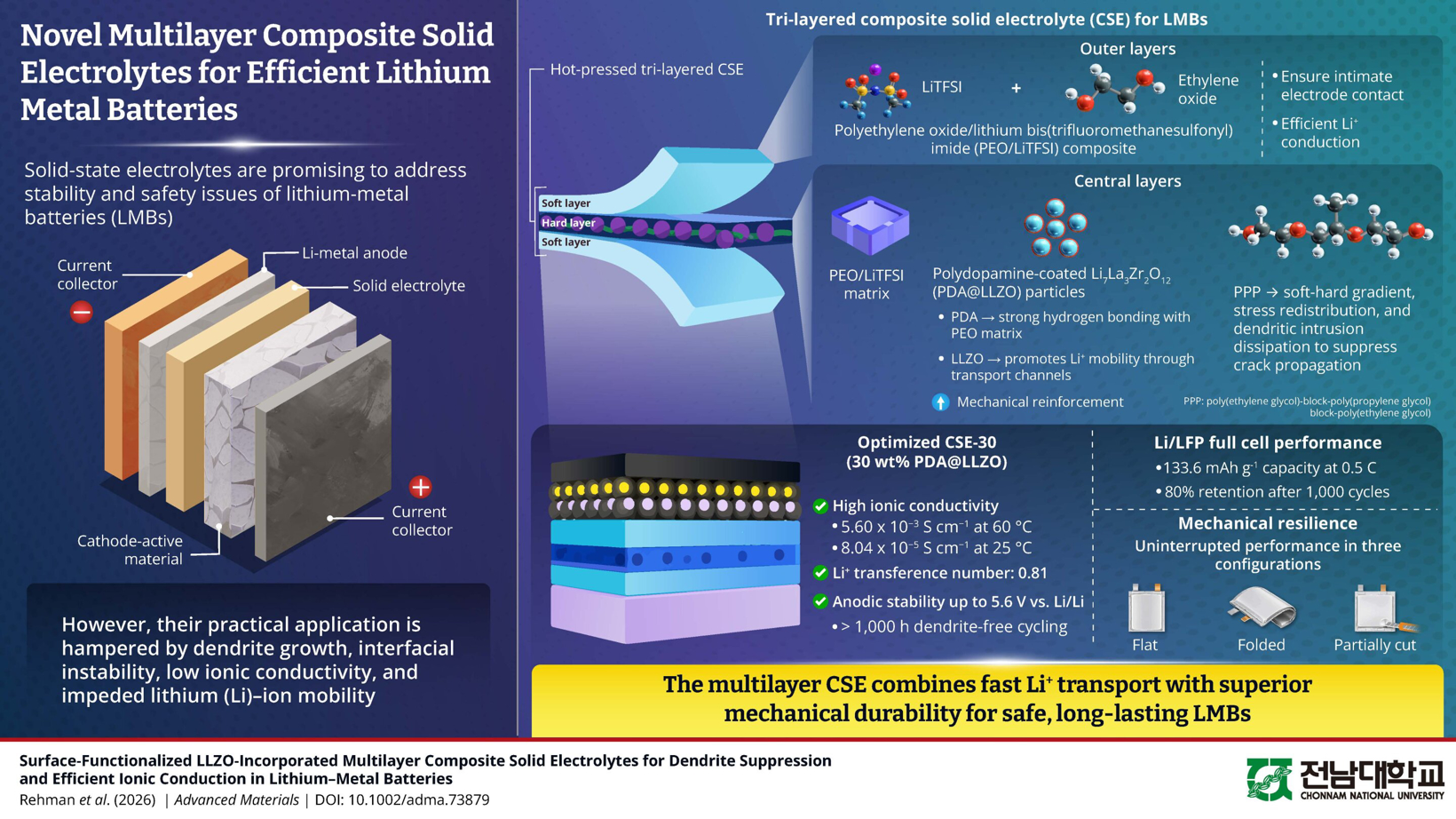
The quest for the ultimate electric vehicle battery has long focused on energy density, with lithium metal batteries (LMBs) widely considered the holy grail. However, safety concerns regarding dendritic growth have stalled commercial progress. In a major lithium metal battery breakthrough, researchers at Chonnam National University in South Korea have developed a novel three-layer electrolyte design that directly mitigates these safety hazards, paving the way for next-generation, high-range EV energy storage.
The Holy Grail of Energy Density: Why Lithium Metal Matters
As an automotive battery technology analyst closely tracking the shifting dynamics of global energy storage, it is clear that traditional lithium-ion chemistry is reaching its theoretical limits (around 300 Wh/kg at the cell level). To achieve driving ranges exceeding 600 miles on a single charge, the industry must transition to lithium metal anodes, which offer a theoretical capacity ten times higher than conventional graphite anodes.
Despite this potential, the commercialization of lithium metal batteries has been hindered by a critical structural failure: lithium dendrites. During rapid charging and discharging, lithium ions deposit unevenly on the anode, forming needle-like structures (dendrites) that can pierce the separator, causing short circuits, rapid capacity degradation, and catastrophic thermal runaway.
How the Three-Layer Electrolyte Solves the Safety Paradox
The core innovation from Chonnam National University lies in a heterogeneous, multi-layered electrolyte design. A single, homogeneous electrolyte material rarely possesses the chemical properties required to be stable at both the highly reductive lithium metal anode and the highly oxidative high-voltage cathode. By engineering a three-layer system, the researchers have customized each layer to address localized degradation mechanisms:
- Anode-Facing Layer: Optimized to facilitate a robust, uniform solid electrolyte interphase (SEI) that actively suppresses the formation of lithium dendrites.
- Intermediate Structural Layer: Acts as a physical and chemical barrier, preventing solvent crossover and providing mechanical resistance against dendritic penetration.
- Cathode-Facing Layer: Engineered with high oxidative stability to prevent electrolyte decomposition when paired with advanced high-voltage cathodes like high-nickel NCM.
This structural synergy dramatically improves the cycle life and safety profile of the battery, representing a massive leap forward for solid-state and semi-solid-state designs.
Comparing Electrolyte Architectures in Next-Gen Batteries
To understand the significance of this development, we can compare this new architecture with existing liquid and solid-state alternatives:
| Electrolyte Type | Energy Density Potential | Dendrite Resistance | Interface Stability | Commercial Readiness |
|---|---|---|---|---|
| Standard Liquid Electrolyte | Moderate (~250-300 Wh/kg) | Poor | Moderate | Fully Commercialized |
| Single-Layer Solid State | High (>450 Wh/kg) | Moderate-High | Poor (High impedance) | Early Pilot Phase |
| New Three-Layer Hybrid | Very High (>500 Wh/kg) | Excellent | Excellent (Dual-optimized) | Research & Development |
Strategic Implications for Global EV Supply Chains
For Western automotive OEMs and global tier-1 suppliers, this breakthrough represents more than just a scientific curiosity; it is a critical pivot point in supply chain resilience. Currently, the commercial battery market is heavily centralized around specific processing pipelines. Diversifying into advanced solid-state and lithium-metal chemistries through strategic partnerships with South Korean, Japanese, and Western tech innovators allows global OEMs to secure leadership in the premium EV sector.
By focusing on technological integration and localized regional sourcing of next-generation components, automotive manufacturers can build highly adaptable product lines that meet stringent global regulatory standards while delivering unmatched performance. Cross-border collaborations between academic institutions and commercial battery joint ventures will be essential to scale this tri-layer casting process from the lab to the gigafactory floor.
Commercialization Bottlenecks: The Road to 2030
While the laboratory performance of the three-layer electrolyte is highly promising, several manufacturing challenges remain. Multi-layer coating requires extreme precision to avoid interfacial resistance between the electrolyte layers themselves. If the layers do not adhere perfectly, the internal resistance of the cell increases, reducing power output and fast-charging capabilities.
Industry experts anticipate that pilot-scale production of batteries leveraging multi-layer electrolyte systems will begin around 2027-2028, with commercial scale-up for premium passenger EVs targeted for the turn of the decade. Investors should monitor development milestones closely, focusing on patents related to high-speed roll-to-roll manufacturing of multi-layer polymer-ceramic composites.