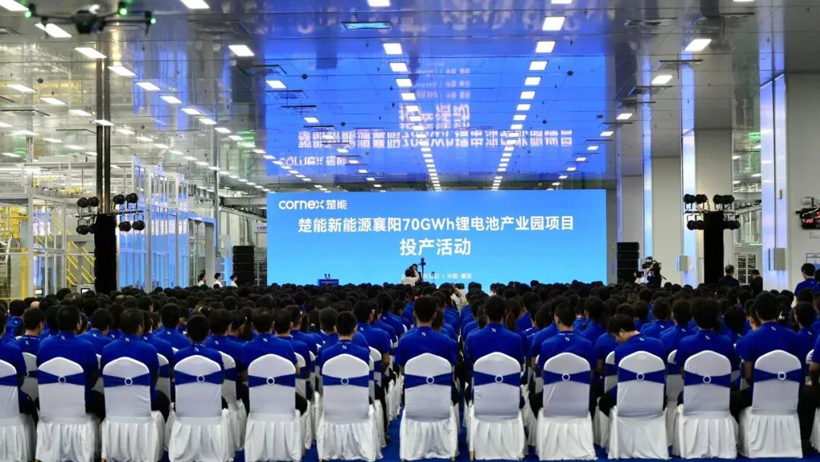
As China continues to expand its industrial footprint, the global landscape for lithium battery production capacity is undergoing a profound structural shift. On August 30, Chuneng New Energy officially commenced production at its massive Xiangyang Lithium Battery Industrial Park in Hubei Province. Boasting a planned annual capacity of 70GWh, this project represents a significant milestone in China's upstream scaling efforts, carrying deep strategic implications for global automotive supply chains and the energy storage sector.
As a supply chain analyst tracking Asian battery manufacturing corridors, this development highlights the widening gap in manufacturing execution. While Western gigafactories face construction bottlenecks, financing headwinds, and scaling delays, Chinese tier-2 manufacturers like Chuneng are rapidly delivering massive-scale facilities, reinforcing China's cost leadership across both electric vehicles (EVs) and energy storage systems (ESS).
The Strategic Scale of the Xiangyang 70GWh Project
The Xiangyang industrial park is one of Chuneng New Energy's core manufacturing bases, designed to integrate R&D, manufacturing, and sales of lithium-ion batteries. The 70GWh planned capacity is split into phases, utilizing highly automated production lines optimized for both lithium iron phosphate (LFP) and ultra-fast charging chemistries.
To put 70GWh into perspective, this single industrial park, when fully operational, can produce enough battery cells to power approximately 1 million passenger electric vehicles with 70kWh battery packs annually. This scale allows Chuneng to achieve immense purchasing power and manufacturing efficiencies that are difficult to replicate in smaller facilities.
| Metric / Feature | Details |
|---|---|
| Total Planned Capacity | 70 GWh per annum |
| Primary Chemistry Focus | Lithium Iron Phosphate (LFP) & Long-cycle ESS Cells |
| Key Application Sectors | Electric Vehicles (EV) & Utility-Scale Energy Storage Systems (ESS) |
| Automation Level | Industry 4.0 fully integrated smart manufacturing lines |
Impact on Global Cell Costs and the Supply Chain Landscape
The introduction of 70GWh of new capacity from a single player intensifies domestic competition within China, which naturally overflows into global markets. This surplus of high-quality, competitively priced LFP and ESS cells places persistent downward pressure on global cell costs. For Western OEMs looking to leverage cost-effective battery chemistries, this dynamic offers an attractive supply source, provided they navigate regional trade structures effectively.
Strategic Sourcing Alliances and Supply Chain Compliance
Western automakers are increasingly looking to forge strategic sourcing alliances and utilize technology integration partnerships to benefit from Chinese manufacturing advancements. Rather than relying solely on import models, many OEMs are exploring joint ventures and localized regional footprints to ensure supply chain compliance with evolving regulations like the US Inflation Reduction Act (IRA) and the EU's battery passport requirements.
Through technology licensing models (similar to Ford's arrangement with CATL), Western players can leverage high-scale manufacturing processes developed in gigafactories like Xiangyang to build localized, highly efficient capacity in their domestic markets.
The Pivotal Role of LFP and Energy Storage
A significant portion of Chuneng's Xiangyang capacity is anticipated to serve the utility-scale energy storage system (ESS) market. LFP chemistry has become the undisputed global standard for stationary storage due to its safety profile, thermal stability, and long cycle life. With global grid modernization and renewable energy integration accelerating, the demand for low-cost, high-durability ESS cells is at an all-time high.
By scaling LFP production to this magnitude, Chuneng is positioning itself as a highly competitive supplier for international grid-scale projects, helping global developers meet aggressive decarbonization and ESG targets efficiently.
Summary: A Double-Edged Sword for Global Competitors
For Western gigafactory startups, the rapid operationalization of Chuneng's 70GWh park is a sobering reminder of China's execution speed. It highlights the steep learning curve and capital efficiency required to compete in the battery industry. However, for the global energy transition, this massive expansion of lithium battery production capacity is a net positive, driving down the capital expenditure required for both grid-scale decarbonization and mass-market electric vehicle adoption.